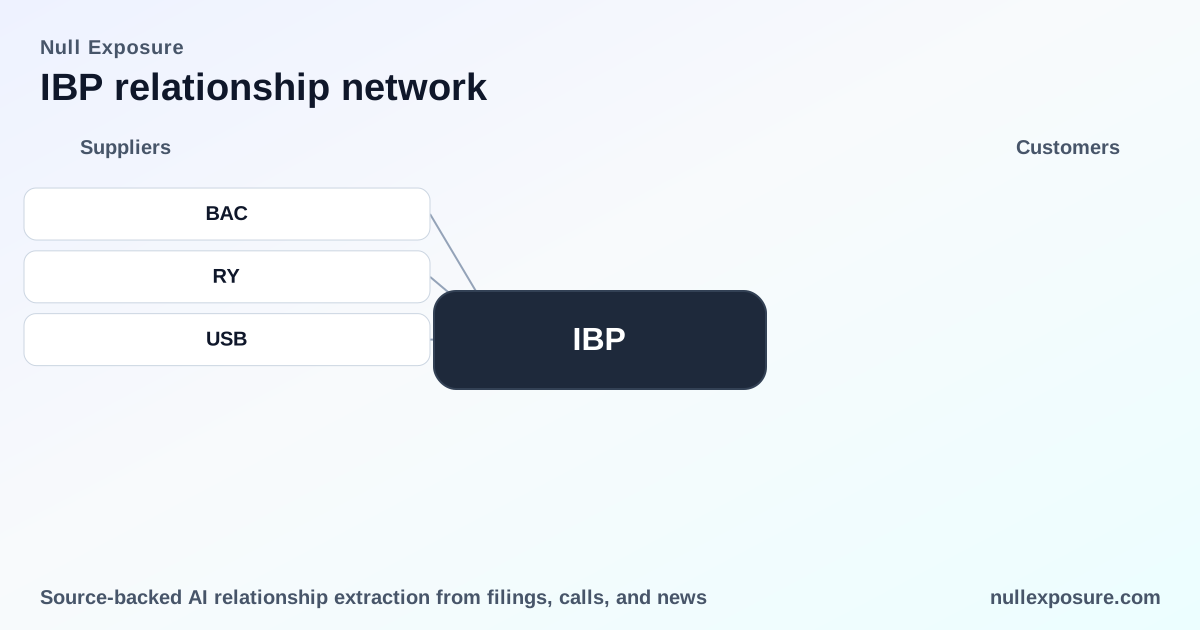
Installed Building Products (IBP): lender relationships, supplier posture, and what investors should price
Installed Building Products installs insulation, waterproofing, fire protection and related building products across the U.S.; it monetizes by buying materials from manufacturers at scale and selling installation and service through local branches and acquisitions, capturing gross margin on materials plus installation labor and recurring service value. With roughly $2.97 billion in trailing revenue and $496 million of EBITDA, IBP runs a capital-intensive, acquisitive model that levers purchasing scale and national distribution to compress unit costs and expand local market share. Visit https://nullexposure.com/ for deeper supplier and counterparty intelligence on IBP.
The recent financing headlines and why they matter to counterparty risk
IBP updated multiple financing agreements in March 2026, and those amendments change the company’s credit posture and the priority of creditor claims. These are not peripheral legal notes — they reframe liquidity access, collateral sharing and the company’s debt maturity profile, which directly affect supplier payment security and the company’s ability to fund material purchases.
U.S. Bank Trust Company — indenture for 2034 senior notes
Installed Building Products signed an indenture with U.S. Bank Trust Company as trustee for the 2034 senior notes, formalizing the trustee relationship that governs the Senior Notes’ payment mechanics and remedies. A TradingView report covered this filing on March 10, 2026. (TradingView, March 10, 2026)
Bank of America — ABL credit agreement amendment and ABL agent role
IBP executed an amendment to its asset-based lending (ABL) credit agreement with Bank of America and identifies BofA as ABL agent, adjusting borrowing terms and revolver mechanics that affect short-term working capital capacity. A TradingView note described the ABL amendment on March 10, 2026. (TradingView, March 10, 2026)
Royal Bank of Canada — intercreditor and term administrative agent activity
Royal Bank of Canada is referenced as the term administrative agent and collateral agent in intercreditor and term loan amendments, reflecting its ongoing role on IBP’s term loan facilities and the chain of priority among lenders. This was reported alongside the other amendments on March 10, 2026. (TradingView, March 10, 2026)
One-page constraints and what they signal about IBP’s operating model
- Contracting posture: IBP predominantly uses short-term supplier and lease arrangements but maintains selective long-term financing and two long-term supply agreements; the company’s disclosures state it “does not typically enter into long-term agreements with suppliers but has done so from time to time,” and shows material long-dated debt instruments and interest-rate hedges in filings (Form 10‑K/10‑Q, 2023–2024). This creates a hybrid posture: operational flexibility for buying but structural lock-in from financing.
- Concentration and criticality: Three largest suppliers accounted for ~37% of material purchases in 2024, making supplier continuity materially important to margins and delivery times. Filings explicitly call supplier loss or product shortages a material risk (Form 10‑K, FY2024).
- Maturity and stage: Supplier relationships are largely active and mature — IBP reports multi-decade ties with major insulation manufacturers and uses both short and long contractual forms. The company’s supplier network is strategic for both manufacturing sourcing and distribution scale.
- Geographic footprint: Operations are primarily North American (leases and operations in 43 states) with a smaller imported component; weather, tariffs and global supply disruptions are cited risks in filings (Form 10‑K, FY2024).
- Spend profile and financial links: Supplier purchase obligations sit across bands: modest recurring spend lines (millions) for some vendors and very large credit exposures ($100M+) tied to debt, ABL availability and lease liabilities. The company’s term loan (outstanding ≈ $492.5 million at 12/31/2024) and interest-rate hedges are financial commitments that influence working capital available for suppliers.
How these constraints translate into commercial risk and negotiating leverage
IBP’s buying power gives it negotiating leverage with major manufacturers — it is one of the largest purchasers of insulation in the U.S., which reduces unit costs and supports margin resilience. However, high supplier concentration, material purchase minimums in signed supply agreements, and significant leverage create asymmetric risk: a manufacturing disruption or unfavorable commodity move would compress margins while debt covenants and fixed obligations limit rapid pricing or capex responses. Company filings show active hedging of interest-rate exposure and use of ABL capacity to smooth working capital needs (Form 10‑K/10‑Q, 2023–2024).
Visit https://nullexposure.com/ to see the primary supplier names, contract terms and stress scenarios that institutional investors and operators use when modeling counterparty failure.
Operational map: roles, segments and third-party dependencies
IBP’s relationships span multiple roles:
- Buyer of materials from national manufacturers (core to revenue/COGS).
- Manufacturer and distributor for some product lines (cellulose manufacturing, distribution expansion).
- Licensee of operational software (jobCORE) and owner/licensor of local trade names.
- Buyer of services (insurance, finance, IT, logistics) — IBP runs high-deductible insurance programs and uses third-party providers for cloud and security.
These cross-functional relationships amplify concentration risk: a supplier outage disrupts both materials flow and the branch installation schedule, while banking relationships affect the liquidity that funds inventory and vehicle fleets.
Bottom line for investors and operators
- Credit and supplier risk are intertwined: the March 2026 amendments that involve Bank of America and Royal Bank of Canada tighten the framework of IBP’s liquidity and creditor priorities, while the U.S. Bank Trust indenture governs the senior notes that sit above unsecured suppliers in a distress scenario (TradingView, March 10, 2026).
- Supply concentration is the single largest operational vulnerability: three suppliers = 37% of purchased materials (Form 10‑K, FY2024).
- Scale is a competitive advantage but not an immunity: large buying volumes and mature supplier relationships give IBP pricing power, yet the company’s leverage and minimum purchase commitments create asymmetric downside in high-cost or disrupted supply cycles.
If you are evaluating counterparty exposure or sourcing strategies with IBP, prioritize monitoring: ABL availability, term loan balances and covenants, the status of any fixed-price or minimum-volume supply contracts, and supplier plant-level capacity reports. For a consolidated view of these counterparty dynamics and to compare IBP’s supplier risk to peers, return to https://nullexposure.com/ — our portal aggregates the filings, amendments and market notices investors use to stress-test counterparties.
Final recommendation: treat IBP as a growth-oriented consolidator with operational scale but non-trivial supplier and financial covenant risk; position sizing should reflect exposure to a concentrated supplier base and to the company’s mid‑to‑long term debt profile.