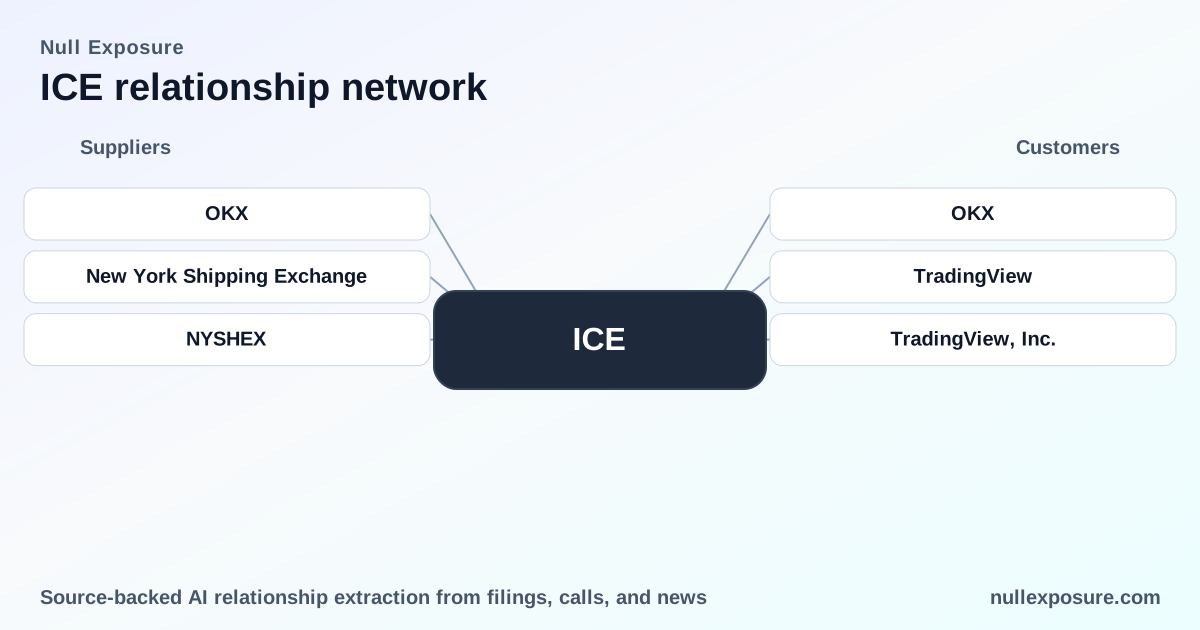
Intercontinental Exchange (ICE) — supplier relationships that change product mix and risk profile
Intercontinental Exchange (ICE) runs global exchanges, clearing houses and a suite of data, listing and mortgage-technology services and monetizes through transaction fees, recurring data and licensing revenues, clearing and margin services, and software subscriptions. Recent supplier and strategic relationships signal a deliberate push into digital assets and freight benchmarks that will reweight ICE’s product revenue mix while leaving its capital and counterparty risk profile broadly unchanged. For investors and operators evaluating ICE as a supplier or customer partner, the operating characteristics—heavy licensing, material long-term commitments, and critical service dependencies—are the primary lenses to assess execution risk and payoff.
Learn more about our supplier intelligence at https://nullexposure.com/ — or return to the homepage for the full platform: https://nullexposure.com/.
How ICE makes money and why suppliers matter for valuation
ICE’s revenue model is twofold: high-margin, recurring data and licensing streams plus variable, volume-driven trading and clearing fees. The business deliberately combines sticky, subscription-like revenue (market data, index licensing, mortgage software) with transaction-linked cash flows (exchange listings, futures and clearing), producing predictable operating leverage and strong free cash flow. Suppliers and partners are therefore not ancillary — they are product enablers. Licensing relationships supply the raw data that becomes tradable futures or packaged data products; hosting and data-center providers underpin uptime and regulatory compliance for exchanges and clearing houses.
Key financial signals reinforce that profile: ICE reports large, multi-year lease and debt commitments, a meaningful commercial paper program for short-term funding, and high planned 2026 capital spending to sustain and extend technology platforms. These commitments create a contracting posture that blends long-term fixed obligations with active short-term liquidity management.
Major relationships disclosed in recent coverage
Below I list every relationship captured in the source set and provide a concise investor-facing summary plus a source reference.
OKX — strategic minority investment and data licensing (multiple news sources, March 2026)
ICE took a minority stake in crypto exchange OKX at an implied $25 billion valuation, secured a board seat, and agreed to license OKX’s spot cryptocurrency prices so ICE can introduce U.S.-regulated crypto futures and expand tokenized equity distribution. According to Fortune (March 5, 2026) and Coindesk (March 5, 2026), the deal expressly ties OKX price feeds to ICE futures product development and broader tokenized-market ambitions. (Sources: Fortune, March 5, 2026; CoinDesk, March 5, 2026.)
OKX — productization plan and regulatory caveat (IndexBox, March 2026)
Public coverage reinforced that ICE will license OKX spot pricing and intend to launch regulated U.S. futures tied to those prices, subject to regulatory clearance — a productization path that converts a licensed feed into exchange-traded instruments. (Source: IndexBox blog, March 2026.)
OKX — investor filing and corporate disclosure (MarketBeat instant alert, March 9, 2026)
A filing-based report noted ICE’s minority investment, planned NYSE-linked tokenized equities, and the licensing arrangement for OKX spot prices used to support U.S. futures, underlining that the transaction has corporate governance implications (board seat) and a strategic distribution lens. (Source: MarketBeat instant alert, March 9, 2026.)
New York Shipping Exchange — freight benchmark futures launch (LeapRate, March 2026)
ICE announced container freight futures indexed to benchmarks from the New York Shipping Exchange that are scheduled to launch on April 7, 2026, expanding ICE’s commodities product set into containerized freight risk. The contracts will track NYSHEX price benchmarks and enable institutional hedging tied to physical shipping data. (Source: LeapRate, March 2026.)
NYSHEX — ICE Data Services as calculation agent (Marketscreener, March 2026)
ICE Data Services has acted as the calculation agent to the NYSHEX indices since 2024, which positions ICE to translate verified shipping transactions into licensed benchmarks and listed futures — a direct data-to-exchange product flow. (Source: MarketScreener, March 2026.)
(Note: multiple press outlets reiterated aspects of the OKX transaction — the summaries above collate the distinct reporting angles: investment, licensing, and product rollout.)
What the constraints and contract signals tell investors and operators
ICE’s public disclosures and the sourced constraints create a consistent picture of supplier risk and operating posture. Presenting those as company-level signals:
- Contracting posture: ICE runs a mix of long-term fixed commitments (senior notes, long-dated leases and large-capital programs) and short-term funding tools (commercial paper). This combination supports large strategic investments while preserving liquidity flexibility.
- Licensing focus: Licensing is a core operating mechanism — ICE both licenses third-party data and is a licensor of indexes and derivatives. Data licensing is a recurring revenue lever and a strategic enabler for new listed products, as demonstrated by the OKX and NYSHEX arrangements.
- Counterparty and geography spread: Counterparty exposure is deliberately diversified across government and large institutional counterparties and across NA/EMEA/APAC regions; ICE uses sovereign and highly rated instruments for custody and repo arrangements, minimizing credit risk on invested deposits.
- Criticality and materiality: Certain third-party services are critical — vendor outages or loss of key licenses can materially harm product delivery and revenue. ICE explicitly flags that interruptions to vendor services or exclusive licenses would have material consequences.
- Spend and scale: ICE’s supplier-related spend runs in the high bands — multiple references show spend and investment totals in the hundreds of millions to billions (acquisitions, committed repo facilities, lease liabilities, and capital expenditure guidance), indicating enterprise-scale supplier engagements rather than ad hoc contracts.
- Relationship lifecycle: Most supplier relationships are active and monitored; governance and SOC audit attestations are standard for critical vendors, and prospective vendors undergo security assessments before engagement.
These signals imply that ICE’s supplier management must be rigorous: contracts are often long-term and high-value, licensing is strategic, and operational resilience of vendors is essential to protect exchange uptime and clearing integrity.
Operational and investor implications
- Product upside from OKX licensing is real and immediate for product roadmaps. Licensing OKX spot prices directly enables U.S.-regulated crypto futures and expands ICE’s tokenized-equity distribution channels, accelerating revenue diversification into digital-assets.
- NYSHEX-linked freight futures diversify commodities exposure and tap a liquidity pool of corporates and hedgers seeking containerized freight risk management; ICE’s role as calculation agent deepens product control over benchmark integrity.
- Operational risk remains the dominant counterweight. ICE’s mix of long-term obligations and critical vendor dependencies means execution hiccups (data licensing disputes, vendor outages, or regulatory delays) would affect both near-term revenue and long-term product credibility.
- Capital intensity and governance matter. Large strategic investments and high spend bands imply dilution of execution optionality if multiple initiatives (crypto, mortgage tech integrations) require simultaneous capex and integration resources.
If you need a detailed supplier risk brief or a tailored counterparty report on ICE’s crypto and freight initiatives, visit our homepage for service options: https://nullexposure.com/.
Actionable takeaways for investors and operators
- For investors: monitor regulatory milestones for ICE’s crypto futures and the integration cadence of OKX pricing into product launches; those milestones will be the revenue inflection triggers that justify re-rating for product diversification.
- For operators and counterparties: treat ICE as a high-capacity partner with material contracting requirements — expect long-term licensing negotiations, SOC and audit requirements, and strict vendor resilience standards.
- For risk teams: prioritize contingency planning around license continuity and data-source redundancy; ICE calls out vendor and license loss as a material risk.
Explore supplier intelligence and bespoke risk reports on our platform: https://nullexposure.com/.
In sum, ICE is executing a targeted expansion of its tradable product universe by converting licensed data (OKX, NYSHEX) into exchange-traded instruments while maintaining a capital and liquidity model built on long-term commitments and short-term funding flexibility. Investors should value the revenue diversification this creates, and counterparties should expect stringent governance around licensing and operational controls.