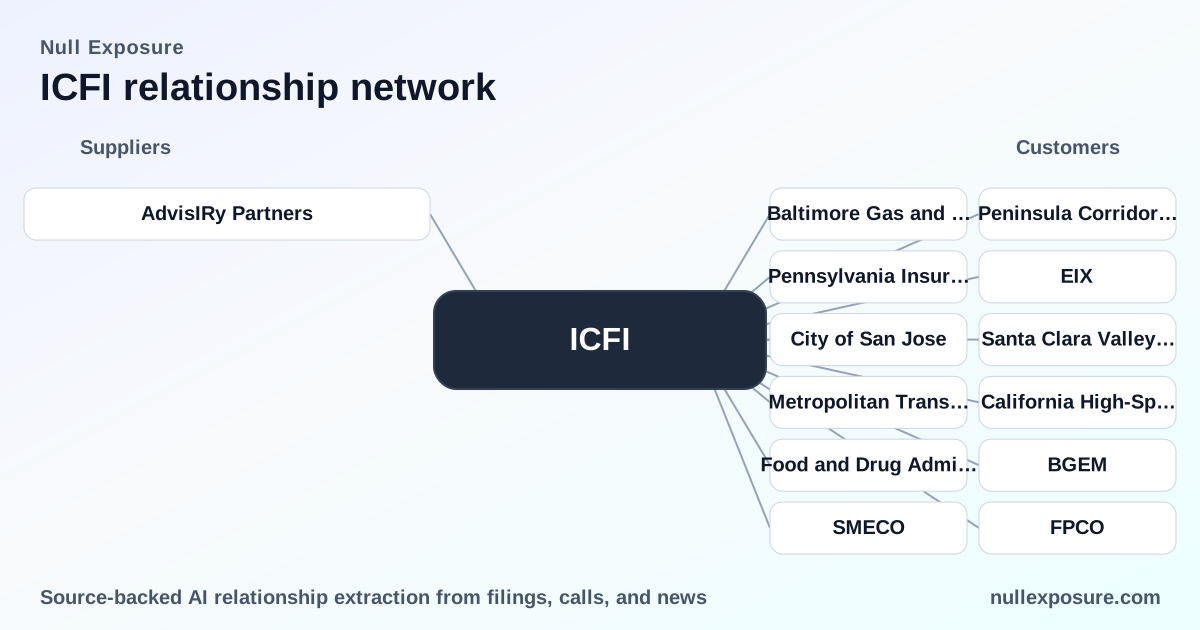
ICF International (ICFI) — supplier relationships, operating posture, and what investors should price in
ICF International operates as a professional services firm that sells consulting, technology and implementation services to government and commercial clients, monetizing through fee-for-service contracts, time-and-materials engagements, and program-level implementation fees. Revenue is delivered by multi-year service relationships and project work, supplemented by targeted acquisitions that add technical depth and near-term revenue. For investors, the key value drivers are contract backlog quality, margin on direct labor and subcontracting, and balance-sheet flexibility to fund acquisitions and share repurchases. For a quick tools-and-sourcing check, visit https://nullexposure.com/.
The company’s financial and operating profile — concise takeaways
ICF is a mid-cap professional services company with roughly $1.87B in trailing revenues and ~$1.26B market capitalization; trailing EBITDA sits around $204M, and operating margin is in the mid-single digits. The firm runs a mixed contract portfolio: long-term leased facilities and finance arrangements, recurring government and commercial service engagements, and active use of subcontractors to scale delivery. The balance sheet shows $411.7M of outstanding indebtedness due May 6, 2027, a significant liquidity lever for near-term capital strategy. These points come directly from the company’s most recent annual disclosures and notes to the consolidated financial statements (FY2024–filed 2025).
- Balance-sheet leverage and liquidity: Large credit capacity remains (hundreds of millions available) but lenders have a maturity event in 2027 that investors must monitor. The firm also runs an active share repurchase program with meaningful authority left.
- Real-estate and lease commitments: ICF holds substantial long-term office leases (notably the Reston HQ through 2039) plus a global footprint of over 70 locations; lease liabilities are treated as long-term obligations in the financials.
- Revenue model and cost structure: Outcomes depend on utilization of staff and subcontractor costs; subcontracting is material to project margins and execution.
These facts derive from ICF’s FY2024 annual report and related notes on leases, long-term debt, and risk factors (filed 2025).
Supplier and counterparty relationships you need to know
Below I cover every relationship item returned in the supplier-scope results and provide a concise plain-English takeaway plus a source reference.
- AdvisIRy Partners — ICF listed investor relations contacts at AdvisIRy Partners in connection with presenting at the Sidoti Year-End virtual investor conference; the firm engaged AdvisIRy Partners for investor outreach and presentation logistics in FY2025. According to a news item summarizing the conference release, Lynn Morgen and David Gold were named as investor information contacts (Finviz, March 10, 2026). Takeaway: a retained investor-relations relationship signals active investor outreach and visibility management.
(That is the complete set of supplier-scope items surfaced in the search results.)
How contract and supplier constraints shape the operating model
The company-level constraints extracted from filings and notes reveal a clear operating posture:
- Contracting posture — long-term orientation with tactical short-term elements. ICF carries long-term leases (Reston HQ through 2039 and many leases across 70+ locations) and long-dated finance leases, while also operating short-duration equipment leases and annual vendor/service relationships. This hybrid posture supports stable delivery capacity while preserving flexibility to scale.
- Concentration and spend scale — multi-band exposure. Spend profiles range from small annual equipment leases to very large financing and liquidity commitments (credit facility draw and share-repurchase authority in the hundreds of millions). This indicates the company can make both tactical and strategic purchases depending on opportunity.
- Criticality of third parties — material for operations and risk. The firm depends on third-party IT and subcontractors for delivery; filings explicitly mark vendor system failures and data-handling failures as material operational risks.
- Maturity and stage — active, established relationships. Evidence shows active credit usage, ongoing share repurchases, and regular audits from an established PCAOB firm—consistent with a mature supplier and partner ecosystem.
These are company-level signals drawn from the company’s public filings (Notes to Consolidated Financial Statements and Risk Factors, FY2024/2025 filing).
Risk and opportunity checklist for investors and operators
Read this as the practical list to monitor and quantify in due diligence:
- Liquidity & refinancing risk: $411.7M debt maturing May 2027 creates a refinancing timeline that will determine near-term capital flexibility (company annual report, FY2024).
- Lease and fixed-cost leverage: Large future minimum lease payments and a long Reston HQ lease increase fixed-cost operating leverage when utilization drops.
- Subcontractor exposure: project margins are sensitive to subcontractor availability and pricing; subcontracting is a meaningful line item in cost accounting.
- Data/privacy/regulatory exposure: global footprint requires compliance with GDPR, CCPA and other evolving privacy regimes; third-party systems are flagged as material risk.
- Strategic optionality: available credit capacity and share-repurchase authority give management levers to pursue acquisitions or return capital when valuation supports it.
Prioritize monitoring the company’s quarterly commentary on credit facility usage, major contract wins/losses, and any large vendor or platform outages.
What operational events will move the stock
- Refinancing or repayment plan for the May 2027 credit maturity — largest single near-term catalyst.
- Major contract awards or losses in government program work — these change baseline revenue.
- Any sizeable acquisition integration results or announced targets — acquisitions are a stated growth channel.
- Cybersecurity incidents or significant third-party vendor failures — these are labeled material in filings and affect reputation and contract performance.
If you want ongoing tracking and alerts on these items, check https://nullexposure.com/ for tailored supplier-risk coverage.
Final view — how to weight ICF in a supplier-focused review
ICF is a services company with predictable recurring elements (long leases, government program continuity) tempered by project-level margin variability driven by subcontractors and labor utilization. The balance sheet provides both a runway for acquisitions and a refinancing horizon that requires attention. For investors evaluating supplier relationships, the key diligence is granular: verify subcontractor concentration on major contracts, confirm vendor SLAs tied to government work, and stress-test liquidity under slower billing scenarios. For operators, the imperative is to codify vendor risk assessments and prioritize continuity plans where third-party systems are material.
Learn more about supplier risk signals and how they affect portfolio decisions at https://nullexposure.com/.
For targeted sourcing intelligence and relationship monitoring, visit https://nullexposure.com/ and set up the specific alerts and coverage you need.