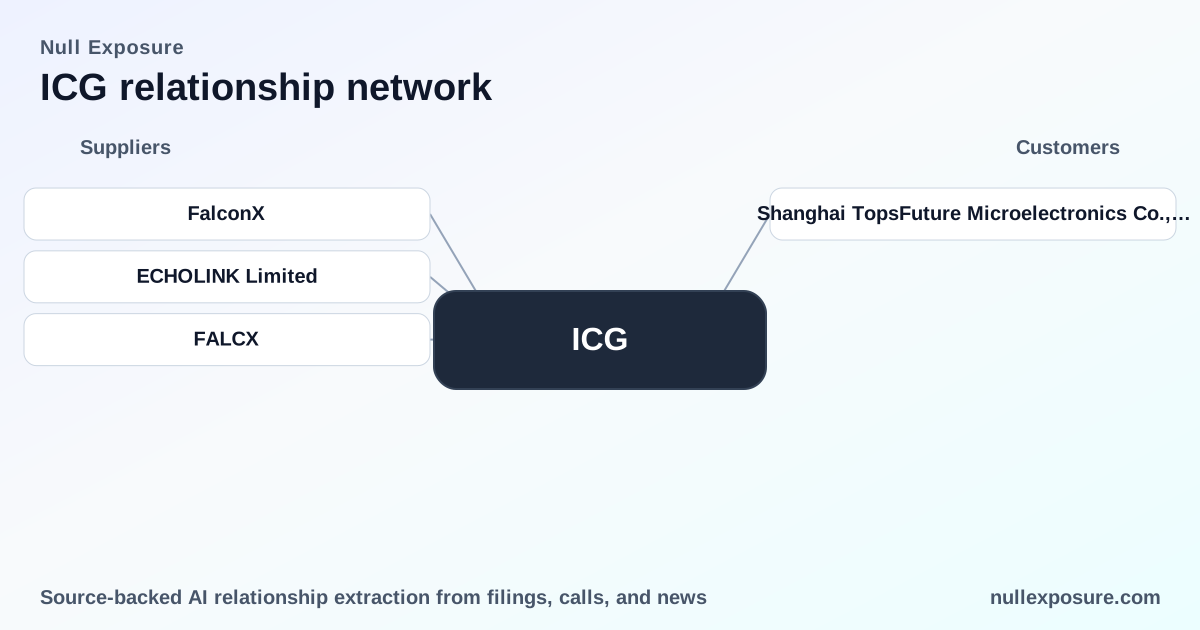
Intchains Group (ICG): Supplier relationships shifting the revenue mix toward digital-asset services
Intchains Group monetizes primarily by designing and selling application-specific integrated circuit (ASIC) chips and related software and hardware for blockchain applications out of Pudong, China; over FY2025 the company visibly extended its commercial model into digital-asset operations — staking, yield-generation and a targeted PoS technology acquisition — to convert idle crypto holdings into recurring returns. For investors and operators, the supplier and partner disclosures show a deliberate move from pure hardware supply toward owning or controlling elements of the crypto value chain, which changes vendor risk, margin drivers and contractual posture. If you want a concise tracker of these supplier relationships, visit https://nullexposure.com/ for live coverage and updates.
What the disclosed relationships tell us about strategy
ICG’s disclosed supplier/partner list in the public feed is short but strategic: the company has a revenue-generating hardware business and is now layering digital-asset services on top of that core product line. These relationships are not large-scale M&A commitments; they are tactical partnerships and a small technology acquisition aimed at extracting yield from cryptocurrency holdings and supporting ETH staking. That signals a pivot in monetization from one-time hardware sales to asset-yield strategies that can smooth revenue volatility from the chip cycle.
- Concentration: Only a handful of partners are named in the reviewed disclosures, which raises concentration risk in the short term but suggests focused strategic initiatives rather than broad supplier diversification.
- Contracting posture: Deal structures disclosed are partnership-and-acquisition driven (a $1.3 million platform purchase and a service partnership), indicating an opportunistic posture that favors control over long-term supplier outsourcing.
- Criticality: The relationships are material for the firm’s nascent digital-asset revenue lines; they are complementary to hardware but not replacements for core chip revenue.
- Maturity: Activity is recent and embryonic (FY2025 / Q4 2025), so these are early-stage operational capabilities, not yet large-scale business lines.
If you need a deeper read on how these supplier ties influence counterparty risk, check the homepage at https://nullexposure.com/ for our ongoing analysis.
Detailed relationship summaries (each disclosed item)
FalconX — partnership to optimize ETH acquisition and yields (news)
In July 2025 Intchains entered a partnership with FalconX to optimize its ETH acquisition and enhance ETH yields, and the company deployed a portion of its ETH holdings into staking and liquidity provisioning to generate incremental returns. This engagement is documented in a QuiverQuant news piece covering Intchains’ FY2025 product and digital-asset initiatives. (QuiverQuant, March 2026 coverage of FY2025 activity.)
FalconX — earnings-call confirmation of staking support (2025 Q4)
In the 2025 Q4 earnings call management confirmed the company expanded its digital-asset strategy by partnering with FalconX specifically to support ETH staking activities, reinforcing the operational intent behind the news release. (ICG 2025 Q4 earnings call transcript, first reported March 2026.)
ECHOLINK Limited — $1.3M acquisition of a PoS platform (FY2025)
Intchains agreed to acquire a Proof-of-Stake technology platform from ECHOLINK Limited for $1.3 million, an explicit technology purchase intended to accelerate in-house staking capabilities and reduce reliance on third-party staking infrastructure. (QuiverQuant report summarizing the FY2025 definitive agreement.)
How these supplier moves change the risk profile
The three recorded relationship entries are compact but meaningful. ICG is moving from selling chips to operating parts of the crypto stack — that is an escalation in operational complexity and counterparty exposure. Practical implications:
- Cash deployment and capital allocation: The $1.3 million PoS platform purchase is small relative to total revenue, indicating a low-cost way to acquire capability rather than build from scratch, but it also ties capital to an unproven internal service line.
- Revenue composition effects: Staking and yield activities convert idle crypto on the balance sheet into incremental operating returns, smoothing revenue but exposing the company to crypto market and protocol risks that differ from semiconductor cycles.
- Counterparty and operational risk: The FalconX partnership concentrates execution risk on an external digital-asset service provider for ETH operations; however, earnings-call disclosures show that ICG is simultaneously building internal capability through the ECHOLINK acquisition.
- Regulatory and jurisdictional exposure: As a China-headquartered supplier expanding into ETH staking and liquidity provisioning, ICG increases its exposure to evolving cross-border digital-asset regulation and custody requirements.
Practical due-diligence checklist for operators and investors
Focus your next round of checks on operational control, counterparty strength, and disclosure completeness:
- Verify the scope of the FalconX agreement (custody, trading, staking mechanics, fees and termination terms) and whether ICG retains custody or delegates it.
- Confirm technical integration and roadmap for the ECHOLINK PoS platform: is it a standalone capability or requires third-party support to run at scale?
- Quantify how much ETH is allocated to staking/liquidity vs. on-chain reserve and understand the liquidity and lock-up terms that affect balance-sheet flexibility.
- Evaluate financial reporting: ensure staking yields and liquidity revenue are clearly separated from hardware sales in future quarters so investors can track margin expansion.
For ongoing monitoring and supplier relationship mapping, use our homepage resource at https://nullexposure.com/ — we keep supplier disclosures and event timelines updated.
Constraints and company-level signals
The supplied constraint feed for ICG contains no explicit constraint entries. That absence is an actionable company-level signal: in the sources reviewed there are no disclosed supplier contractual constraints, restrictive covenants, escrow arrangements, or similar vendor-side limitations captured by the feed. Operationally, that implies ICG is executing a light, opportunistic contracting posture for its FY2025 initiatives rather than entering long-term restrictive supplier agreements that would tie operational flexibility.
Bottom line and recommended next steps
ICG is executing a deliberate, low-cost strategy to monetize crypto holdings and build staking capability while preserving its core ASIC business. The disclosed relationships — a service partnership with FalconX and a small PoS-platform acquisition from ECHOLINK — materially change the firm’s operational profile by adding protocol, counterparty and regulatory risk to an otherwise hardware-centric model.
For active investors and operators: prioritize verification of deal economics, custody arrangements, and revenue accounting for staking operations. For a live tracking feed and deeper supplier intelligence, visit https://nullexposure.com/ and set alerts for ICG supplier disclosures.
Key takeaway: these are early, strategic steps toward recurring digital-asset revenues, not full-scale transformation; risk is concentrated but manageable if counterparty controls and disclosure improve.