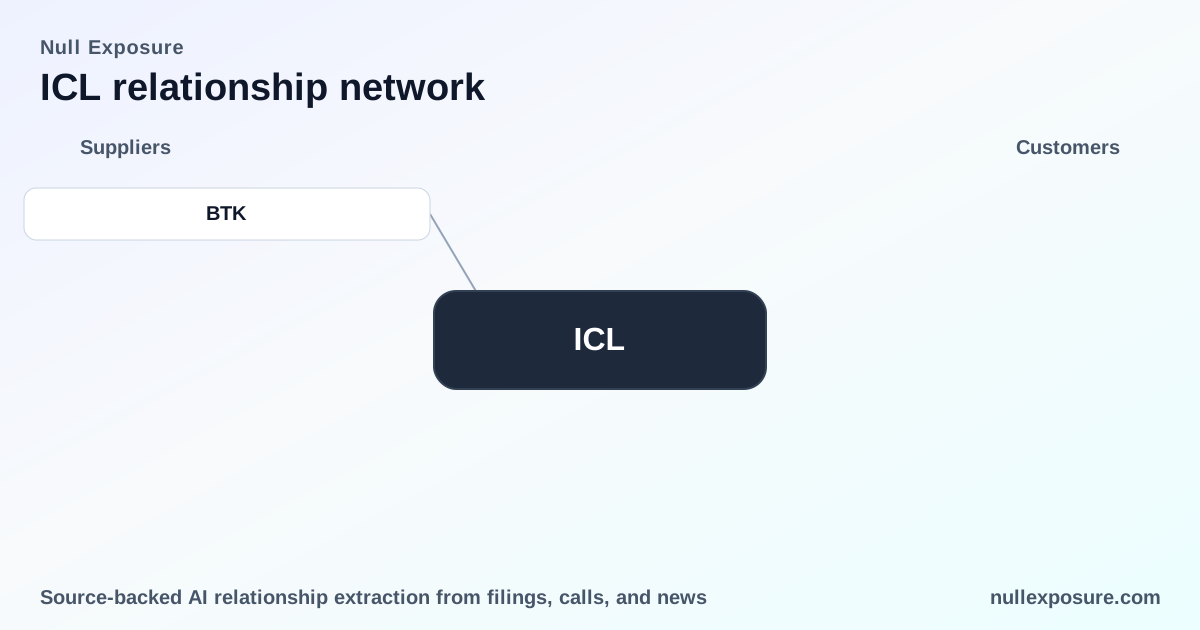
ICL (Israel Chemicals): Supplier relationships and what they mean for investors and operators
ICL monetizes a global chemicals and minerals franchise through sales of agricultural inputs, specialty minerals and industrial-grade chemical intermediates, converting natural resources into recurring commercial contracts and commodity cycles. Revenue of $7.15 billion and EBITDA of $1.22 billion (TTM) show a mature, cash-generating business built on long-tail customer relationships and periodic commodity pricing cycles; the company uses vertical moves and acquisitions to lock in higher-margin specialty streams. For investors and procurement leaders, the critical question is how supplier and ownership moves change cost of goods sold, margin stability and counterparty concentration. Visit https://nullexposure.com/ for deeper supplier-risk detail.
How ICL’s financial profile informs its supplier posture
ICL operates at the intersection of commodities and specialty chemicals. The scale (Revenue TTM $7.15B) and positive EBITDA margin indicate a supplier role that is both strategic and transactional: strategic where specialty inputs (food-grade acids, phosphate derivatives) are essential to customers; transactional where commodity fertilizer cycles drive volume and cash flow. According to company reporting through 2025-12-31, ICL’s operating margin is roughly 6.35%, with a price-to-sales ratio near parity and an EV/EBITDA of ~6.8, which signals a market that values stable cash flow but also expects cyclical pressure.
Several company-level signals are relevant for supplier assessment:
- Contracting posture: ICL’s public disclosures and recent M&A language show an active acquisition strategy to capture upstream control of specialty inputs and integrate suppliers into its own distribution chain. This reduces reliance on third-party vendors for key chemistries.
- Concentration and governance: Insiders hold a notably high stake (about 44%) while institutions hold roughly 38%, suggesting a governance environment where a concentrated shareholder base can drive strategic supplier integration decisions.
- Maturity and criticality: The company’s scale and product mix indicate a mature supplier that supplies core inputs to agriculture and food industries—a high criticality role for customers who source malic/fumaric acids or phosphate-based products.
- Financial signals for counterparties: A trailing P/E of ~29.6 and a forward P/E above 55 reflect market expectations for slower near-term earnings growth; procurement teams should factor potential margin compression into long-term supplier commitments.
What ICL disclosed about suppliers: the Bartek Ingredients acquisition
ICL’s earnings call commentary for Q4 2025 specifically references the acquisition of Bartek Ingredients. According to ICL’s Q4 2025 earnings call (transcript published March 7, 2026), ICL disclosed the acquisition of Bartek Ingredients, described as the global leader in food‑grade malic and fumaric acids. This is a deliberate vertical move to own a specialist supplier that sits upstream of food and beverage ingredient chains.
- Bartek Ingredients: ICL said the deal adds global leadership in food-grade malic and fumaric acids, expanding ICL’s specialty portfolio and internalizing a supplier for key acid chemistries (ICL Q4 2025 earnings call, reported March 7, 2026).
Why the Bartek move matters for operators and buyers
The Bartek acquisition is not a cosmetic bolt-on; it changes the supply equation in three practical ways:
- Supply security and margin capture: Owning Bartek shifts the cost curve—ICL can capture margin previously earned by an independent supplier and reduce volatility for product lines that require high-purity food acids.
- Customer lock-in: Food and beverage customers that require traceability and regulatory rigor for malic/fumaric acids will view integrated supply from ICL differently than purchases from commodity distributors.
- Integration risk and execution: While the strategic logic is clear, integration will require regulatory, quality and commercial harmonization; these execution steps are the primary near-term operational risks.
All supplier relationships identified in filings (complete coverage)
The review of ICL’s supplier-related disclosures surfaced one explicit relationship: the purchase of Bartek Ingredients disclosed in the Q4 2025 earnings call. No additional supplier contracts or vendor names were identified in the examined materials.
- Bartek Ingredients — ICL announced the acquisition to gain ownership of a global leader in food-grade malic and fumaric acids, signaling vertical integration into specialty food ingredients (ICL Q4 2025 earnings call, March 7, 2026).
No supplier-specific contractual constraints were disclosed in the reviewed materials; that absence itself is a company-level signal that ICL is choosing disclosure through M&A commentary rather than granular supplier contract reporting.
Operational and counterparty risks to price into models
For investors and procurement professionals, the combination of ICL’s financial profile and the Bartek acquisition implies these concrete risks and opportunities:
- Integration execution risk — integrating food-grade manufacturing and compliance regimes is operationally demanding; underperformance here will compress realized synergies.
- Concentration risk upside/downside — concentrated insider ownership supports bold strategic moves but can accelerate integration activity without broad investor consensus.
- Commodity exposure remains — despite specialty expansion, a sizable portion of ICL’s revenue is linked to commodity cycles; procurement agreements that lock prices must be stress‑tested against cyclic margins.
- Valuation sensitivity — with a forward P/E materially higher than trailing, market expectations are stretched; any supplier integration setbacks could be reflected quickly in equity valuation.
Visit https://nullexposure.com/ for tailored supplier concentration analytics and scenario workups that quantify these operational risks.
Actionable takeaways for investors and procurement leaders
- Investors: Treat the Bartek acquisition as a margin-accretive growth vector but price in integration and regulatory execution risk; use the company’s TTM margins and EV/EBITDA as baseline cash-flow assumptions.
- Procurement/Operators: Re-evaluate contracts that source malic and fumaric acids; an integrated supplier (ICL + Bartek) changes bargaining dynamics and likely improves traceability and on-spec reliability.
- Risk managers: Monitor how ICL transitions third-party supply contracts post-close and whether it enforces preferred-customer terms that could reshape market pricing.
For a practitioner-grade read on counterparty concentration and supplier resilience, see our platform at https://nullexposure.com/ — it provides actionable intelligence for scenario-driven decision making.
Bottom line
ICL is shifting from being primarily a commoditized minerals supplier toward capturing higher-margin specialty chemistries through targeted acquisitions such as Bartek Ingredients. This strategy improves control over key food-grade inputs and captures upstream margin but introduces integration and execution risk that investors should price into earnings and procurement teams should address in contract planning. Keep supplier exposures under active review as ICL executes on vertical integration and converts acquisition rhetoric into operational performance.