ICON supplier relationships: capital partners, listing mechanics, and what operators should price in
Icon Energy Corp. operates as a small-cap marine shipping owner-operator that monetizes primarily through vessel ownership and chartering, complemented by opportunistic asset sales and recurring access to public equity markets. Recent disclosures show the company relying on at-the-market equity placements and single-ship financing structures to sustain operations and manage balance-sheet liquidity, while simultaneously pursuing exchange-compliance actions to preserve market access. For investors and operators evaluating ICON’s supplier and capital relationships, the signal is straightforward: this is a capital-constrained shipping operator that monetizes assets and market access in lieu of deep liquidity from operations. Explore supplier intelligence and relationship tracking at https://nullexposure.com/.
Why these supplier links matter to investors and operators
Capital providers, listing venues and placement agents function as operational suppliers for a small shipping company. They determine how fast Icon can scale, the price at which it dilutes shareholders, and the bandwidth available for technical upkeep and chartering flexibility. The three relationships surfaced in public reporting over 2024–2026 reveal a company that is actively using public equity channels and single-asset transactions as the primary levers for funding. This pattern changes counterparty negotiation dynamics: counterparties assess payment risk knowing the operator is regularly in the market for capital. If you manage counterparty exposure or underwrite charters, that is a material sourcing signal.
If you want a broader look at ICON’s supplier and capital network, start here: https://nullexposure.com/.
Detailed relationship evidence (plain-English summaries)
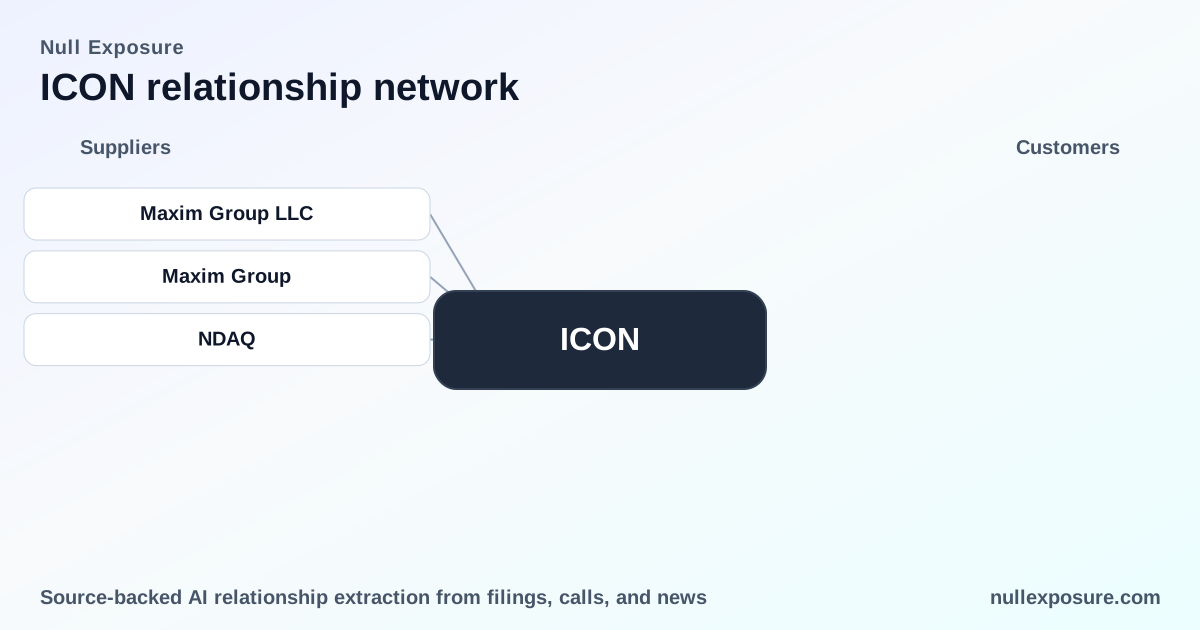
Maxim Group LLC — at-the-market placement agent (FY2026)
On Feb 4, 2026 Icon Energy entered into an at-the-market equity offering agreement with Maxim Group LLC that authorizes the sale of up to $3.4 million of common shares through Maxim acting as sales agent. This arrangement gives Icon immediate, on-demand access to public-equity capital while transferring execution work to a broker-dealer. According to the press release carried by The Globe and Mail, the agreement explicitly positions Maxim as sales agent for incremental equity raises in 2026 (The Globe and Mail, Feb 4, 2026 — https://www.theglobeandmail.com/investing/markets/stocks/ICON-Q/pressreleases/59710/icon-energy-launches-3-4-million-at-the-market-share-offering-agreement-with-maxim-group/).
Maxim Group — single-ship financing / raising $5M (FY2024)
A Maxim-led financing effort supported Icon Energy in raising $5.0 million backed by an 18‑year‑old bulker, signaling the company’s willingness to structure transactions anchored to single-asset economics rather than diversified fleet credit. TradeWinds reported the raise in connection with a U.S. capital-markets listing effort driven by a Greek family owner, which underscores the use of boutique capital partners to convert physical assets into short-term working capital (TradeWinds, FY2024 — https://www.tradewindsnews.com/finance/greece-s-panayotides-family-returns-to-us-capital-markets-with-one-ship-ipo-listing/2-1-1677018).
Nasdaq Capital Market — reverse stock split and continued listing mechanics (FY2026)
Icon implemented a reverse stock split effective Jan 8, 2026 and began trading on the Nasdaq Capital Market under the existing symbol ICON, a step consistent with maintaining exchange listing standards and improving per-share pricing. Dry Bulk Magazine covered the reverse split and Nasdaq transition, which signals management’s emphasis on preserving public market access as a strategic funding corridor (Dry Bulk Magazine, Jan–Jul 2026 coverage — https://www.drybulkmagazine.com/dry-bulk/07012026/icon-energy-corp-announces-reverse-stock-split/).
Company-level operating-model signals and constraints
The public relationship evidence produces a set of company-level operating signals that investors and counterparty operators should price into underwriting and negotiation:
- Contracting posture — opportunistic and market-driven. ICON uses at-the-market offerings and single-vessel raises rather than long-term, committed credit facilities, indicating a contracting posture built around short-duration, flexible capital solutions.
- Concentration — limited pool of capital partners. The recurrence of Maxim in public filings and press coverage indicates capital concentration toward a small set of specialized brokers and placement agents rather than broad institutional coverage.
- Criticality — capital markets access is a critical operational input. The reverse split and Nasdaq-focused activity demonstrate that exchange access is strategically critical; loss of that access would materially constrain funding options.
- Maturity — early-stage / microcap dynamics. The mix of single-ship financing, ATM placements and corporate actions to sustain listing status is consistent with microcap maritime operators in a capital-cycle phase, not a fully diversified owner with stable, internal cash generation.
These signals are company-level observations and are not attributed to any single relationship unless expressly named in a source excerpt.
What operators and investors should do with this evidence
- Price counterparties for short funding windows and higher roll risk: charterers and suppliers should demand stronger short-term protections or tightened payment terms given the operator’s demonstrated reliance on immediate market funding.
- Treat Maxim and similar boutique capital providers as supply-chain counterparties: their willingness to facilitate equity raises materially affects liquidity and operational continuity.
- Monitor exchange-compliance actions closely: continued market access through Nasdaq is an operational necessity for Icon’s capital plan; any deterioration there will be the first-order risk to suppliers and lenders.
For a deeper supplier network readout and ongoing monitoring of ICON’s counterparty exposures, visit https://nullexposure.com/.
Bottom line
Icon Energy’s public filings and press coverage reveal a capital-dependent shipping operator that executes financing through at-the-market placements and single-asset transactions while defending Nasdaq listing status. For investors, the combination signals dilution risk and concentration of funding partners; for operators and counterparties, it signals a need for tighter contract protections and active monitoring of capital-market actions. For ongoing supplier-insight coverage and relationship mapping, check the platform at https://nullexposure.com/.