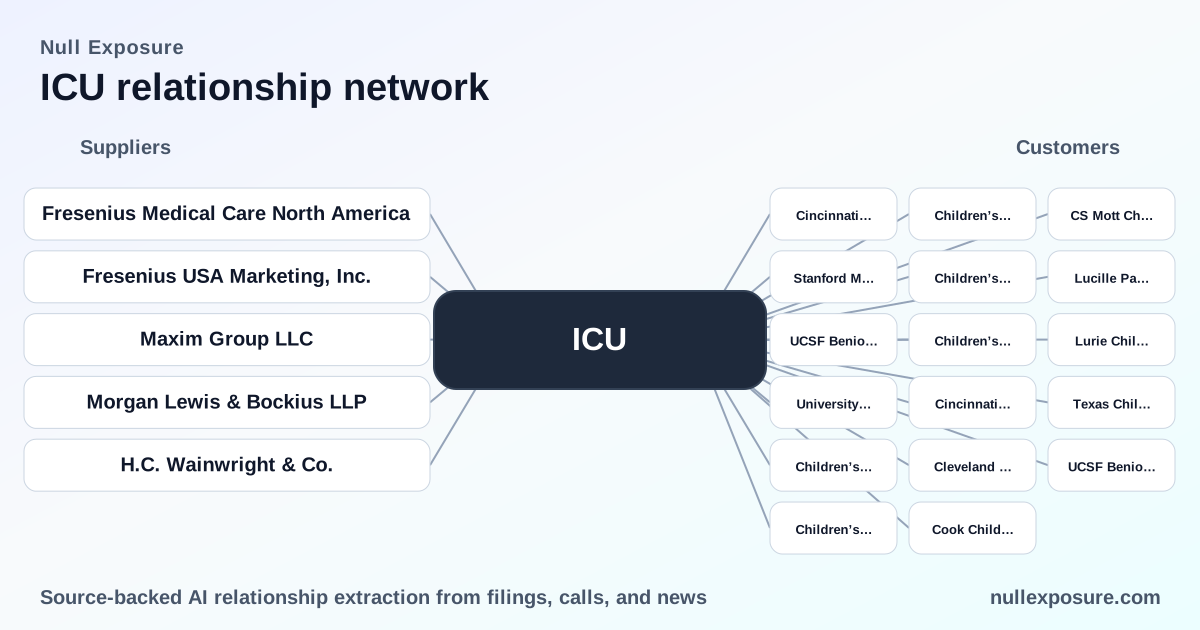
SeaStar Medical (ICU) — Supplier relationships and what they mean for investors
SeaStar Medical is a clinical-stage biotechnology company that develops an immunomodulatory cartridge-based therapy (the SCD) for acute kidney injury and related indications. The company monetizes by licensing core intellectual property, outsourcing complex cartridge manufacturing, and ultimately selling assembled SCD kits and related services to hospitals and trial sponsors; near-term revenue is driven by clinical trial activity and staged commercial rollouts. For investors, the supplier map defines operational leverage and single‑point risks: SeaStar outsources critical cartridge production to third parties, holds exclusive academic licenses for its technology, and uses investment banks and law firms to execute financings and corporate transactions. Learn more about supplier signals and counterparty risk at https://nullexposure.com/.
Supplier snapshot: the relationships that matter today
SeaStar’s disclosures identify a small set of counterparties that cover three practical needs: cartridge manufacturing and tubing supply, intellectual property/legal advisory, and capital markets execution. Each relationship below is active in the record and has implications for scale, regulatory readiness, and cash consumption.
Fresenius Medical Care North America
SeaStar lists Fresenius Medical Care North America (FMCNA) as the supplier of the cartridges used in its SCD and notes a supply agreement dating from March 2022 for cartridges priced on a per‑case basis for use in clinical trials and beyond. This is a single‑source, high‑criticality supplier for the cartridge component of the SCD. (Source: SeaStar FY2024 Form 10‑K filing, FY2024).
Fresenius USA Marketing, Inc.
An FMCNA affiliate, Fresenius USA Marketing, Inc. (FUSA), is the contractual counterparty under the March 2022 supply agreement to supply cartridges at an agreed per‑case amount, explicitly covering upcoming and additional clinical trials. This affiliate relationship reinforces concentration with the Fresenius platform for cartridge supply. (Source: SeaStar FY2024 Form 10‑K filing, FY2024).
Maxim Group LLC
Maxim Group LLC acted as SeaStar’s sole financial advisor in the business combination that brought the company public through a SPAC-style transaction, and the company paid material advisory fees in that process. Maxim functioned as a material capital markets advisor during the business combination phase. (Source: GlobeNewswire press release, Oct 28, 2022).
Morgan Lewis & Bockius LLP
Morgan Lewis served as legal counsel to SeaStar in connection with the same business combination, providing external legal services for corporate and transaction work. Morgan Lewis provided critical transactional legal support during SeaStar’s business combination and listing. (Source: GlobeNewswire press release, Oct 28, 2022).
H.C. Wainwright & Co.
H.C. Wainwright & Co. has acted as placement/placement agent for equity offerings and at‑the‑market programs, and SeaStar disclosed placement agent fees and placement agent warrants in connection with several financings. Wainwright is a primary distribution partner for equity capital raises and ATM sales programs. (Source: QuiverQuant news report on SeaStar registered direct offering and placement agent arrangements, FY2025).
What the relationship map implies about SeaStar’s operating model
SeaStar’s supplier and advisor universe delivers a compact, outsourced operating model with the following characteristics:
-
Contracting posture — mixed short and long horizons. The company holds an explicit supply agreement with a major supplier (Fresenius) for cartridges—contracted at a case price—while many other arrangements (financings, short‑term leases, monthly financing for insurance premiums) are short‑term in nature. The mix suggests the company balances operational continuity for manufacturing with financial flexibility for working capital.
-
Concentration — single‑supplier exposure is high. SeaStar relies on a single named cartridge supplier and sources tubing sets from Medtronic‑manufactured components in Mexico, showing single‑source dependency for mission‑critical components. This elevates supply chain risk and negotiating leverage toward the supplier.
-
Criticality — manufacturing and licensing are strategic chokepoints. Manufacturing of SCD cartridges is flagged repeatedly as critical; supplier delays would directly delay trials and commercialization. Concurrently, SeaStar’s exclusive licenses with academic licensors (University of Michigan and others) are central to its product rights and regulatory pathway.
-
Maturity and outsourcing posture — limited in‑house scale, heavy reliance on external providers. SeaStar outsources manufacturing of components and relies on third‑party service providers for clinical trial execution, IT security, and capital markets activity, indicating a scaled‑down internal manufacturing footprint and a reliance on partners to reach commercial scale.
-
Geography and regulatory overlay — U.S.-centric with global IP scope. Operational sourcing and key regulatory decision points are U.S.‑centric (FDA and federal funding rights/Bayh‑Dole implications), while intellectual property licenses are worldwide; this split creates U.S. regulatory concentration risk alongside global commercialization potential.
-
Spend profile — small to mid single‑counterparty spend with episodic larger transactions. Disclosed spend bands range from sub‑$100k operating items to $0.7M financings and several million in past transactional payments, indicating operational expenditures are generally modest but financings and transaction fees can be material.
Practical investor takeaways and where risk sits
-
Supply chain is the largest operational risk. The contract with Fresenius and the single‑source nature of cartridge production make supply continuity the primary delivery risk: regulatory approval or trial delays can translate directly into revenue and cash flow shortfalls.
-
Intellectual property licensing is a strategic gatekeeper. Exclusive academic licenses underpin the SCD platform; any licensor dispute or Bayh‑Dole government interests would have outsized implications for commercialization.
-
Capital markets relationships are active and consequential. Placement agents and financial advisors (H.C. Wainwright, Maxim) have been central to recent financings and corporate transactions, indicating continued reliance on equity financing to fund operations.
-
Operational model favors outsourcing, which compresses fixed overhead but transfers execution risk to partners. This is efficient for a clinical‑stage company but raises vendor selection and qualification as governance priorities.
If you want a deeper, operationally focused supplier risk scorecard or counterparty monitoring for SeaStar, start here: https://nullexposure.com/ — we map supplier criticality to contract maturity and spend to show where to focus diligence.
Final assessment and action plan for investors
SeaStar’s supplier footprint is concentrated and strategically focused: one primary cartridge manufacturer, academic licensors for core IP, and a compact set of capital markets and legal advisors. For investors and operators evaluating exposure, prioritize three actions: validate continuity clauses and backup suppliers for the cartridge; confirm license grant stability and encumbrances; and stress‑test financing pathways given ongoing cash burn and reliance on placement agents.
For a structured engagement or to commission a supplier due‑diligence brief tailored to SeaStar’s counterparties, visit https://nullexposure.com/ and get a supplier risk profile customized to your investment horizon.
Bold takeaway: SeaStar’s path to commercial revenues is functionally gated by cartridge supply continuity and license stability — both are single points of operational failure and deserve top priority in any investment diligence.