Idaho Strategic Resources (IDR) — supplier relationships and operating implications
Idaho Strategic Resources operates as a regional critical-minerals explorer and developer, monetizing through the discovery, development and sale of mineral concentrates and through royalty/lease income on its Idaho properties. The company’s commercial model combines near-term assay-driven exploration programs, retained surface and mineral leases, and revenue exposure tied to NSR royalties and property sales, while capex and milling activity drive the path to recurring production. For investors evaluating supplier counterparty risk and procurement posture, the supplier footprint is concentrated, service‑heavy, and tightly linked to permitting and state/federal land regimes. Learn more at https://nullexposure.com/.
Labs, processing partners and the service backbone
IDR’s supply chain is dominated by laboratory services, consultants and government permits rather than long vendor lists. This reflects a small‑cap mining profile: exploration-focused spend is often under $100k per line item, while reclamation bonds and mill capital sit in the mid- and high‑hundreds of thousands. The consequence for operators and financiers is a supplier ecosystem where accuracy of assay partners and continuity of permitting services are material to value realization.
All reported supplier relationships (one-by-one)
-
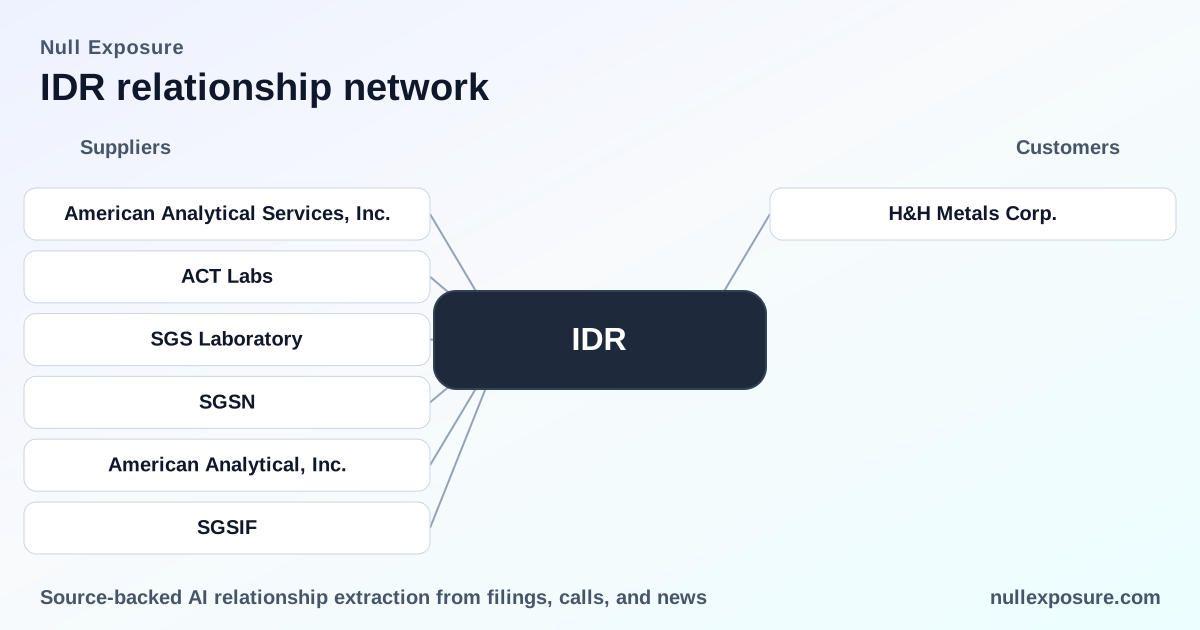
American Analytical Services, Inc. — Drill core samples from the Golden Chest Mine were analyzed by American Analytical Services, an ISO 17025‑accredited lab in Osburn, Idaho, using 30‑gram fire assay with a gravimetric finish. According to a Junior Mining Network press release covering Golden Chest drill results (FY2025), AAS performed the assay work (https://www.juniorminingnetwork.com/.../181675-idaho-strategic-announces-multiple-high-grade-drill-results...).
-
ACT Labs — Rare earth samples from the Lemhi Pass soil program were analyzed using ACT Labs’ 8‑REE Assay Package (FUS‑MS), supporting REE targeting and permitting refinement. That analysis is reported in a Junior Mining Network release on Lemhi Pass sampling (FY2025) (https://www.juniorminingnetwork.com/.../193149-lemhi-pass-soil-sampling-and-radiometrics-survey-results...).
-
SGS Laboratory — IDR engaged SGS for first‑round REE processing tests and consultant work as the company planned its 2026 exploration and permitting activities. Junior Mining Network described SGS Laboratory involvement in processing tests during the winter planning cycle (FY2025) (https://www.juniorminingnetwork.com/.../193149-lemhi-pass-soil-sampling-and-radiometrics-survey-results...).
-
SGS (SGSN) — Reporting to investor outlets, InsiderMonkey noted IDR’s intention for expanded radiometrics and soils work and explicit plans to conduct SGS processing tests and initiate drilling at Lemhi Pass and Mineral Hill for 2026. This public filing/comment appeared in 2026 coverage (InsiderMonkey, FY2026) (https://www.insidermonkey.com/blog/idaho-strategic-resources-idr-ceo-sold-20000-common-shares-as-the-stock-skyrockets-256-over-the-past-six-months-1670988/).
-
American Analytical, Inc. — Historical assay work (30‑gram fire assays with gravimetric finish) for surface mining and portal work at Golden Chest was completed by American Analytical, Inc., per a Company press release describing surface mining and planned underground exploration (FY2023). Junior Mining Network covered that work (https://www.juniorminingnetwork.com/.../141733-idaho-strategic-completes-surface-mining-of-high-grade-jumbo-vein-portal-and-underground-exploration-planned.html).
-
SGS (SGSIF) — A separate investor piece repeated IDR’s plan to expand radiometrics/soils and to use SGS processing tests ahead of permitting and drilling (insider coverage in 2026), indicating multiple outlets have reported the same SGS engagement (InsiderMonkey list article, FY2026) (https://www.insidermonkey.com/blog/9-best-junior-gold-mining-stocks-to-buy-now-1670390/2).
What the supplier list tells investors about IDR’s operating model
IDR’s supplier roster signals a service‑oriented, exploration‑heavy procurement posture with the following characteristics:
-
Contracting posture — mix of long-term land leases and short-term operational contracts: the company holds a 20‑year State of Idaho mineral lease with fixed annual rent escalators while routine office and professional services are handled on month‑to‑month or project bases. Those dynamics create a stable land tenure backbone combined with flexible operational spend.
-
Concentration and maturity — concentrated reliance on a small set of accredited laboratories and processing consultants (AAS, ACT Labs, SGS, ALS referenced in corporate disclosures). This concentration increases the importance of individual lab continuity but supports high-quality assay reproducibility and permitting credibility.
-
Criticality — supplier services are critical to value realization: laboratory accuracy, processing test results and environmental/permit consultants directly influence drilling decisions, permitting timelines, and resource statements. The constraints data highlight water availability and reagent/energy inputs as potential production chokepoints, making some supplier relationships functionally critical.
-
Spend profile — many supplier relationships are low-dollar recurring items, with multiple annual fees and claims under $100k, while reclamation bonds and mill capital represent mid‑to‑high‑hundreds‑of‑thousands or multi‑million items. This creates a cashflow profile where routine operations are low single‑digit spend but capital projects require discrete higher funding rounds.
Risk map for operators and procurement teams
-
Permitting/government exposure is material: a significant portion of IDR’s land and regulatory obligations involve BLM, USFS and State of Idaho leases and fees; interactions with these public counterparties are frequent and ongoing.
-
Lab and processing partner continuity matters: the company’s drill and REE targeting decisions depend on a handful of certified labs and SGS processing tests. Any interruption in these services delays drilling, permitting and potential production ramp.
-
Resource and environmental constraints are financially meaningful: water rights, reclamation bonds and insurance limits are cited as cost drivers that can materially affect project economics.
-
Spend concentration reduces procurement complexity but raises single‑vendor risk: many line items are under $100k, which simplifies contracting, but the reliance on specific accredited labs and consultants increases vendor-specific operational risk.
Key investor takeaway: IDR is a small‑cap explorer that monetizes through property development and royalties, and its supplier risk profile is dominated by a small number of accredited labs and government counterparty interactions; these are strategic, not low‑priority, supplier relationships.
For a concise view of supplier signals across small‑cap explorers, visit https://nullexposure.com/ for comparative supplier intelligence.
Practical implications and recommended actions
-
Underwrite project timelines with explicit contingency for laboratory turnaround and re‑test cycles, and model permitting timelines against BLM/USFS approval lags and reclamation bond requirements.
-
Treat SGS/ACT/AAS assay and processing reports as operational gate‑events for capital deployment; require milestone‑linked spend and conditional drawdowns for larger mill or drill financing.
-
Maintain a focused supplier‑monitoring program for water rights, reclamation bonds and key lab certifications to protect timelines and asset value.
Explore granular supplier profiles and supplier‑risk scoring at https://nullexposure.com/ — use that intelligence to align contracting posture with exploration milestones.
Investors evaluating IDR should weigh the high informational value of assay and processing partners against the concentration and government dependence inherent in Idaho‑based critical‑minerals projects. The supplier footprint is small but strategically essential to unlocking the company’s resource value.