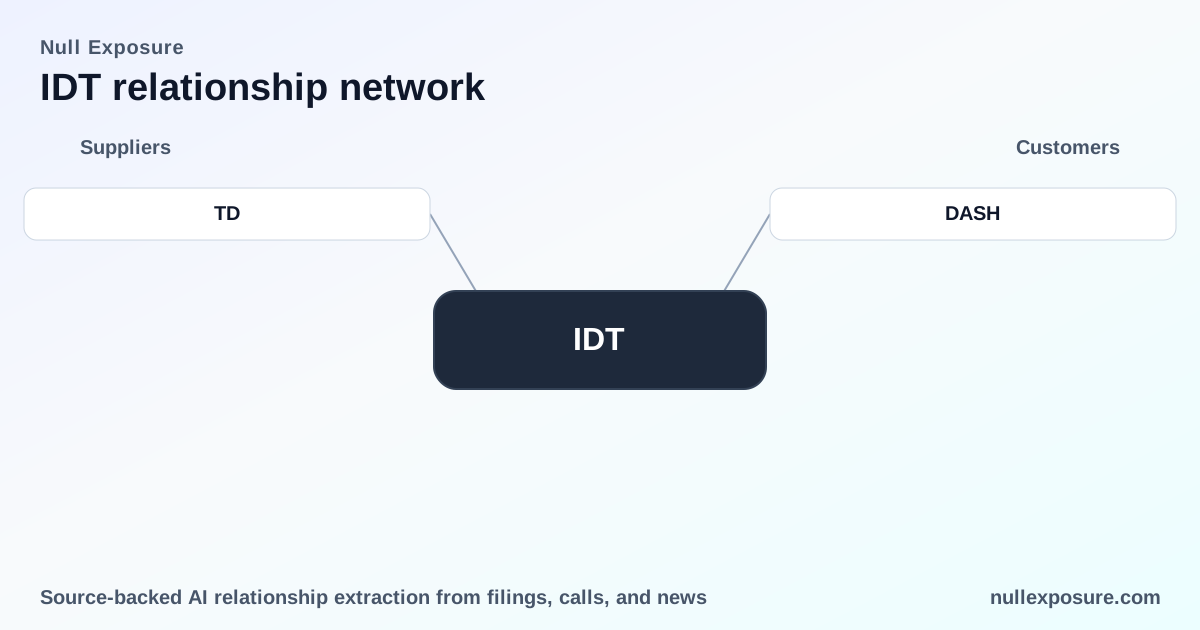
IDT Corporation (IDT) — Supplier relationships, credit lines, and operational constraints investors should price in
IDT Corporation operates in communications and payments, monetizing through network services, payment processing and related service revenue across the U.S. and international markets. The company generates roughly $1.23 billion in annual revenue with mid‑teens EBITDA margins in headline terms; it funds working capital and occasional capex through a combination of operating cash flow and short‑term credit lines while relying on a small set of external service and manufacturing providers. Investors evaluating IDT supplier relationships should weight a modestly leveraged operating model against concentrated supplier dependencies and multi‑jurisdictional manufacturing exposure.
For a quick company reference, see the firm homepage: https://nullexposure.com/
What the supplier picture looks like at a glance
IDT’s disclosures show three clear operational signals for investors: a revolving credit facility with a U.S. bank, material reliance on a limited number of suppliers for certain functions, and contracted purchase commitments in the mid‑double‑digit millions. These elements combine into a supplier posture that is operationally important but financially manageable at current scale — provided counterparties remain available and international manufacturing channels stay intact.
If you want a structured view of counterparties and contract risks, start here: https://nullexposure.com/
The lender relationship every analyst should note: TD Bank, N.A.
TD Bank, N.A. — IDT maintains a revolving credit facility with TD Bank for up to $25.0 million. According to coverage of IDT’s FY2025 earnings and related filings, the bank commitment is an active part of the company’s short‑term liquidity architecture and provides a backstop for working capital and seasonal cash flow variability. (Source: Quartz coverage of IDT’s FY2025 results, March 2026.)
Why this matters: the $25 million revolver is a conventional corporate credit line sized to IDT’s working capital needs and speaks to a conservative borrowing posture rather than large structural leverage. Investors should treat this as a liquidity tool rather than a growth financing lever.
Named service partners and small‑ticket relationships that show governance detail
Mason and Company Consulting, LLC — IDT discloses that Mason and Company (owned by Jonathan Mason) receives commissions and fees for insurance brokerage referral and placement, with reported payments aggregating $54,000 in fiscal 2025. This is a small, disclosed related‑party service relationship that illustrates IDT’s use of external brokers for insurance placement. (Source: IDT FY2025 disclosures.)
Zedge — The company’s filings show a one‑off commercial relationship where IDT paid $86,000 for consulting services provided by a Zedge employee, categorizing IDT in the role of a buyer for that engagement. This line item is immaterial to overall spend but important for diligence on related‑party and consulting governance. (Source: IDT FY2025 disclosures.)
Manufacturing and third‑party software exposures to flag
Desktop devices used in IDT operations are manufactured by vendors in China, creating a cross‑border supply chain exposure; the company also states reliance on non‑proprietary third‑party software, including open source components. These are company‑level signals that affect resilience and vendor management; they are not attributed to a named supplier in the filing but should be modeled into scenario analysis for supply disruption or compliance events. (Source: IDT FY2025 disclosures.)
Commitments and spend profile — where contract scale matters
IDT reports purchase commitments of $14.5 million at July 31, 2025, primarily for services, placing incremental, known contractual spend in the $10M–$100M band. This is a meaningful operating commitment relative to cash flow and speaks to moderate forward obligations for outsourced services. Treat this as a firm‑level contractual baseline rather than a list of discrete supplier obligations. (Source: IDT FY2025 disclosures.)
How these facts translate into practical investment considerations
- Concentration risk is present. The company discloses that certain business functions depend on a single supplier or small group of suppliers, and loss of those relationships could have a material impact on results — a direct company warning that requires monitoring. This elevates operational risk above a typical diversified telecom services business and requires active supplier monitoring in due diligence. (Source: IDT FY2025 disclosures.)
- Liquidity posture is conservative but finite. The $25M revolving facility with TD Bank supplies working capital cushion; it is not large relative to revenue but fits the company’s modest leverage profile and positive operating cash flow. (Source: Quartz coverage; IDT financials FY2025.)
- Supplier spend is moderate and service‑heavy. With $14.5M in purchase commitments mostly for services, contractual outlays are meaningful but not enterprise‑threatening — unless concentrated suppliers fail to perform. (Source: IDT FY2025 disclosures.)
- Operational complexity includes offshore manufacturing and third‑party software reliance. These are typical for telecom suppliers but increase the importance of compliance and supply‑chain continuity planning. (Source: IDT FY2025 disclosures.)
Relationship roll‑call (complete list from the supplier results)
- TD Bank, N.A.: IDT holds a revolving credit facility for up to $25.0 million, used to support working capital and seasonal liquidity. (Source: Quartz coverage of FY2025 earnings, March 2026.)
- Mason and Company Consulting, LLC (Jonathan Mason): IDT paid commissions and fees totaling $54,000 in fiscal 2025 for insurance brokerage referral and placement services. (Source: IDT FY2025 filings.)
- Zedge: IDT paid $86,000 for consulting services provided by a Zedge employee, recorded as a buyer relationship. (Source: IDT FY2025 filings.)
Final takeaways and what investors should do next
IDT operates a lean, service‑oriented supplier base with focused contractual commitments and a conservative short‑term borrowing posture. The principal risks for investors are concentrated supplier dependencies and cross‑border manufacturing exposure rather than aggressive financial leverage. Active monitoring of counterparty continuity, renewal terms on the TD Bank facility, and any material changes to purchase commitments should be integral to ongoing coverage.
If you need a structured counterparty map or deeper diligence on supplier concentration and contract terms, begin your research here: https://nullexposure.com/
For portfolio managers evaluating operational risk adjusted returns, prioritize: vendor concentration checks, insurance placement disclosure review, and confirmation of the TD Bank revolver renewal mechanics. For a gateway to more supplier‑centric intelligence, visit: https://nullexposure.com/