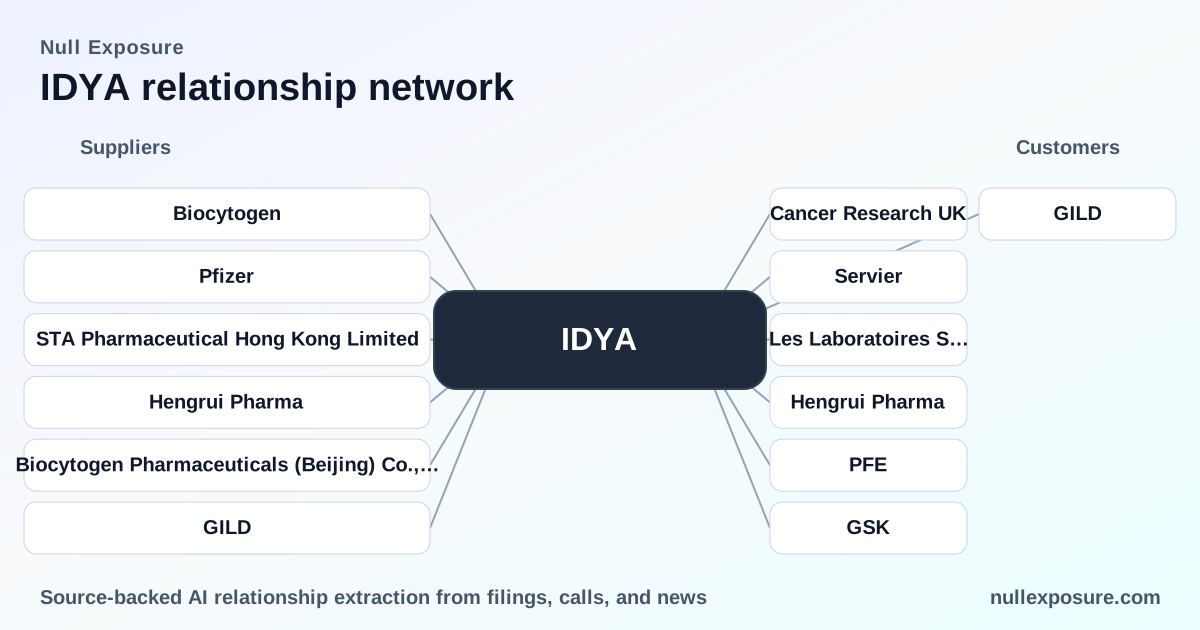
Ideaya (IDYA) supplier map: what investors need to know
Ideaya Biosciences operates as a synthetic precision-medicine oncology company that generates value by discovering targeted therapeutics and monetizing through partnerships, licensing and milestone-driven collaborations. The company outsources core manufacturing, clinical supply and certain discovery assets, retains global commercial rights in key cases, and realizes near-term cash relevance from milestone triggers and partner-supplied drugs in combination trials. For a detailed supplier relationship view and ongoing coverage, visit https://nullexposure.com/.
Investment thesis in one paragraph
Ideaya builds a capital-efficient R&D model by leaning on third-party CMOs/CROs and licensing deals to advance multiple oncology programs while preserving upside through worldwide or regionally carved rights. Revenue realization for investors is transaction-driven: licensing fees, milestone receipts and value creation from advancing clinical-stage assets toward partnerships or commercialization. The balance sheet and valuation therefore depend on program readouts and the cadence of partner milestones and supply arrangements rather than predictable product sales.
Explore Ideaya supplier profiles on NullExposure
How Ideaya structures supplier relationships — the operating model drivers
Ideaya’s supplier posture is that of a development-stage biopharma company that outsources manufacturing and clinical execution to third parties. The firm routinely contracts CMOs, CROs and specialty chemistry partners to produce APIs, formulate drug product and run GLP/GCP-compliant studies. That contracting posture delivers speed and capital efficiency but creates concentration and criticality risks where single-source inputs or specialized biologics supply chains are involved. Ideaya’s public disclosures indicate:
- Geography signal: some suppliers are based in the PRC, establishing APAC exposure for parts of the supply chain.
- Contracting flexibility: many agreements include termination provisions and limited non‑cancelable obligations, signaling manageable near-term commitments at the company level.
- Material single-source risk: Ideaya acknowledges that interruption in limited or sole-sourced raw materials could materially harm manufacturing until alternate qualified sources are identified.
- Role mix: suppliers act as service providers and manufacturers (CMOs/CROs), with distribution arrangements possible once products are approved.
- Stage: supplier arrangements are active and oriented to clinical/commercial readiness.
These structural signals define where operational risk concentrates and where investor due diligence should focus — qualification status for external manufacturers, geographic risk management, and milestone timing tied to partner-supplied assets.
Visible supplier and partner relationships (company filings and press)
The relationships below summarize every partner mentioned in Ideaya’s supplier-focused results. Each relationship note is plain English with a concise source reference.
Biocytogen / Biocytogen Pharmaceuticals (Beijing) Co., Ltd
Ideaya obtained an option and exercised it to in-license IDE034, a preclinical B7H3/PTK7 bispecific ADC, giving Ideaya worldwide commercial rights to the molecule; dosing the first patient in the IDE034 trial triggers a $5 million milestone payment from Ideaya to Biocytogen. These points are documented in Ideaya’s FY2024 10‑K and in company press releases and news coverage in early 2026. According to Ideaya’s 10‑K (FY2024) and subsequent PR Newswire and Finviz reports (Mar 2026), IDE034 received IND clearance and the first-patient dosing milestone is contractually defined.
Pfizer
Pfizer supplies binimetinib and crizotinib for use in Ideaya clinical trials at no cost, supporting combination studies without direct drug procurement expense for Ideaya. This arrangement is disclosed in Ideaya’s FY2024 10‑K.
STA Pharmaceutical Hong Kong Limited (and Yuhan / Patheon)
Ideaya has a manufacturing and formulation network for darovasertib that includes STA Pharmaceutical Hong Kong Limited and Yuhan Corporation for API synthesis, plus STA Pharmaceutical and Patheon Inc. for formulation and drug product manufacturing. These contractual manufacturing relationships are laid out in Ideaya’s FY2024 10‑K and represent Ideaya’s external CMO footprint for that program.
Hengrui Pharma
Ideaya entered a license agreement with Hengrui Pharma granting global development and commercial rights to IDE849 (a DLL3-targeting ADC) outside Greater China, reflecting a carve‑out licensing structure that preserves Ideaya’s economics in most territories while sharing regional rights with a large China-based partner. This is described in Ideaya’s FY2024 10‑K.
Gilead
Ideaya has clinical combination activities with Gilead (Trodelvy) that have been reprioritized; Ideaya is concluding enrollment in ongoing Phase 1/2 trials with Gilead as it focuses on its proprietary MTAP-deleted pipeline. This strategic reprioritization and the winding down of those combination trials were announced in Ideaya’s business update and press materials in early 2026.
Meaningful implications for investors
- Cash flow cadence tied to milestones and partnerships. The Biocytogen IDE034 milestone structure (a $5M payment on first dosing) illustrates how near-term liquidity and event-driven value realization operate for Ideaya: program progress generates discrete cash flows and de-risks valuation gaps.
- Operational leverage through external suppliers. Using CMOs and CROs reduces capital expenditure but concentrates execution risk on a small set of specialized partners, including APAC-based suppliers that introduce geopolitical and logistics variables.
- Single-source vulnerabilities are material when they exist. Company disclosures explicitly state that interruptions in limited or sole-sourced raw materials could materially harm manufacturing timelines; that is a core operational risk, not a peripheral note.
- Strategic trade-offs drive portfolio moves. The decision to deprioritize combination work with Trodelvy shows management is willing to reallocate clinical resources toward programs they control, increasing the importance of proprietary assets (IDE397, IDE892) to long-term value.
Review Ideaya coverage and supplier analytics at NullExposure
Risk checklist for further diligence
- Confirm qualification status and redundancy plans for external CMOs, especially those with APAC exposure.
- Quantify milestone timing and probability for licensed assets where Ideaya retains rights (e.g., IDE034, IDE849 outside Greater China).
- Monitor partner-supplied drug terms that reduce near-term cash needs but can constrain trial design or commercialization strategy.
- Track program prioritization decisions that affect ongoing combination trials and partner relationships (e.g., Gilead/Trodelvy).
Conclusion and recommended next steps
Ideaya’s operating model delivers capital efficiency and optionality by outsourcing manufacturing and leveraging licensing deals, while creating concentrated operational and supplier risk where single-source inputs or regionally based CMOs are used. Investors evaluating IDYA should prioritize supplier qualification, milestone timing, and partner-supplied drug arrangements as the determinants of short- and medium-term value realization.
For continual updates on supplier change‑points and material contract triggers, visit https://nullexposure.com/ and bookmark Ideaya’s supplier profile.