IFED: Who supports the product and how investors should read supplier links
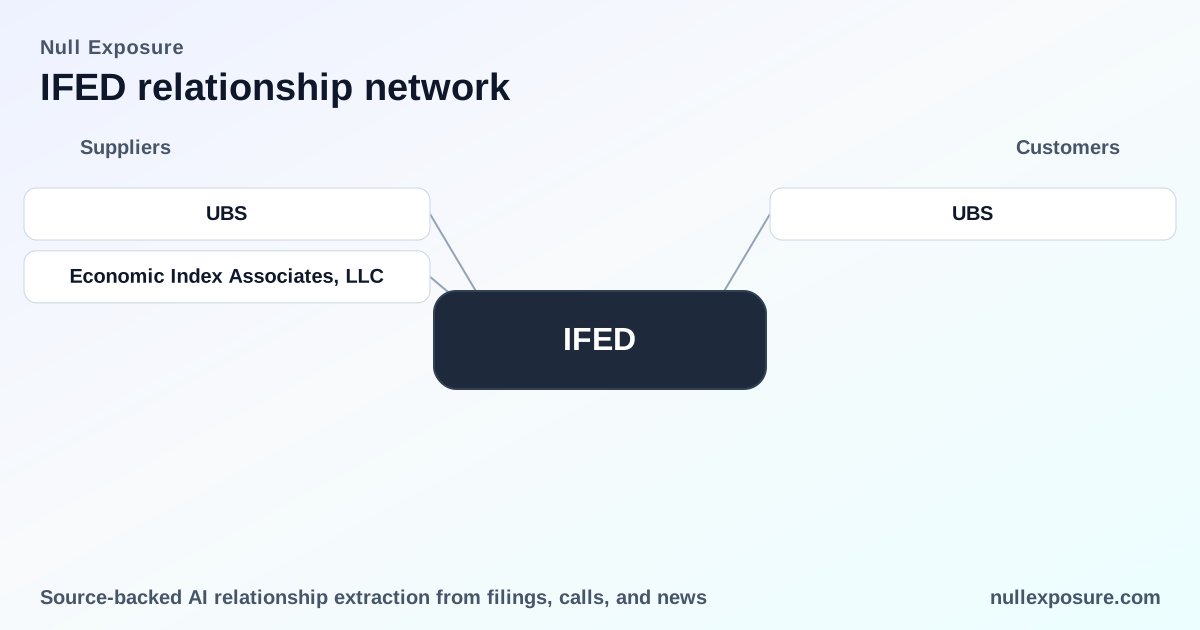
IFED is an exchange-traded note (ETN) product that monetizes through issuance and market-making by a major bank and by licensing an index methodology for replication. UBS is the issuer and distribution anchor for IFED, while Economic Index Associates provides the index calculations that underpin the ETN’s tracking mechanism. Investors evaluate IFED as a short-duration exposure sold via an issuer structure, where revenue to counterparties comes from issuance spreads, fee arrangements, and licensing/servicing payments. For a concise supplier-risk view, visit https://nullexposure.com/.
How IFED makes money and why supplier links matter
IFED’s economic model is straightforward: investors buy an ETN issued by a bank (UBS), and returns are tied to the performance of an index calculated by a specialist index provider (Economic Index Associates, LLC). UBS captures issuance economics and liquidity provisioning benefits; the index provider is compensated for calculation and licensing. That split of responsibilities creates two primary supplier risk vectors for investors: counterparty credit and operational dependency.
- Counterparty credit risk concentrates on the issuer (UBS) because ETNs are unsecured obligations of the issuing bank.
- Operational and model risk concentrates on the index provider (Economic Index Associates) because index calculation and dissemination are integral to pricing and replication.
These dynamics define contracting posture, concentration, criticality, and maturity: the contracting posture is issuer-led and bank-centric; concentration is high because a single bank issues the ETN; criticality is material for investors because both issuer solvency and index integrity drive return outcomes; and maturity is mid-stage since IFED launched in 2021 and continues to trade. If you want a structural supplier-risk brief or comparative supplier maps, see https://nullexposure.com/ for tailored reporting.
What the public record shows about supplier relationships
Below are the supplier relationships contained in the public results for IFED. Each entry is a plain-English summary with the original source cited.
-
UBS — DefenseWorld news report (Feb 26, 2026): IFED was launched on September 14, 2021 and is issued by UBS, which undertakes issuance, market making and distribution functions that anchor investor exposure to the ETN. (Source: DefenseWorld, Feb 26, 2026 — coverage of IFED issuance and market metrics.)
-
UBS Group AG — TradingView symbol page (record referencing FY2021): Market reference documentation lists IFED shares as issued by UBS Group AG, reinforcing that the product is an unsecured obligation of a major global bank rather than a closed-end fund or a pooled mutual vehicle. (Source: TradingView symbol page for AMEX-IFED, historical note referencing FY2021.)
-
Economic Index Associates, LLC — BizWire/FinancialContent press release (Sept 2021): Economic Index Associates outsources end-of-day and real-time calculation of the IFED large-cap U.S. equity index, serving as the licensed index administrator whose calculation services enable NAV-like reference pricing for the ETN. (Source: Business Wire / FinancialContent press release announcing UBS ETNs and the role of Economic Index Associates, Sept 2021.)
What these relationships imply for investors
The supplier map describes a classic bank-issued ETN structure with an external index administrator. From an operational and credit viewpoint:
-
Contracting posture: The issuer (UBS) holds primary contractual responsibility to noteholders; index licensing and calculation are delegated to a specialized third party. This structure centralizes legal exposure with UBS while outsourcing crucial pricing functions, which is typical for ETN products.
-
Concentration: High issuer concentration is the dominant structural risk — the note is an unsecured claim on UBS. Operational concentration is lower but meaningful because index calculation is handled by Economic Index Associates, a single named administrator.
-
Criticality: Both supplier roles are critical. UBS’s creditworthiness is paramount for principal protection and settlement mechanics; Economic Index Associates is critical for price reference, which affects tracking accuracy and investor confidence.
-
Maturity and robustness: IFED launched in 2021, placing it in a post-launch but still relatively recent lifecycle. The product benefits from being issued by an established banking group, which increases market access and liquidity potential, while the use of a specialized index firm is customary and operationally standard for exchange-traded products.
Key risk and value takeaways
- Primary credit exposure is to UBS. Investors hold an unsecured claim on the issuing bank rather than direct ownership of underlying equities, so issuer solvency and liquidity provision determine ultimate capital exposure.
- Index reliance is operationally important. Index calculation by Economic Index Associates is a single point of dependency for pricing and transparency; problems in calculation or dissemination would affect tracking behavior and market confidence.
- Concentration of duties simplifies governance but raises systemic linkage. Having one bank issue and one index provider calculate reduces counterparty multiplicity but concentrates failure modes.
If you want a deeper comparison across issuer and index-provider pairings, or a supplier-risk scorecard for IFED and peer ETNs, explore our analytical products at https://nullexposure.com/.
Practical implications for portfolio managers and operators
- For portfolio managers, monitor UBS credit indicators and liquidity metrics—spread widening or issuer-specific stress will be the dominant channel of value impairment.
- For risk or operations teams, validate index-source continuity and SLA terms with Economic Index Associates; operational outages, methodology changes, or recalculation events are the meaningful second-order risks.
- For compliance and legal reviewers, confirm the ETN prospectus provisions around issuer default, index substitution, and termination triggers; those contract clauses define the recovery framework for investors.
Final read: what to act on next
IFED’s supplier footprint is compact and transparent: UBS as issuer and Economic Index Associates as index administrator. That configuration gives investors clear levers to monitor—credit and calculation continuity—rather than opaque, multi-party webs. For investors who need a structured supplier-risk profile, counterparty scoring, or comparative ETN supplier analytics, request our bespoke reports at https://nullexposure.com/.
Bold, focused monitoring of issuer health and index integrity will provide the earliest signal of value disruption for IFED investors.