IFLR: What Investors Need to Know About Its Supplier Relationships and Go-to-Market
IFLR operates as an ETF product — the Innovator International Developed Equity Managed Floor ETF — issued and managed by Innovator Capital Management, and it monetizes through management fees and product-level spread capture embedded in the managed-floor structure. The product is positioned to deliver downside protection for international developed equities while retaining upside exposure, and its economics are driven by asset-gathering, fee compression in ETF markets, and the margin on option or derivatives overlays used to implement the floor. For a full supplier map and ongoing monitoring tools, visit https://nullexposure.com/.
A concise commercial thesis for investors
IFLR is a product-led revenue stream: an asset-management fee business built on a single product innovation (managed-floor ETF) that scales with AUM. Success depends on distribution reach, investor comprehension of the managed-floor proposition, and the cost efficiency of the options or derivatives used to implement the floor. The issuer-supplier relationship and product governance determine operational continuity and cost structure because the ETF’s economics rely on third-party liquidity and options markets to deliver the stated floor.
How Innovator positions the product in the market
Innovator has expanded its managed-floor lineup to target international developed markets with IFLR, which separates it from prior domestic-focused offerings. The product’s differentiator is explicit downside protection in non-US equities, giving distributors a retail-friendly story while retaining the operational complexity of hedging international exposure. According to StructuredRetailProducts (report published March 10, 2026 covering FY2025), Innovator rolled out the Innovator International Developed Equity Managed Floor ETF as the first in the series to focus on international developed markets.
Who is the supplier: the full relationship set
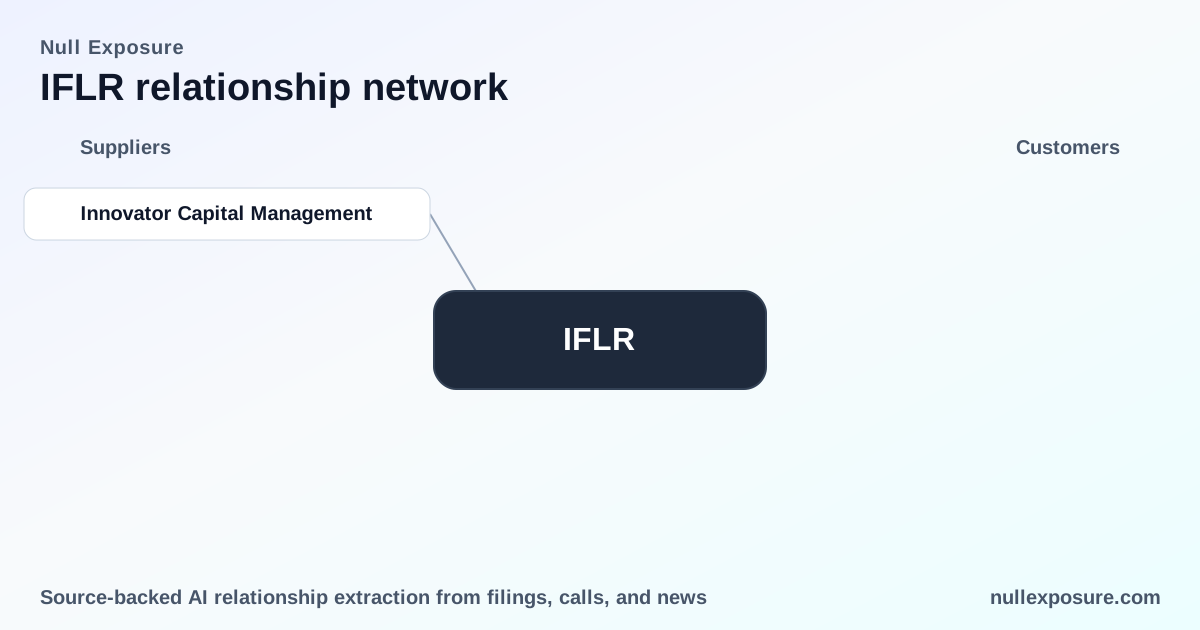
The public relationship data for IFLR lists a single supplier relationship:
- Innovator Capital Management — Innovator launched the Innovator International Developed Equity Managed Floor ETF (IFLR) as an expansion of its managed-floor ETF series and is the product sponsor and manager responsible for investment strategy, distribution, and fee capture. According to StructuredRetailProducts (March 10, 2026, covering FY2025), this ETF is the first managed-floor offering in the series to focus on international developed markets.
This relationship covers the core commercial, regulatory, and operational responsibilities for IFLR: product design, portfolio construction, disclosure, and distributor relationships. For deeper supplier coverage and ongoing alerts, visit https://nullexposure.com/.
What the operating model signals tell investors
With no additional supplier relationships disclosed in the available results, several company-level operating-model characteristics stand out:
- Contraction posture: The product model is issuer-centric. Innovator acts as the contracting party in fund registration, distributor agreements, and custodian/administrator appointments. That centralization concentrates counterparty and execution risk with a single sponsor.
- Concentration risk: Public data lists a single named supplier relationship (the issuer/manager). Concentration is material at the product level because third-party execution (options counterparties, custodians, market makers) will be operationally critical but are not enumerated here.
- Criticality and failure modes: The managed-floor structure depends on timely options execution across international markets; any disruption to the hedging pipeline or counterparties can materially affect delivered protection and performance. Investors should treat the hedging execution chain as a de facto critical supplier network even when not explicitly listed.
- Maturity and product lifecycle: IFLR is a product expansion for Innovator — a growth-stage product within a known series (managed-floor ETFs). That implies Innovator has an established playbook but is still iterating on distribution and product-market fit for international equities.
Operational and commercial implications for investors and operators
- Fee economics are product-level and scale-dependent: As with any ETF, revenue scales with AUM, and distribution economics will determine profit margins. The managed-floor overlay introduces additional execution costs that should be monitored as AUM grows.
- Due diligence should prioritize counterparty and execution transparency: Even though only Innovator is listed as supplier, the fund’s performance and protection depend on the options/derivatives counterparties, custodial arrangements, and liquidity providers. Investors should request disclosure on those operational partners and stress-test loss scenarios.
- Distribution concentration matters: If Innovator relies on a small set of broker-dealers or platform partners for initial flows, early AUM growth is vulnerable to distribution shocks. Operators should track platform placements and shelf relationships.
- Regulatory and disclosure governance is central: Managed-floor ETFs have bespoke disclosures around how floors are implemented. Investors should confirm that prospectus disclosures and periodic filings clearly state the hedging methodology, costs, and scenarios where floors can slip.
For ongoing supplier monitoring in structured products like this, see practical resources at https://nullexposure.com/.
Relationship-by-relationship practical takeaways
- Innovator Capital Management: The sponsor and manager; responsible for the product concept, fee structure, and investor-facing governance. Investors should treat Innovator as the single most important counterparty for product continuity and seek transparency on hedging counterparties and custodian relationships (StructuredRetailProducts, March 10, 2026; FY2025 coverage).
Key risks and what to watch next
- Execution risk: The product’s promise of a floor is only as strong as the hedge execution and liquidity in international options markets. Confirm counterparty lists and contingency plans.
- Concentration and single-sponsor exposure: With Innovator as the central supplier, sponsor-level operational risk or reputation events would flow directly to the product.
- Distribution and education: Adoption depends on the ability of platforms and advisers to explain the managed-floor trade-offs; poor uptake will compress fee revenue and hurt scale.
How to act on this analysis
- For allocators: request contract-level disclosure from Innovator on counterparties, hedging counterparties, and custodian arrangements before allocating material capital.
- For operators and platform managers: evaluate onboarding controls and stress scenarios for managed-floor products and demand clear, operational SLAs from the issuer.
- For market researchers: track flows into Innovator’s managed-floor suite and measure retention versus competing downside-protection products.
If you want a broader supplier map or continuous monitoring of IFLR and similar products, explore our platform at https://nullexposure.com/. For tailored research or coverage of issuer-counterparty networks across ETF strategies, contact our team via https://nullexposure.com/ and we will assemble a focused supplier risk profile.
Bottom line
IFLR is a product-driven revenue stream under a single visible supplier — Innovator Capital Management — and its value hinges on distribution scale and the integrity of the hedging/execution chain. Investors should treat sponsor disclosure and counterparty transparency as primary due-diligence items and demand specific operational SLAs for options execution and custodial continuity. For a full supplier analysis and ongoing monitoring, visit https://nullexposure.com/.