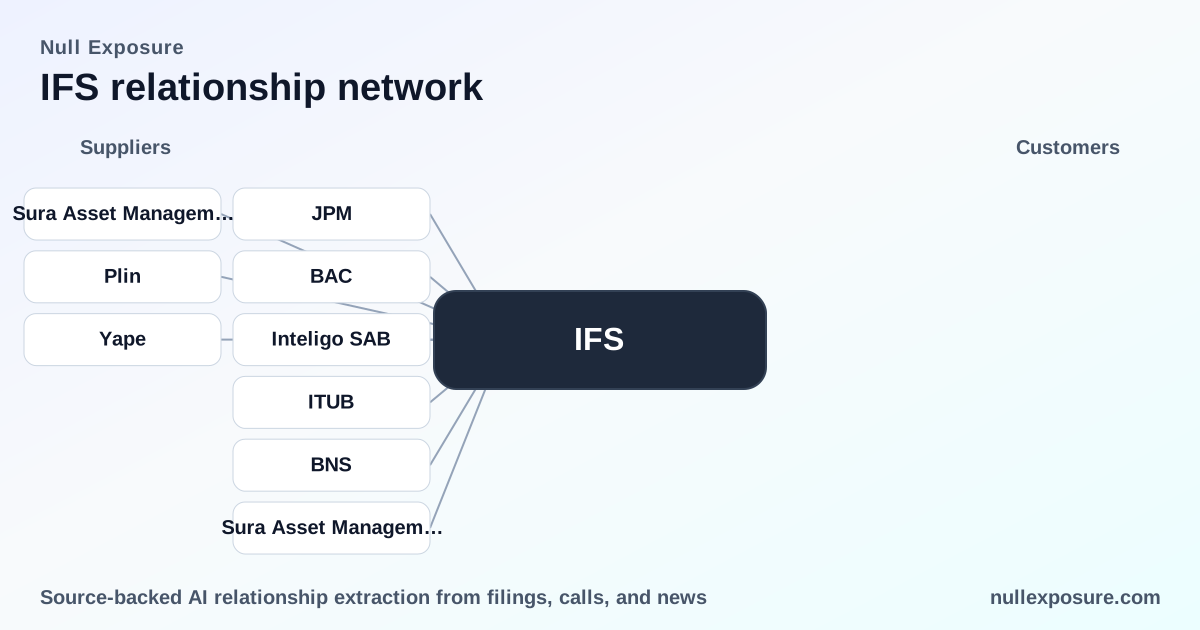
Intercorp Financial Services (IFS): Supplier relationships that shape a Peruvian financial champion
Intercorp Financial Services (IFS) is a Lima‑based financial holding company that monetizes through a mix of retail and commercial banking, insurance underwriting, and wealth-management fees, supported by a growing payments franchise. The firm’s profitability profile — a reported 35.8% profit margin and a 17.5% ROE (TTM) — reflects both traditional net‑interest and non‑interest income streams, and an active strategy of acquiring adjacent businesses (payments, insurance) to capture fee growth and cross‑sell economics. For investors and operators, the critical question is how external partners (capital markets banks, payments platforms, insurance sellers) enable or constrain that strategy. Learn more at https://nullexposure.com/.
Why suppliers matter for IFS: a concise investor thesis
IFS’s operating model blends banking scale with strategic verticals: capital markets relationships enable access to international funding and M&A execution, while payments and insurtech partners drive retail volume and fee growth. High insider ownership (over 73% insider-held shares) signals concentrated control of strategic decisions and a willingness to use balance‑sheet and M&A levers aggressively; institutional ownership is modest (~25%), so minority governance pressures are limited. The available public records do not disclose detailed supplier contract terms, which is a company‑level signal about the limits of external transparency; this elevates the importance of visible counterparties and announced deals for assessing operational risk.
How IFS contracts, concentrates risk, and scales partners
- Contracting posture: IFS uses global banks for capital markets tasks and local/regionally focused firms to structure deals and operate payments. This combination is consistent with an issuer that sources international distribution while relying on domestic specialists for market execution.
- Concentration and control: Insider majority ownership introduces execution continuity but concentrates strategic risk; external counterparties therefore execute under a predictable sponsor but with limited market governance pressure.
- Criticality and maturity: Relationships span life‑cycle needs — underwriting/IPOs, deal structuring, payments flows and acquisitions — reflecting a mature franchise executing repeatable partnerships rather than one‑off vendor arrangements.
- Disclosure gap: The public record provided here does not include explicit supplier contract terms; treat announced roles and M&A headlines as primary signals of commercial reliance.
Explore IFS relationship intelligence and supplier risk services at https://nullexposure.com/.
The partner roster — who matters and what they do
J.P. Morgan
A Gestion report covering IFS’s New York listing notes that J.P. Morgan acted as a Global Coordinator and joint bookrunner on IFS’s public offering, a role that provided underwriting muscle and international distribution for the IPO (Gestion, FY2019: https://gestion.pe/economia/mercados/intercorp-empezo-cotizar-bolsa-nueva-york-273671-noticia/).
BofA Merrill Lynch
The same Gestion coverage records BofA Merrill Lynch as a Global Coordinator and joint bookrunner, supplying underwriting and placement services for IFS’s U.S. listing and thereby facilitating access to U.S. dollar investors (Gestion, FY2019: https://gestion.pe/economia/mercados/intercorp-empezo-cotizar-bolsa-nueva-york-273671-noticia/).
Itaú BBA
Itaú BBA was named among the joint bookrunners alongside the global banks, giving IFS regional distribution capacity in Latin America and contributing to syndication depth for the listing (Gestion, FY2019: https://gestion.pe/economia/mercados/intercorp-empezo-cotizar-bolsa-nueva-york-273671-noticia/).
Inteligo SAB
Local specialist Inteligo SAB acted as the Structuring Agent on the IPO, providing deal structuring and local market advisory services that complemented the global coordinators’ distribution work (Gestion, FY2019: https://gestion.pe/economia/mercados/intercorp-empezo-cotizar-bolsa-nueva-york-273671-noticia/).
Scotiabank
IFS completed an acquisition in April 2022 where it bought Scotiabank’s 100% stake in Procesos de Medios de Pago S.A. (PMP), the operator of Izipay, consolidating IFS’s position in payments and removing a competitor stake (La República, April 2022: https://larepublica.pe/economia/2022/04/18/intercorp-adquirio-el-100-de-las-acciones-de-scotiabank-en-izipay).
Sura Asset Management Perú S.A.
In a separate strategic move, IFS executed an acquisition that involved Sura Asset Management Perú S.A. as a counterparty in the purchase of Interseguro, reflecting IFS’s focus on owning insurance distribution and underwriting capabilities (Gestion, FY2017: https://gestion.pe/economia/empresas/intercorp-compra-100-seguros-sura-e-hipotecaria-sura-us-268-mlls-136250-noticia/).
Sura Asset Management S.A.
The 2017 transaction documentation also lists Sura Asset Management S.A. among the sellers in the Interseguro deal, indicating the group‑level disposition of insurance assets into IFS’s insurance platform (Gestion, FY2017: https://gestion.pe/economia/empresas/intercorp-compra-100-seguros-sura-e-hipotecaria-sura-us-268-mlls-136250-noticia/).
Plin
Company commentary transcribed from IFS’s Q4 2025 earnings highlights that Plin’s transaction flow grew 35% and Interbank captures roughly 40% of that volume, signaling Plin is an important source of retail payments volume for IFS’s banking franchise (Earnings call transcript, Q4 2025: https://www.insidermonkey.com/blog/intercorp-financial-services-inc-nyseifs-q4-2025-earnings-call-transcript-1695307/).
Yape
IFS management confirmed in the same earnings call that Yape and Interbank are collaborating to capture joint payments opportunities, underlining an ecosystem approach where mobile payment platforms amplify deposit and fee generation (Earnings call transcript, Q4 2025: https://www.insidermonkey.com/blog/intercorp-financial-services-inc-nyseifs-q4-2025-earnings-call-transcript-1695307/).
What these relationships imply for investors and operators
- Capital markets access is institutionalized. Global banks (J.P. Morgan, BofA, Itaú) gave IFS international market access at listing — a structural advantage for future cross‑border capital transactions. That underwriting network reduces financing frictions for major corporate actions.
- Vertical integration of payments and insurance is explicit. Acquisitions from Scotiabank and Sura show a deliberate tilt toward owning fee‑rich adjacent businesses, strengthening cross‑sell and customer lifetime value.
- Retail payments partnerships drive volume growth. Expanding flows from Plin and collaborative activity with Yape are direct levers for fee and deposit expansion, important given IFS’s retail focus.
- Control concentration accelerates execution but heightens sponsor risk. With insiders holding a large majority, strategic moves will execute with speed; investors should price governance concentration into risk premia.
- Disclosure limitations raise due‑diligence requirements. The public record here lists announced roles and transactions but does not include supplier contract terms, so counterparties’ commercial leverage and termination risk are less visible.
If you need a supplier risk brief tailored to a portfolio position in IFS, commission a targeted review at https://nullexposure.com/.
Bottom line: a supplier profile that fits a growth‑oriented bank
IFS combines structural capital‑markets relationships, targeted strategic acquisitions, and partnerships with payments platforms to drive fee diversification and retail scale. The company’s supplier mix is intentional: global banks for capital access, local specialists for structuring, and payments partners to capture retail flows. For investors and operators, monitoring announced counterparties, integration outcomes (Izipay, Interseguro), and the trajectory of Plin/Yape volumes provides the clearest near‑term signal of business model execution and supplier risk.