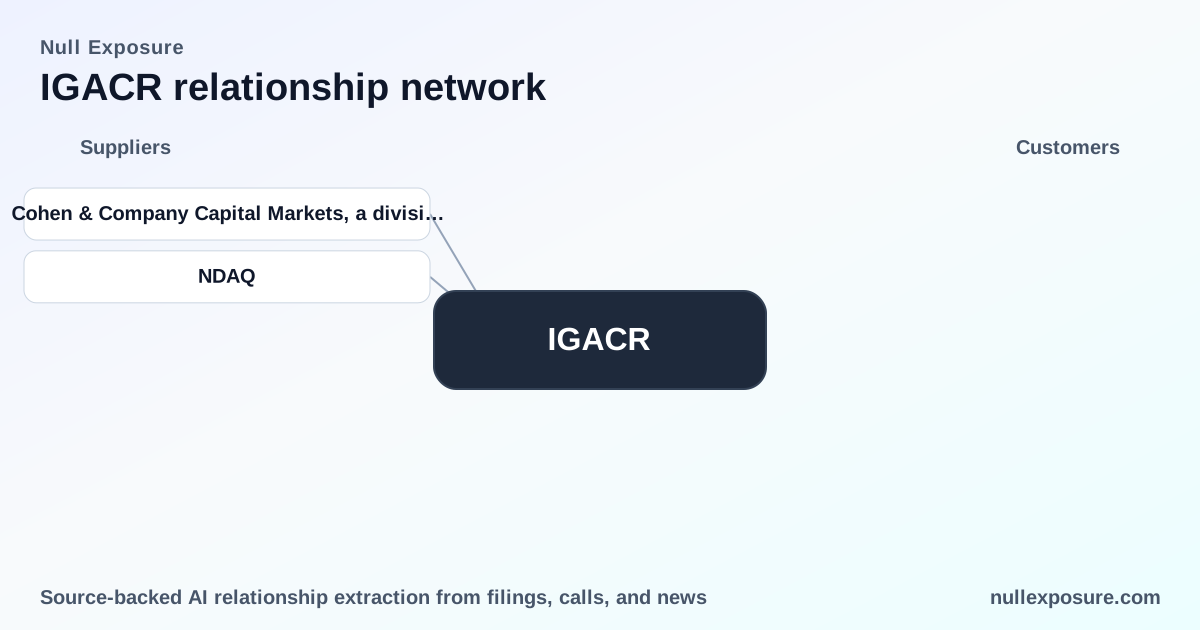
Invest Green Acquisition Corporation Rights (IGACR): Supplier Relationship Briefing
Invest Green Acquisition Corporation Rights (IGACR) is a SPAC instrument tied to a sponsor-managed vehicle that seeks target companies in green technology and sustainability; value is captured through capital raised at IPO, sponsor economics on a successful business combination, and secondary-market trading of units, shares and rights/warrants. IGACR itself carries no operating revenue and is a financial instrument whose value is dependent on deal execution, listing mechanics, and counterparty arrangements such as underwriters and exchanges. For a concise view of supplier exposures and how they affect capital providers, visit https://nullexposure.com/.
How this SPAC structure creates cash flows and operational dependencies
Invest Green is structured like a typical SPAC: it raises capital from public investors at IPO via units that include common shares and rights or warrants, retains sponsor control until a merger partner is identified, and monetizes when the business combination is consummated or when the market re-prices the rights and warrants. Monetization for rights holders is fundamentally speculative and event-driven—the instrument’s value is a function of (a) the sponsor’s ability to source a viable target, (b) shareholder vote and redemptions, (c) listing and trading liquidity, and (d) the legal and underwriting framework that supported the IPO.
From an operational standpoint, several company-level characteristics matter for investors evaluating counterparty risk:
- Contracting posture: Sponsor-led, time-limited (typical SPAC life cycles impose a deadline to complete a transaction), so counterparties operate under compressed timelines and standardized contractual terms.
- Concentration: Counterparty concentration is high by design; key relationships are typically a small number of underwriters and the listing exchange, which control critical go-to-market and liquidity functions.
- Criticality: Relationships with the lead book-running manager and the listing market are critical — their performance directly influences distribution, market access, and secondary-market liquidity.
- Maturity: The vehicle is immature from an operational revenue perspective; it is a pre-deal financial sponsor vehicle, so traditional operating metrics are not applicable.
Supplier relationships on record (what’s on file)
This section covers every supplier relationship captured in the available disclosures.
Cohen & Company Capital Markets, a division of Cohen & Company Securities, LLC
Cohen & Company Capital Markets is listed as acting as lead book-running manager for Invest Green’s offering, indicating they oversaw syndication and pricing of the IPO units, which is central to primary market distribution and initial capital formation. This positioning makes them a primary underwriter and a critical execution partner for the company’s public offering efforts, as reported in Invest Green’s press release distributed through Yahoo Finance on March 10, 2026.
Source: Invest Green press release on Yahoo Finance (March 10, 2026) noting Cohen & Company Capital Markets as lead book-running manager.
Nasdaq Global Market
The units were scheduled for listing on the Nasdaq Global Market under the ticker “IGACU” beginning November 25, 2025, which confirms the exchange venue responsible for primary listing and ongoing market access for investors in the units and related securities. The choice of Nasdaq as the listing venue defines trading liquidity pathways, compliance obligations, and market visibility, as stated in the same company announcement distributed via Yahoo Finance on March 10, 2026.
Source: Invest Green press release on Yahoo Finance (March 10, 2026) confirming Nasdaq Global Market listing plans for IGACU beginning November 25, 2025.
What these relationships imply for investor risk and operational control
The disclosed supplier roster is short and functionally concentrated. A single lead underwriter and a single listing exchange represent the most material supplier relationships for IGACR. For investors and operators, that concentration creates a few clear implications:
- Execution risk is concentrated. If the underwriter fails to syndicate successfully or the listing process encounters regulatory or operational friction, primary capital formation and secondary liquidity can be impaired.
- Liquidity and price discovery depend on Nasdaq’s market structure and the underwriter’s syndicate. Market-making behavior, listing designation, and post-listing compliance are critical levers for value realization.
- No operating revenue cushions counterparty failure. As a pre-deal SPAC with zero reported revenue or operating metrics, any disruption in these supplier relationships reduces the instrument’s intrinsic support and amplifies downside.
Bold takeaway: Investors in IGACR are exposed primarily to execution and market-access risk driven by a concentrated set of financial suppliers rather than counterparty operational performance.
For deeper supplier-risk modeling and exposure mapping, see more at https://nullexposure.com/.
Company-level constraints and signals
The available records include no explicit contractual constraints or supplier-imposed covenants in the public disclosures provided. That absence is itself a signal: there are no identified supplier constraints documented in the examined disclosures, which aligns with the SPAC model where large, bespoke supplier covenants are uncommon prior to a business combination. This lack of supplier-level constraints should be read alongside the high counterparty concentration: absence of visible constraints does not reduce the criticality of the underwriter and exchange relationships.
Practical guidance for investors and operating partners
- Prioritize monitoring of underwriter syndication and lock-up details, as these determine immediate post-IPO liquidity.
- Track listing compliance events and Nasdaq disclosures for any adverse notices or added obligations that could affect tradability.
- Treat IGACR as a short-duration, event-driven exposure rather than a conventional equity investment; position sizing and exit planning must reflect binary outcomes tied to deal announcement and execution.
If you are structuring exposure or advising stakeholders on SPAC-linked instruments, perform counterparty stress tests on the underwriter’s syndicate and liquidity scenarios on Nasdaq to quantify execution risk.
Ready to map counterparty exposures across SPACs and financial instruments? Start with a tailored supplier-risk assessment at https://nullexposure.com/.
Final assessment
IGACR is a classic SPAC rights instrument: value is tied to sponsor execution and two principal supplier relationships—the lead underwriter and the Nasdaq listing venue. The publicly noted relationships are concise and concentrated, with Cohen & Company Capital Markets driving distribution and Nasdaq supplying market access, as disclosed in Invest Green’s March 10, 2026 announcement. Given zero operating revenues and the pre-deal status, investors must underwrite execution risk and market liquidity rather than operating performance. For ongoing monitoring and supplier-centric risk insight, visit https://nullexposure.com/.