IGC supplier intelligence: what recent clinical-site and research relationships reveal for investors
India Globalization Capital (IGC) today functions as a clinical-stage pharmaceutical company operating through targeted trial partnerships and external research coverage to advance IGC‑AD1, an AI-assisted Alzheimer’s program; the company monetizes progress largely through equity value appreciation, potential licensing or partnerships, and eventual product commercialization rather than material product revenue today. IGC’s economics are driven by R&D milestones and the successful execution of outsourced clinical trials, with modest current revenue (TTM revenue ~$1.1M) and negative operating results, making supplier and investigator relationships central to near-term valuation and risk. Read more about supplier intelligence and relationship impact at https://nullexposure.com/.
IGC’s recent public communications show the company aggressively expanding its Phase 2 CALMA trial by adding clinical sites and leaning on a combination of networked site operators, research-support providers and sell‑side coverage to manage trial execution and investor expectations. The following analysis translates those relationships into investor-relevant signals: contracting posture, concentration, criticality, and operational maturity.
Why supplier relationships matter for a clinical-stage equity
Clinical-stage biotechs are not between R&D and revenue — they live through their suppliers. Trial sites, hybrid visit providers, contract manufacturers and investor relations desks directly control enrollment, data quality, timelines and market perception, which are the levers that move equity value for pre-commercial companies like IGC.
- Contracting posture: IGC uses project-based, site-level engagements rather than integrated clinical infrastructure. Public disclosures highlight additions of third‑party clinical sites and a vendor for hybrid visits, consistent with a variable-cost, outsourced model.
- Concentration and diversification: The company is adding several geographically distributed sites (U.S. and Colombia), suggesting deliberate diversification of enrollment risk, but trial outcomes still depend on a small set of high-impact sites and external manufacturing partners referenced in filings.
- Criticality and maturity: Clinical operations and third‑party manufacturing are mission-critical today; IGC’s financials (negative EBITDA, limited revenue) show no internal commercial cushion, so supplier failures translate immediately into timeline and financing risk.
- Commercial signal: Equity research coverage and investor-facing events are being used to manage expectations while trials progress, signaling active market engagement to support liquidity and valuation.
Explore deeper supplier mappings and signals at https://nullexposure.com/ for investment diligence.
The relationship roll call — what each partner does and why it matters
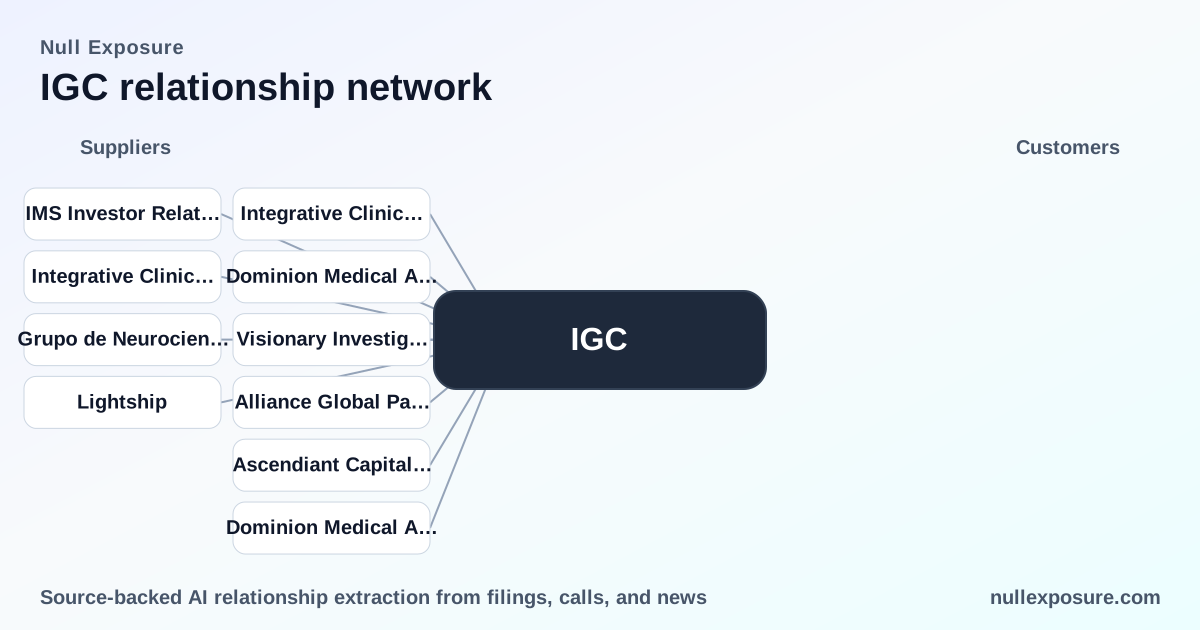
Below are every supplier- and partner-related entity surfaced in IGC’s recent public notices, with a concise investor-oriented summary and source.
-
Integrative Clinical Trials, LLC — IGC added Integrative Clinical Trials in Brooklyn as a Phase 2 CALMA clinical site to expand enrollment for IGC‑AD1 (announced Mar 10, 2026). This represents localized site capacity in New York to accelerate patient recruitment (source: DigitalJournal press release, 2026-03-10: https://www.digitaljournal.com/pr/news/access-newswire/igc-pharma-expands-phase-2-173631638.html).
-
Dominion Medical Associates, Inc. / Dominion Medical Associates — IGC announced a new clinical site at Dominion Medical Associates in Richmond, VA, which partners with the Lightship network to support hybrid/remote visits; this adds capacity and remote-visit capability to the CALMA trial (source: Yahoo Finance press release, 2026-03-10: https://finance.yahoo.com/news/igc-pharma-expands-phase-2-140000905.html).
-
Visionary Investigators Network — Listed as another clinical-site addition to the Phase 2 CALMA trial, Visionary Investigators Network increases multi-site enrollment footprint and supports the company’s 65-patient milestone reporting (source: Finviz news summary, March 2026: https://finviz.com/news/249416/igc-pharma-reports-65-patient-enrollment-milestone-in-phase-2-calma-alzheimers-agitation-trial).
-
Grupo de Neurociencias de Antioquia (GNA) — IGC expanded CALMA into Colombia through GNA, indicating international site diversification and the company’s effort to broaden recruitment channels beyond the U.S. (source: BioSpace press release, 2026-03-10: https://www.biospace.com/press-releases/igc-pharma-expands-phase-2-calma-trial-into-colombias-premier-alzheimers-research-center).
-
Lightship — Lightship supplies hybrid and virtual visit infrastructure and trained mobile research nurses for sites such as Dominion Medical Associates, enabling decentralized components of the CALMA trial and potentially improving retention and data collection efficiency (source: Yahoo Finance press release, 2026-03-10: https://finance.yahoo.com/news/igc-pharma-expands-phase-2-140000905.html).
-
Alliance Global Partners — AGP published updated equity research coverage on IGC, providing sell‑side analysis and distribution that can influence liquidity and investor sentiment; this is part of IGC’s public investor-relations cadence (source: DigitalJournal press release, 2026-03-10: https://www.digitaljournal.com/pr/news/access-newswire/igc-pharma-announces-equity-research-1761899042.html).
-
Ascendiant Capital Markets — Ascendiant provided updated research coverage and hosted a fireside chat with IGC executives, which serves as a coordinated investor-engagement channel to manage expectations and disseminate trial updates (source: Finviz/press reports and local coverage, Feb–Mar 2026: https://finviz.com/news/308956/igc-pharma-to-participate-in-fireside-chat-with-ascendiant-capital-markets).
-
IMS Investor Relations — IMS is named as the investor relations contact for distribution of company announcements and analyst access, functioning as the primary corporate communications conduit for financial and operational updates (source: Finviz press summary, Mar 2026: https://finviz.com/news/268023/igc-pharma-aligns-fiscal-year-with-calendar-year-to-enhance-us-investor-transparency-and-comparability).
Each of these relationships feeds directly into trial execution, enrollment cadence, or market-facing communications—three short-term levers that determine IGC’s ability to hit R&D milestones and access capital.
Compact assessment: what investors should watch next
- Operational risk is concentrated in trial execution and third‑party manufacturing. Public constraint language explicitly notes reliance on third parties for trials and manufacture, which places outsized operational leverage on external suppliers (company filings and press material, FY2026 signals).
- Diversifying sites (U.S. + Colombia) reduces single-site enrollment risk but does not remove timeline sensitivity. Multiple new sites are positive for recruitment velocity but increase coordination complexity.
- Sell-side coverage and IR activity are being used to manage capital-market expectations. Frequent equity research updates and fireside chats indicate active investor outreach to sustain market interest while clinical readouts are pending.
If you are modeling downside scenarios, assume trial delays translate immediately to increased cash‑burn and potential dilution, because current revenue and profitability metrics show limited near-term commercial buffers.
Continue diligence and scenario planning with supplier-level intelligence at https://nullexposure.com/.
Suggested near-term KPIs tied to supplier performance
- Enrollment rate per site and cumulative enrollment versus target.
- Number of completed hybrid visits supported by Lightship (as a proxy for retention effectiveness).
- Public confirmations of manufacturing partners or CMO timelines (contractual criticality).
- Frequency and tone of sell-side updates and investor events, which impact the financing window.
Conclusion — how relationships inform valuation
For investors and operators, IGC’s value proposition is executional: clinical partnerships and research coverage are the levers that convert a pre-commercial pipeline into tradable milestones. The company’s reliance on third-party clinical sites and virtual-visit providers makes supplier diligence equally important to scientific and financial analysis. Track enrollment performance, manufacturing confirmations, and investor‑relations cadence as primary indicators of whether equity value will re-rate on clinical progress or re-price on financing risk.
For a focused supplier-risk map and ongoing relationship monitoring, visit https://nullexposure.com/ and review supplier intelligence aligned to your investment horizon.