International General Insurance Holdings (IGIC): Why ratings and counterparty signals matter for investors
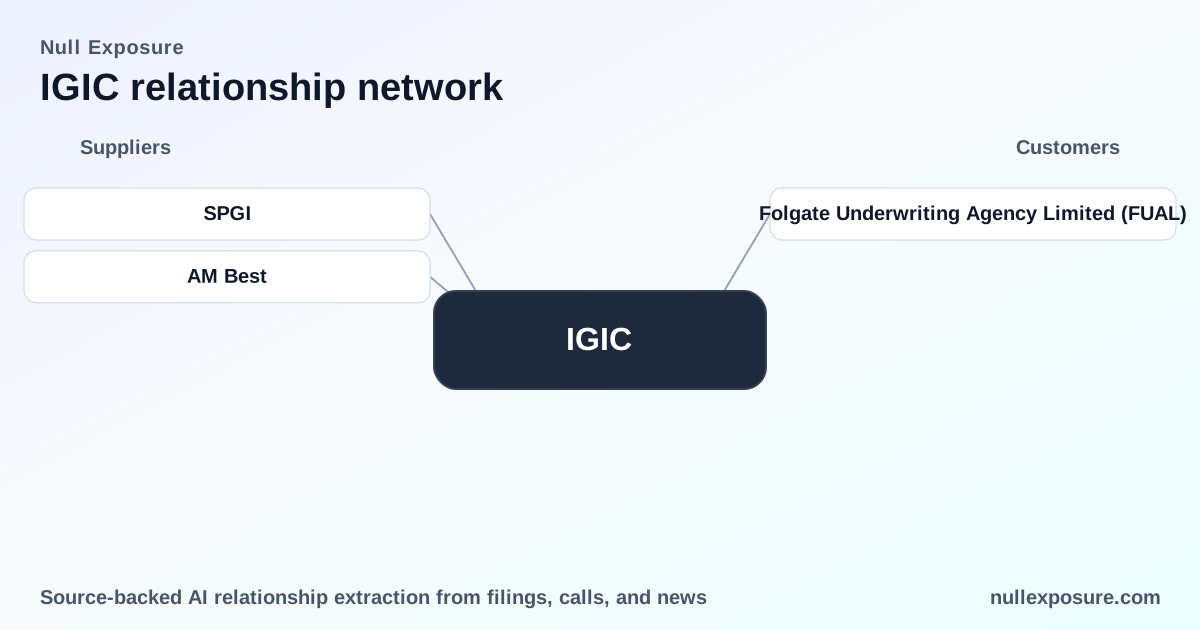
International General Insurance Holdings (IGI) is a specialty insurer and reinsurer that earns by underwriting niche commercial insurance risks, ceding and purchasing treaty reinsurance, and investing float. The company monetizes through premium margin and investment income while using reinsurance to manage capital volatility; on a trailing twelve‑month basis IGI reports $516.9M in revenue, an ROE of 18.6%, and a market capitalization near $1.04B, all consistent with a capital‑efficient specialty insurer. For investors and operators assessing supplier and counterparty exposure, the most material external relationships reported in public sources are IGI’s credit‑rating linkages to S&P Global Ratings and AM Best — both of which directly affect capital access, reinsurance pricing, and cost of capital.
Read more detailed supplier profiles and relationship mapping at https://nullexposure.com/.
Why ratings and supplier mentions are investment‑relevant
Ratings are not cosmetic for an insurer: an insurer’s external credit ratings drive reinsurance counterparties’ acceptance, large account placements, and capital treatment for ceded business. For IGI, the publicly reported ratings are part of the operating infrastructure — they influence treaty attachment levels, retrocession terms, and how brokers position the company with large clients. When rating agencies publish upgrades, downgrades, or affirmations, underwriters and portfolio managers reprice risk; when agencies are stable or favorable, IGI can expand underwriting capacity while keeping capital costs controlled.
Public relationship signals found in news coverage
The supplier‑scope results returned three news items that consistently reference IGI’s external ratings. Below are the relationships surfaced and what they mean for investors.
S&P Global Ratings — short plain English take
IGI is rated “A‑” (Strong)/Stable by S&P Global Ratings, a rating that supports the company’s access to reinsurance markets and signals strong capitalization relative to specialty peers. This relationship has been cited in multiple media items, including Reinsurance News (reporting IGI’s improved core operating results and noting the S&P upgrade language) and regional business coverage (Royal Gazette and CityBiz) that repeat the S&P rating reference. (See ReinsuranceNews: https://www.reinsurancene.ws/igi-posts-improved-q325-cor-amid-lower-large-loss-activity/; Royal Gazette: https://www.royalgazette.com/local-business/business/article/20250709/igi-to-report-half-year-results-on-august-5/; CityBiz: https://www.citybiz.co/article/763725/igi-appoints-malcolm-barnes-as-head-of-specialty-treaty/.)
AM Best — short plain English take
AM Best assigns IGI an “A” (Excellent)/Stable rating, a complementary endorsement that reinforces capacity for treaty placements and reassures counterparties on balance‑sheet strength. Regional reporting and trade coverage cite the AM Best grade prominently when discussing IGI’s financials and leadership changes, underlining the rating’s role in market positioning. (See Royal Gazette: https://www.royalgazette.com/local-business/business/article/20250709/igi-to-report-half-year-results-on-august-5/; CityBiz: https://www.citybiz.co/article/763725/igi-appoints-malcolm-barnes-as-head-of-specialty-treaty/.)
No supplier‑level contractual constraints were returned — company‑level signals instead
The reviewed results include no explicit supplier constraints or contractual caveats indexed against IGI. That absence is itself a signal: there is no public supplier filing or constraint excerpt in the reviewed sources specifying limits or termination exposures tied to particular counterparties. As a result, investors should evaluate a set of company‑level operating characteristics that govern supplier dynamics:
- Contracting posture: IGI operates with bilateral treaty and facultative reinsurance agreements typical of specialty insurers; contracting tends to be relationship‑driven and renews on an annual or multi‑year basis depending on lines and loss experience.
- Concentration: IGI underwrites a diversified global portfolio of specialty risks, but the specialty focus introduces underwriting concentration by line and geography that channels which suppliers and reinsurers are critical during loss events.
- Criticality: External ratings and reinsurance partners are highly critical to IGI’s capital efficiency — downgrades or disruptions to reinsurance access would force capital or pricing adjustments quickly.
- Maturity: Public ratings from AM Best (“A”) and S&P (“A‑”) indicate a mature underwriting platform with established governance, which reduces counterparty replacement risk relative to smaller, unrated specialty insurers.
These company‑level signals should be incorporated into scenario analysis when modeling counterparty stress, reinsurance renewal shocks, or cost‑of‑capital re‑rating.
Explore supplier risk dashboards and deeper relationship analysis at https://nullexposure.com/.
Investment implications — what investors should price in
IGI’s publicly cited ratings profile and operating statistics generate a clear investment checklist:
- Positive earnings power: The company posts solid margins (operating margin ~26.7% and a profit margin ~24.6%) that underpin the current low forward P/E (~7.99) and support dividend policy (latest dividend per share $0.20).
- Rating‑sensitive runway: Maintaining AM Best and S&P outcomes is central to sustaining reinsurance capacity and pricing; any material rating drift would directly affect underwriting capacity and cost of reinsurance.
- Ownership and governance: Insider and institutional share ownership are both high (roughly 51% each), which concentrates control and reduces free‑float liquidity — a factor for investors looking to enter or exit large positions.
- Volatility limits: Beta is low (0.154) and loss‑event sensitivity should be modeled through catastrophe and large‑loss scenarios because specialty portfolios can see abrupt P&L swings even when average margins are attractive.
Key takeaways: ratings equal access and underwriting discipline drives return on equity; price in both when valuing forward earnings and stress testing capital adequacy.
What to watch next and recommended actions
- Monitor rating agency publications from S&P and AM Best for any commentary around capital adequacy, reserve development, or governance changes; these are trigger events for repricing risk.
- Track quarterly underwriting updates for changes in large‑loss activity and ceded reinsurance cost trends that will feed into rating agency views.
- Evaluate reinsurance counterparties and treaty structures in diligence sessions where possible, since the public signal set does not show explicit supplier constraints.
If you want structured supplier mapping or a tailored counterparty risk brief for IGI, request a profile at https://nullexposure.com/.
Final verdict for investors and operators
IGI is a capital‑efficient specialty insurer with strong public endorsements from two major rating agencies — a dual rating profile that enhances reinsurance access and supports underwriting scale. The public relationship signals are positive and stable today, but they are also the fulcrum of IGI’s operating model: ratings and treaty partner stability are the drivers of growth and the primary downside risk. For investors focused on insurance value chains, IGI’s combination of robust margin profiles, favorable ratings, and concentrated underwriting exposures presents an attractive risk‑return profile if rating stability is preserved.
For more supplier relationship intelligence and continuous monitoring, visit https://nullexposure.com/.