IGR-R-W: Rights issuance relationships that enable a capital raise — what investors need to know
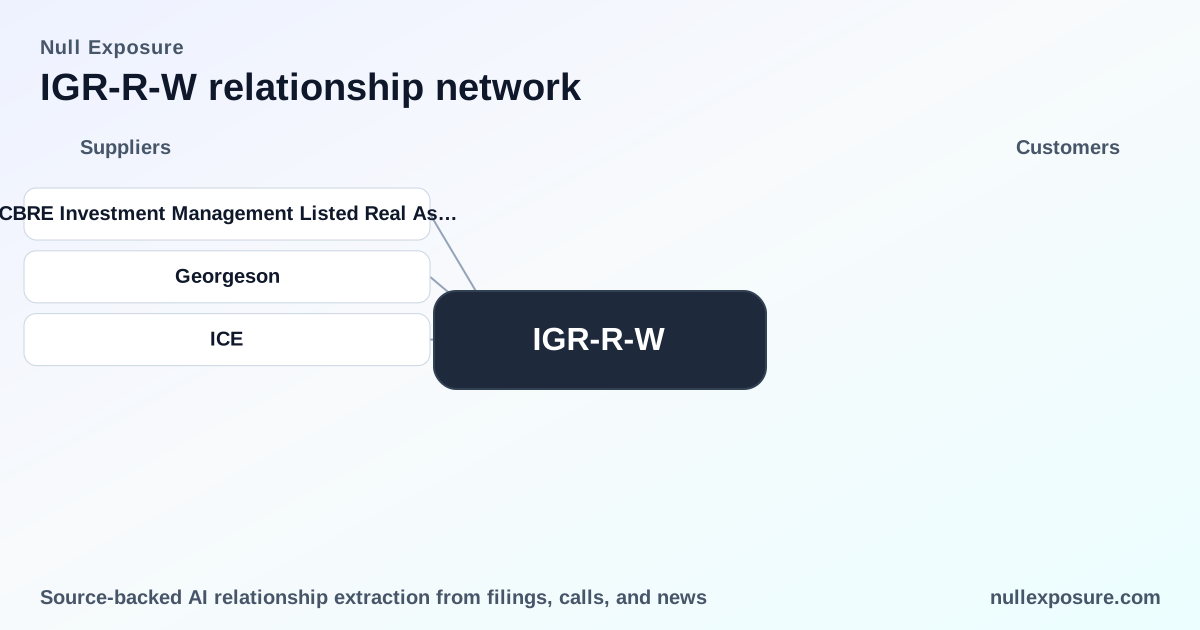
IGR-R-W represents traded rights tied to a CBRE-managed real estate income vehicle; the instrument exists to operationalize a rights offering that increases fund assets and, in turn, fee-bearing AUM for the manager. The economics are straightforward: the adviser executes a capital-raise through transferable rights, third-party agents handle investor communications and logistics, and the NYSE provides a trading venue that preserves liquidity for those rights. For investors and counterparties evaluating supplier exposures, the relationship map is short, transaction-focused, and concentrated on a small set of service providers that deliver distinct operational capabilities.
Explore how these supplier relationships affect execution risk and counterparty exposure at https://nullexposure.com/.
How this rights offering structure drives value and where the cash flows come from
A rights offering is a capital-raising mechanism that converts potential investor demand into immediate subscription proceeds for the fund. The adviser (CBRE Investment Management Listed Real Assets LLC) drives the strategic decision and controls placement mechanics, which directly influence the amount of fee-bearing assets under management if the raising succeeds. The value chain is linear and purpose-built: adviser sets the terms and rationale; an information agent distributes the prospectus and materials; an exchange lists the rights to enable transferability.
- Contracting posture: Short-term, event-driven agreements are typical here — the adviser and service providers contract for the offering lifecycle rather than long-duration operational supply.
- Concentration and criticality: Concentration is high in functional terms (a few named providers perform essential roles), but each role is narrowly scoped and replaceable across subsequent offerings; nonetheless, the adviser is the critical gatekeeper of strategy and execution.
- Maturity: These relationships are transactional and often immature in longevity; the criticality stems from timing and compliance rather than long-term dependency.
- Commercial implication: Successful execution expands AUM and fee revenue; failed execution reduces growth prospects and can depress secondary-market liquidity for rights.
If you are mapping counterparty exposure for portfolio underwriting or operational due diligence, this profile signals focused counterparties and transactional risk that can be managed through contractual SLAs and reputational vetting. Learn more at https://nullexposure.com/.
Supplier relationships and what they do — the complete roll call
Below are the supplier relationships disclosed in the rights-offering announcement and what each party concretely provided.
CBRE Investment Management Listed Real Assets LLC
CBRE Investment Management Listed Real Assets LLC is identified as the Fund’s investment adviser and the decision-maker behind the rights offering, deciding it would be in shareholders’ interest to increase assets to pursue global real estate opportunities consistent with the Fund’s income and appreciation objectives. According to a February 27, 2023 Business Wire release reposted on FinancialContent, the adviser framed the offering as a strategic move to position the fund for additional investments (FY2023).
Georgeson
Georgeson served as the Information Agent for the offering, handling investor inquiries and distribution of the prospectus supplement; investors were directed to Georgeson for copies of offering materials and further instructions. This role is documented in the same February 2023 press release (FY2023).
NYSE
The rights were designated to be transferable and listed on the New York Stock Exchange under the symbol “IGR RT,” creating secondary-market access for rights holders and facilitating liquidity around the subscription exercise window. This listing detail is stated in the February 27, 2023 Business Wire announcement (FY2023).
Operational and credit implications for counterparties and operators
The relationship map above yields several practical implications for investors and operators evaluating IGR-R-W exposures:
- Execution concentrates around a few specialized providers. The adviser, an information agent, and an exchange perform discrete, non-overlapping functions; operational failure in any leg — e.g., late prospectus distribution or listing timing issues — will impair the offering’s economics.
- Counterparty credit risk is concentrated but timebox-limited. These are not long-duration supplier contracts; financial exposure is front-loaded around the offering window. That profile reduces long-term supplier credit drag but increases short-term operational concentration risk.
- Liquidity and secondary-market mechanics are material to investor outcomes. Listing the rights on the NYSE under “IGR RT” enabled tradeability, which affects how investors price short-window subscription decisions and the fund’s capacity to convert rights into subscribed capital.
- No supplier constraints were disclosed in the source materials. The absence of explicit contractual constraints or restrictive covenants in the announcement is a company-level signal: expect conventional, market-standard contracting terms for event-driven services rather than bespoke long-term supply agreements.
Key takeaways:
- Adviser-led capital strategy is decisive for outcome and fee scalability.
- Execution risk is concentrated but finite — manage through operational due diligence on the adviser and agents.
- Market liquidity (NY exchange listing) materially affects investor exit and subscription economics.
Practical guidance for investors and operators
- For credit or counterparty risk workstreams, prioritize operational readiness and compliance capacity of the adviser and information agent during the offering window.
- For market risk assessment, treat the NYSE listing as a liquidity backstop but stress-test scenarios where trading is thin or rights trade at discounts.
- Negotiate clear performance and delivery clauses into agent contracts in future offerings to reduce timing and disclosure risk.
If you want a structured supplier-risk profile and exposure map for this issuance or others, start here: https://nullexposure.com/.
Bottom line
IGR-R-W’s supplier network is concise and purpose-built for a single corporate action: a rights offering driven by the fund’s adviser, supported by an information agent, and made tradable via the NYSE listing. That structure creates concentrated, short-term operational risk but aligns incentives — successful execution expands AUM and fee income for the adviser. For investors and operators, the focus should be on verifying the adviser’s execution playbook and confirming the information agent’s distribution capacity and the exchange’s listing mechanics before underwriting or onboarding exposure.
For a detailed supplier-exposure assessment or tailored due diligence templates, visit https://nullexposure.com/.