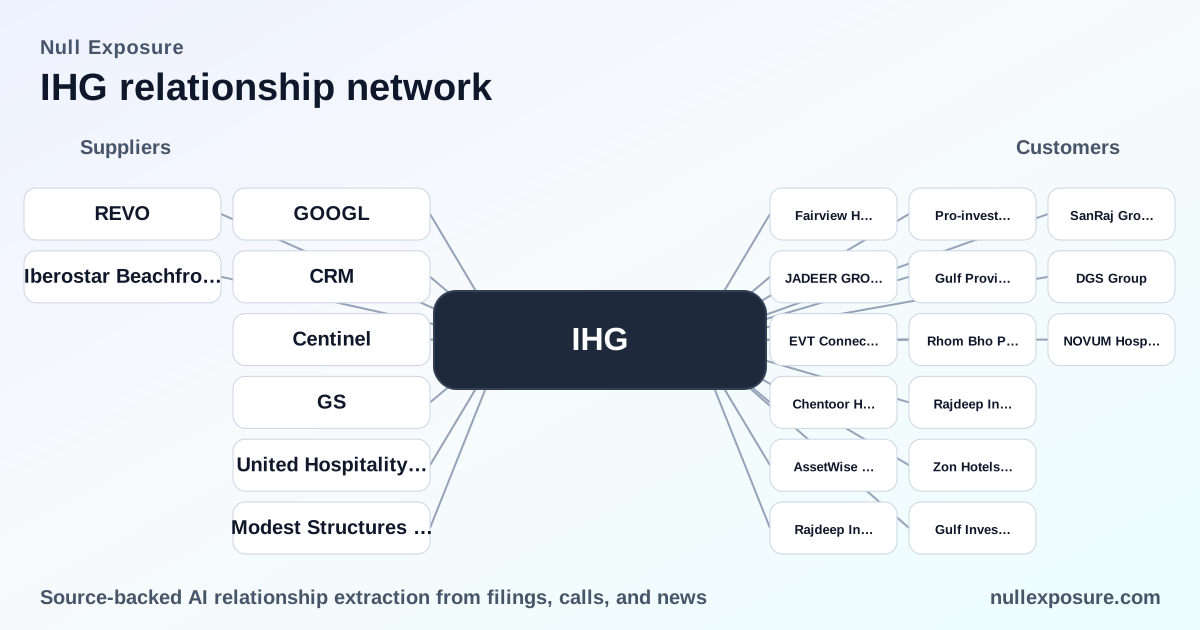
IHG supplier relationships: who drives distribution, loyalty and operations
InterContinental Hotels Group (IHG) monetizes a global lodging platform through a low-capex franchising and management model supplemented by selectively owned and leased assets. Revenue flows from franchise and management fees, branded room revenue on owned assets, and loyalty-driven ancillary spend, while strategic technology and financial partnerships amplify distribution and customer lifetime value. For investors evaluating supplier risk, the current supplier map shows a deliberate mix of global technology partners, regional management and development contractors, and financial intermediaries that support capital actions and loyalty monetization.
Explore supplier risk and concentration analysis at https://nullexposure.com/ for a structured issuer view.
How IHG runs its business and why suppliers matter
IHG’s operating model is asset-light at scale: the company expands primarily through franchises and third-party management contracts rather than wholesale property ownership. That contracting posture produces high-margin, recurring fee revenue but also creates operational dependence on two supplier classes: (1) brand managers and owners who deliver on-the-ground hotel operations and (2) technology and distribution partners that control customer acquisition and loyalty engagement. Contracts are typically long-term and relationship-oriented, supporting revenue stability while transferring much of CapEx and construction risk to partners. Financial counterparties support capital management and repurchase execution rather than core hotel operations.
Key business drivers: global brand scale, loyalty program penetration, distribution economics with digital partners, and selective capital deployment. These drivers make supplier selection strategic rather than transactional.
The partner list you need to know
Below I list every supplier/partner relationship surfaced in the source material, each with a concise investor-oriented read and the public source.
-
Google — IHG is working with Google on trip‑planning capabilities, linking the hotel platform more tightly into Google’s travel discovery flow; this is a distribution and demand-generation partnership that supports direct-booking economics. (InsiderMonkey Q4 2025 earnings call transcript, published Mar 10, 2026: https://www.insidermonkey.com/blog/intercontinental-hotels-group-plc-nyseihg-q4-2025-earnings-call-transcript-1698071/)
-
Salesforce — IHG will launch a new loyalty CRM powered by Salesforce in the referenced year, indicating a material upgrade in customer data, personalization, and loyalty monetization capabilities. (InsiderMonkey Q4 2025 earnings call transcript, Mar 10, 2026: https://www.insidermonkey.com/blog/intercontinental-hotels-group-plc-nyseihg-q4-2025-earnings-call-transcript-1698071/)
-
Centinel — IHG partners with Centinel as the owner/developer of the PAL program to modernize on‑post lodging across Army installations, reflecting specialized programmatic management and modernization activity in defense-adjacent lodging. (WebWire press release, Mar 2026: https://www.webwire.com/ViewPressRel.asp?aId=350442)
-
Goldman Sachs International (GSI) — Goldman Sachs executed share repurchases on behalf of IHG in February 2026, indicating GSI’s role as execution agent for capital allocation and buyback programs. (AccessNewswire, Feb 19, 2026 company announcement: https://www.accessnewswire.com/newsroom/en/travel/intercontinental-hotels-group-plc-announces-transaction-in-own-shares-february-19-1139164)
-
United Hospitality Management (UHM) — UHM is contracted to manage a 45‑key hotel developed by Modest Structures in India and the Middle East, illustrating IHG’s reliance on regional third‑party management firms to scale brand presence in growth markets. (HospitalityNet announcement, Mar 2026: https://www.hospitalitynet.org/announcement/41014061.html)
-
Modest Structures Private Limited — Modest Structures is the local developer for the same 45‑key hotel, showing IHG’s model of partnering with local developers for pipeline growth while delegating operations to trusted managers. (HospitalityNet announcement, Mar 2026: https://www.hospitalitynet.org/announcement/41014061.html)
-
Revolut — IHG launched a credit card collaboration with Revolut in the U.K., extending loyalty distribution and payment integration through a financial‑services partner to drive member acquisition and non‑room spend. (InsiderMonkey Q4 2025 earnings call transcript, Mar 10, 2026: https://www.insidermonkey.com/blog/intercontinental-hotels-group-plc-nyseihg-q4-2025-earnings-call-transcript-1698071/)
-
Iberostar Beachfront Resorts — Cited as an “exclusive partner” in a WebWire release, this relationship signals selective brand or distribution collaborations with other hospitality groups in certain markets or projects. (WebWire press release, Mar 2026: https://www.webwire.com/ViewPressRel.asp?aId=350342)
Constraints and operating-model signals investors should treat as company‑level
With no supplier-specific constraint excerpts in the record, extractable signals speak to IHG’s overall operating posture:
-
Contracting posture is long-term and relationship-driven. Franchise and management agreements govern the majority of revenue streams and reduce IHG’s capital intensity while increasing reliance on third‑party operator performance.
-
Concentration is diversified but functionally concentrated. IHG spreads development and management across many regional partners, yet distribution and loyalty depend disproportionately on a small number of global technology vendors and financial partners.
-
Criticality of tech and loyalty partners is high. CRM, distribution and payment/card partnerships control guest acquisition economics and loyalty value; failures or unfavorable terms with these suppliers would meaningfully affect booking margins.
-
Maturity is mixed. The core franchising model is mature and predictable; digital and loyalty initiatives (new CRM, Google trip planning, partner credit cards) are growth-stage investments intended to modernize booking funnels and increase direct revenue.
What this map means for investors: opportunities and risks
IHG’s supplier footprint shows intentional delegation of on-the-ground risk to developers and managers while concentrating strategic control over guest relationships through technology partners. That is a positive margin dynamic: franchise and management fees scale with brand reach, and improved CRM/distribution partnerships can expand direct bookings and reduce OTA fees.
Risks are concentrated and actionable:
- Execution risk on digital transformation. The Salesforce CRM rollout and Google trip-planning integration are high-impact — success elevates loyalty economics; failure would slow share-of-wallet gains. (InsiderMonkey transcript, Mar 2026)
- Operational dependency on regional managers and developers. Pipeline delivery and brand standards depend on partners like UHM and Modest Structures, which increases reputational and operational risk in growth markets. (HospitalityNet, Mar 2026)
- Capital-allocation signaling. Use of Goldman Sachs for buyback execution confirms active capital management; monitor buyback cadence against cash flow and capex needs. (AccessNewswire, Feb 2026)
Investor takeaway: IHG’s supplier relationships reinforce an asset-light growth model augmented by selective, high-leverage technology partnerships that are central to long-term margin expansion. Track the Salesforce CRM rollout, Google distribution integration, and card partnerships for leading indicators of loyalty monetization.
For a structured supplier risk score and ongoing monitoring, visit https://nullexposure.com/ to compare counterparty concentration and criticality across hotel operators.
Conclusion — what to watch next
Monitor three near-term datapoints: (1) CRM adoption metrics and loyalty spend uplift post‑Salesforce launch, (2) direct‑book share movement tied to Google trip‑planning integration, and (3) pace of regional pipeline openings managed by third‑party operators. These signals will determine whether IHG converts platform scale into higher margins rather than simply wider footprint. Learn more about supplier exposure analytics and tracking at https://nullexposure.com/.
Overall, the partner map is consistent with a high-margin franchising model that is being actively modernized around digital distribution and loyalty; the next 12 months of execution will determine whether these supplier choices translate into durable earnings leverage.