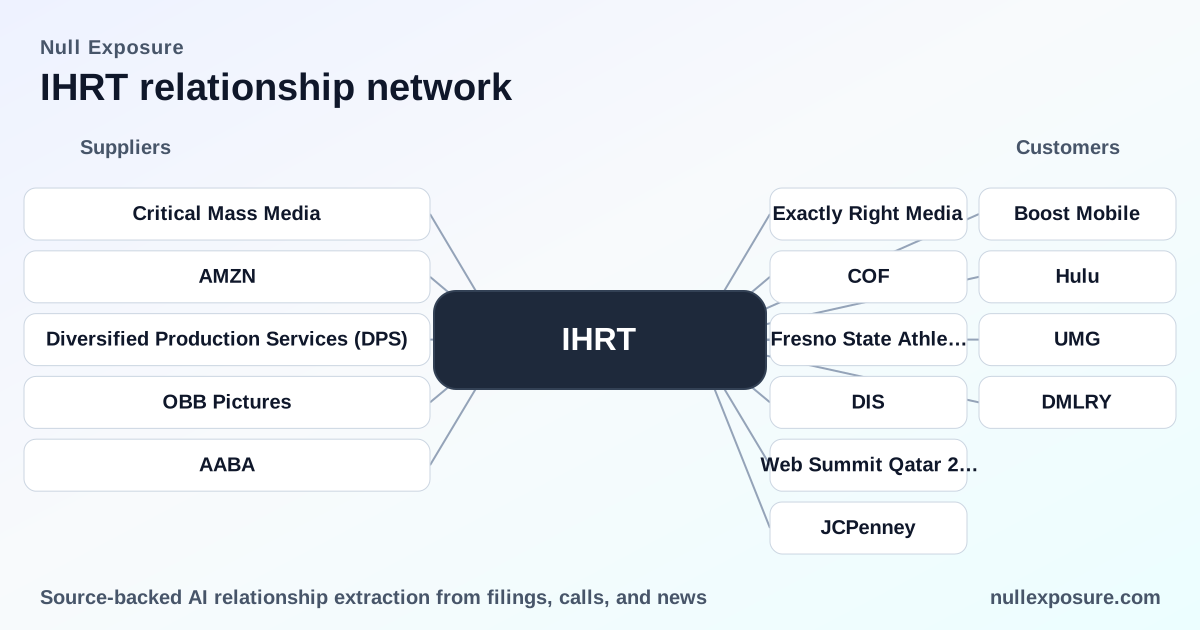
iHeartMedia (IHRT) — supplier map and what it means for investors
iHeartMedia operates as a diversified audio and entertainment platform that monetizes through advertising, events and content licensing across broadcast radio, streaming (iHeartRadio), and live experiences; suppliers range from production partners for marquee events to digital advertising platforms that distribute iHeart inventory. Revenue is ad-driven, content-dependent, and sensitive to royalties and distribution economics, so supplier arrangements that enable advertising reach, event production and licensed content are direct levers on margins and growth.
Explore deeper supplier intelligence and watchlists at https://nullexposure.com/.
Why suppliers matter to the iHeart investment thesis
iHeart’s cost base and top-line distribution are shaped by two supplier classes: content and rights providers (royalty and licensing exposure), and distribution/commerce partners (ad DSPs and event producers). Licensing and usage-based royalty structures translate audience growth into higher content costs, while DSP and production partnerships determine how effectively iHeart converts audience into advertising revenue and event profits. The company’s latest public metrics show $3.856B revenue and positive EBITDA, but negative net income and a leveraged financial profile, so supplier economics directly affect free cash flow and deleveraging trajectories.
For a wider view on supplier risk and concentration, visit https://nullexposure.com/.
What the public relationships tell investors
Below I cover every supplier relationship surfaced in public filings and news for IHRT, with plain-English takeaways and source context.
Critical Mass Media — research partner for consumer studies
iHeart fielded consumer research through Critical Mass Media that found large public concern about AI and a strong preference for content created by humans; this work supports iHeart’s positioning of human-led audio as a value proposition for advertisers and listeners. According to a MarketScreener press summary published March 10, 2026, the study underpins marketing claims around authenticity and audience trust (FY2025 / MarketScreener).
Amazon (AMZN) — DSP partnership for programmatic ad distribution
Management disclosed on the 2025 Q4 earnings call that iHeart maintains partnership agreements with Amazon DSP, which carries implications for programmatic demand and the ability to plug iHeart inventory into large-scale digital buyers. This is a strategic distribution relationship for advertising monetization (2025Q4 earnings call).
Diversified Production Services (DPS) — executive producer for live tour events
iHeartRadio’s Jingle Ball Tour is executive produced by Diversified Production Services, indicating iHeart outsources large-scale event production to specialized live-event vendors; this affects event economics and margin capture on touring and sponsorship revenue. The arrangement was described in a WebWire press release covering the Jingle Ball (FY2025 / WebWire).
OBB Pictures (OBB Media) — television production partner for broadcast specials
The iHeartRadio Jingle Ball special on ABC lists OBB Pictures as a producing partner, showing iHeart leverages third-party production expertise and rights-sharing when bringing audio brands to network TV. This relationship shapes syndicated content economics and cross-platform monetization (FY2025 / WebWire).
Yahoo! (AABA) — DSP inclusion for broadcast and digital inventory
iHeart told investors on the 2025 Q4 earnings call that Yahoo! DSP is among the demand-side platforms that include iHeart’s broadcast radio inventory, expanding programmatic buyer access to linear and digital audio audiences. That distribution helps diversify demand channels for ad inventory (2025Q4 earnings call).
Operational constraints that shape supplier risk and upside
iHeart’s public disclosures reveal structural constraints that govern supplier economics and contract posture:
-
Licensing posture: iHeart maintains public performance licenses with major PROs (ASCAP, BMI, SESAC, GMR), signifying recurring contracted royalty obligations that are non-discretionary and material to cost of goods sold. According to company filings, these licenses require ongoing fee payments and influence margin stability.
-
Usage-based cost exposure: Certain content costs, including digital music performance royalties, vary with listening hours on iHeart platforms, so audience growth increases content expense in step with revenue. This creates a variable-cost model for streaming but compresses gross margins if ad fill or price cannot keep pace.
-
Licensee obligations under statutory regimes: iHeart operates as a licensee for online performance rights and pays public performance royalties to entities like SoundExchange under statutory licenses, indicating operational reliance on compliance and statutory rate frameworks that can change with regulatory or legislative developments.
These are company-level signals extracted from iHeart disclosures and should be treated as structural characteristics of how iHeart contracts for and consumes content rights.
Strategic read: concentration, criticality and maturity
-
Concentration: iHeart’s supplier set spans many specialized vendors, but the most critical cost lines—performance licenses and royalties—are concentrated against the major PROs and statutory regimes; that concentration creates single-line exposure to royalty rate changes and litigation/regulatory outcomes.
-
Criticality: Relationships with DSPs like Amazon and Yahoo! are critical for ad monetization because they provide scale demand and programmatic yield management; losing or weakening those connections would immediately pressure revenue per hour of audience.
-
Maturity: Production partnerships for events and specials are mature outsourcing models—iHeart transfers execution risk to producers (DPS, OBB) but retains brand and sponsorship upside; this limits capital intensity while concentrating upside on sponsorship sales and ticketing.
Investment implications — what operators and investors should watch
-
Royalty visibility is the gating risk: Because music and performance royalties are licensed and usage-based, audience growth is necessary but not sufficient—monetization must outpace royalty cost growth to expand margins. Monitor filings and rate negotiations for PROs and SoundExchange.
-
Programmatic distribution is a strategic lever: Partnerships with Amazon DSP and Yahoo! increase yield diversification on ad inventory; advertisers’ continued migration to DSPs supports revenue resilience. Watch programmatic fill rates and CPM trends reported in quarterly disclosures.
-
Event and special production limits capex but reduce margin capture: Outsourcing to DPS and OBB reduces execution risk and upfront investment but means iHeart shares revenue with producers; evaluate sponsorship and ticket revenue growth to gauge profit capture from live initiatives.
Key takeaways:
- Licensing and usage-based royalties are an embedded cost that scales with audience.
- DSP relationships materially affect demand-side pricing and ad monetization.
- Outsourced production preserves capital but reduces per-event margin capture.
For supplier risk models and due-diligence checklists tailored to audio media, visit https://nullexposure.com/ for resources and comparative supplier maps.
Bottom line and next steps for relationships monitoring
iHeart’s supplier profile is a mix of non-discretionary licensing commitments and commercial distribution partnerships that together determine margin trajectory. Investors should prioritize monitoring royalty-rate developments, programmatic demand metrics tied to Amazon and Yahoo!, and revenue capture from outsourced live productions. For systematic supplier monitoring and alerts tied to IHRT relationships, start your exploration at https://nullexposure.com/.
In summary: iHeart’s path to stable profitability runs through advertising distribution quality and control over licensing costs—both driven by the supplier relationships mapped above.