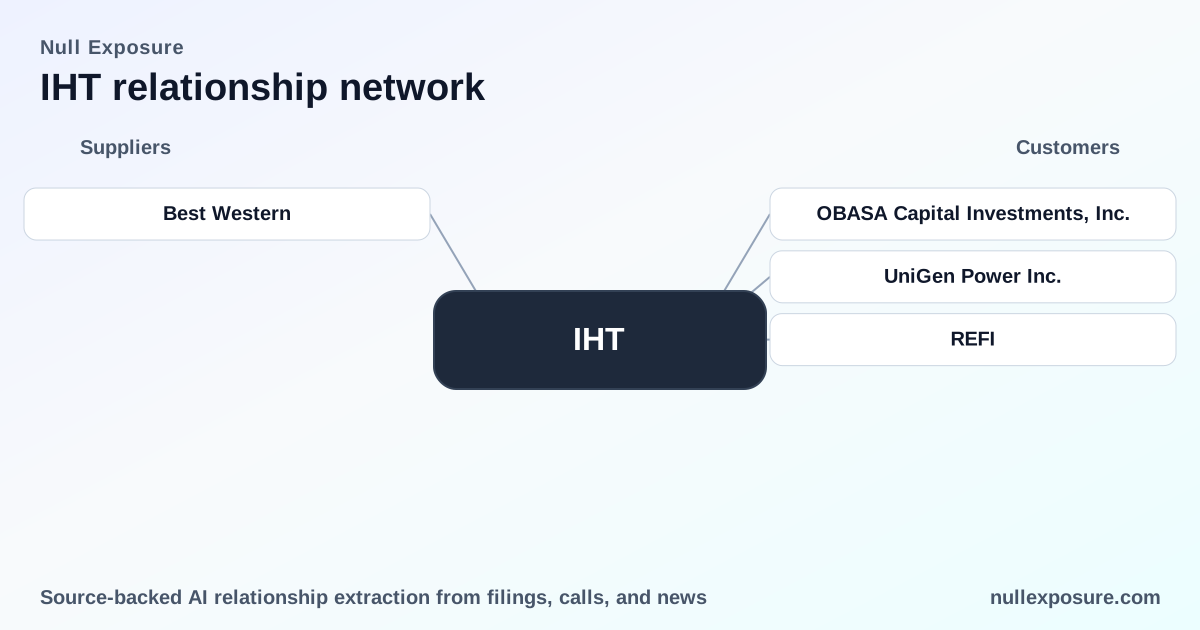
InnSuites Hospitality Trust (IHT): supplier exposure and brand dependencies investors should price in
InnSuites Hospitality Trust owns and operates a small portfolio of hotels that monetize through room revenues, ancillary services and franchise/membership arrangements with national brands; the company also relies on asset-level financing to fund property improvements and liquidity. Revenue flows are a mix of direct hotel cashflows and usage-based fees to brand partners, while capital structure is driven by long-dated mortgages at the property level and concentrated insider ownership.
Explore supplier intelligence and supplier risk profiles at https://nullexposure.com/ for a deeper view.
Why brands and contracts determine the economics here
InnSuites runs properties under its own federally trademarked InnSuites name and under third‑party brands such as Best Western, which gives the company distribution and reservation reach in exchange for fees. The business model combines three monetization levers: room revenues, brand/marketing/reservation fees that are usage-based, and asset-level financing that funds capital expenditure and refinance activity.
Operationally, that creates predictable revenue capture from rooms but variable cost pressure from usage-based franchise fees tied to reservations and monthly room revenues. On the capital side, the company exhibits long-term mortgage commitments that convert property-level investments into long-duration obligations, while the brand agreements themselves are structured for short-term renewal flexibility.
Key operating signals:
- Contracting posture: Brand membership agreements with Best Western are described as year‑to‑year and cancelable annually, signaling limited contractual lock‑in for the operator but ongoing tactical flexibility for both parties.
- Fee structure: Brand fees are usage-based, levied on reservations and monthly room revenues, linking marketing costs directly to occupancy and ADR performance.
- Capital maturity: A historical property-level loan (the Tucson Loan) carries a long maturity through June 19, 2042, indicating multi‑decade financing on specific assets rather than corporate-level long-term debt.
- Concentration and governance: Insiders own ~71% of the float while institutional ownership is low (
2.8%), a governance footprint investors must price alongside small market capitalization ($9.7M).
All supplier relationships documented in the public record
Below are every relationship instance found in the public results for IHT. Each entry is presented verbatim to ensure no omission.
Best Western — MarketScreener mention (March 10, 2026)
MarketScreener reported on March 10, 2026 that InnSuites hotels operate under the InnSuites trademark and also under the Best Western brand, confirming the company’s dual-brand operating posture and reliance on a national reservation/branding platform for at least some properties. (Source: MarketScreener news item, 2026-03-10.)
Best Western — GlobeNewswire press release (December 15, 2025)
A GlobeNewswire press release dated December 15, 2025 discloses that consolidated net income before non‑cash depreciation and Best Western Rewards Guest Vouchers expense was roughly break‑even (-$48,000) for the first three fiscal quarters ended October 31, 2025, explicitly referencing the Best Western related voucher expense as a material non‑cash line item. (Source: GlobeNewswire press release, 2025-12-15.)
What those relationships mean for investors and operators
The two relationship instances point to a single, economically meaningful supplier relationship with Best Western that affects both revenue generation (distribution and reservations) and expenses (marketing and reward vouchers). Combine that with the contract excerpts and the capital profile and the investment picture clarifies:
- Revenue sensitivity: Because brand fees are usage‑based, occupancy and reservation channels directly affect margins; improved demand flows through to the bottom line but so do higher variable fees.
- Limited contractual lock‑in: Annual, cancelable membership agreements reduce the vendor lock risk for InnSuites but also mean franchise support is not contractually long-term, increasing exposure to re‑negotiation and brand strategy changes.
- Capital risk is asset‑level: The presence of a long‑dated property mortgage (Tucson Loan maturing in 2042) signals that financing risk and refinancing timing are concentrated at the hotel level rather than at a centralized corporate bond or bank facility. This creates maturity cliffs at the asset level that operators must manage through occupancy or property sales.
- Governance and liquidity: High insider ownership (71%) and tiny institutional presence (2.8%) implies low trading liquidity and potential control risks; strategic decisions will reflect insider priorities, which can be positive for long-term stewardship or negative for minority liquidity.
Financial reminders investors should weigh
IHT’s public metrics underscore the company’s small scale and operative stress points: TTM revenue of ~$7.44M, negative profitability (TTM profit margin -19.5%), and a small market capitalization (~$9.7M). The reported EV/EBITDA figure in the public snapshot is 895.39, a reflection of very low EBITDA that inflates leverage multiples; treat that number as a structural signal of thin operating profitability, not as a conventional valuation multiple.
Mid‑term focus areas for investors:
- Monitor occupancy and reservation channel mix; shifts away from Best Western reservations would reduce usage‑fee expense but also cut distribution.
- Track any renegotiation of membership agreements and whether Best Western changes fee schedules or reservation routing.
- Watch asset‑level financing events—refinances, paydowns, or distressed sales will be direct drivers of shareholder value given the company’s limited free cash and concentrated asset base.
Explore supplier risk profiles and comparative brand dependency analysis at https://nullexposure.com/ to benchmark InnSuites against peers.
Bottom line and recommended investor actions
InnSuites is a micro‑cap hotel REIT whose economics are materially shaped by its Best Western membership agreements (usage‑based fees) and long‑dated property mortgages. Investors should treat Best Western as a de facto supplier partner that influences both top-line distribution and variable marketing expense, while recognizing company‑level signals of insider control and low institutional oversight.
For investors conducting due diligence: request the full membership agreement language, quantify the share of reservations routed through Best Western channels, and model sensitivity of room revenues to increases in usage-based fees. Operators negotiating with InnSuites should emphasize reservation performance guarantees and clarity on voucher liabilities.
Learn more about supplier dependencies and how they affect valuation at https://nullexposure.com/ — the hub for actionable supplier intelligence and relationship risk analysis.