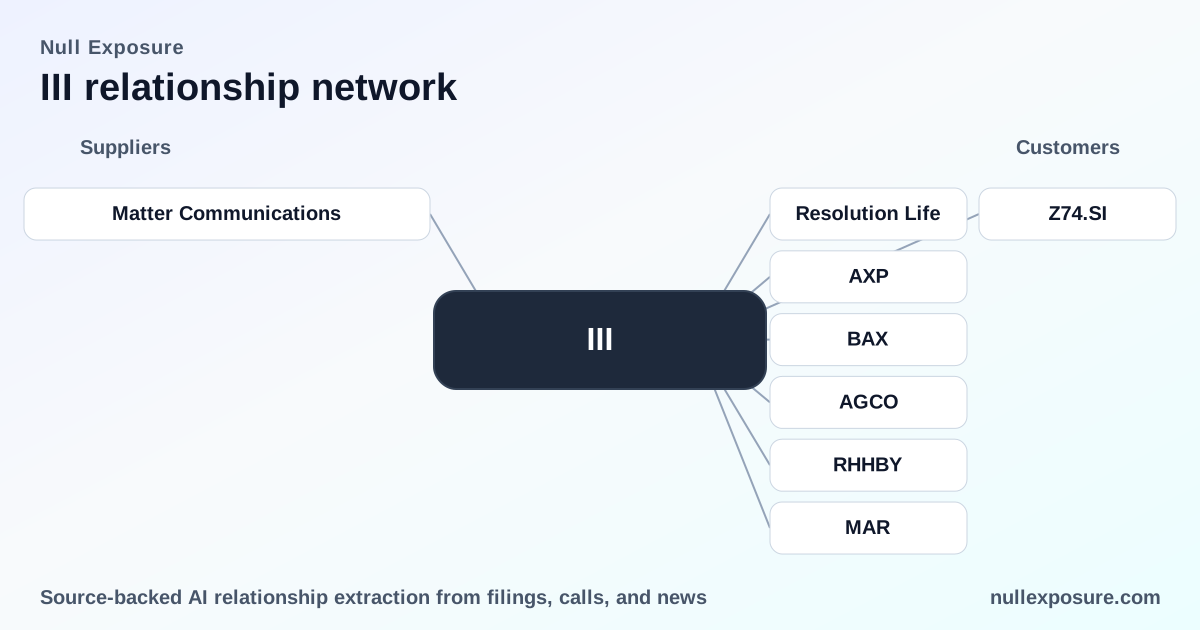
Information Services Group (III) — supplier relationships, operating posture, and investor implications
Information Services Group (III) is a global technology research and advisory firm that monetizes through client engagements: recurring advisory subscriptions, project-based consulting, and professional services tied to transformation programs across the Americas, Europe and Asia Pacific. Revenue derives from selling research and advisory time, managed services assessments, and consulting projects rather than from product licensing; profitability therefore tracks utilization, client retainer roll‑offs and the mix of high‑margin advisory versus lower‑margin program work. For a concise supplier intelligence view, visit https://nullexposure.com/.
The core business model and what it means for supplier exposure
ISG is a services‑led business whose economics are driven by billable headcount and client engagements rather than capital intensity. Key financial signals underline this operating model: Revenue TTM $244.7M, gross profit $105.4M, operating margin ~8.3%, and market capitalization roughly $192M. Valuation multiples show a tradeoff between near‑term earnings and expectations for service growth: trailing P/E ~21 and forward P/E ~11.9, EV/EBITDA ~10.25. Dividend income is modest but present, with a dividend yield around 4.5% and a per‑share payout of $0.18.
This mix creates specific supplier characteristics:
- Contracting posture: transactional and project‑driven with a steady need for third‑party suppliers that support client delivery (research partners, communications firms, data providers, and hosting/IT vendors).
- Concentration: publicly available data does not disclose supplier concentration, but the global footprint implies multiple regionally contracted suppliers rather than single‑source dependency.
- Criticality: supplier services that support client deliverables — e.g., PR, data feeds, or cloud hosting — are operationally significant because loss of service can interrupt revenue recognition on client projects.
- Maturity: ISG operates as a mature mid‑market advisory firm with established commercial relationships; supplier arrangements will vary from short consulting buys to longer retainer agreements.
Supplier relationships found in our review
The supplier records for III in the reviewed results are narrow but informative. Each relationship listed below is summarized plainly with source context.
Matter Communications — a PR/contact supplier for ISG’s communications team. The entry lists a Matter Communications contact for ISG (Julianna Sheridan) and provides PR contact details for press outreach in FY2026, indicating Matter handles or supports external communications for ISG. Source: Newswire Korea press release, March 2026 (FY2026 contact listing) — https://www.newswire.co.kr/newsRead.php?no=1027315
What that Matter Communications relationship implies operationally
Matter Communications acting as a communications supplier is a low‑to‑moderate criticality relationship: the firm does not deliver billable advisory services to clients, but it shapes market perception, investor communications and crisis messaging. For investors and operators this matters because reputational events or earnings surprises require rapid external communications — a reliable PR supplier reduces execution risk on messaging and can materially limit client fallout from public incidents.
Company‑level constraint signals investors must track
ISG’s public disclosures include an explicit company‑level warning about third‑party supplier risk: the firm states that a cybersecurity incident affecting a supplier could cause loss of service, exposure of ISG or client data, or a backdoor into ISG systems. This language frames supplier risk as a material operational control issue rather than a reputational footnote.
From that disclosure we derive these actionable signals:
- Vendor cyber risk is a real operational constraint. Third‑party security failures can interrupt client delivery and therefore revenue recognition.
- Risk management focus should be on contractual controls and SLAs, not just price or scope. Investors should probe for indemnities, security attestations, and breach notification timelines in procurement contracts.
- Maturity of third‑party governance is a determinative factor for future margin stability; firms that substitute high‑margin advisory for reactive remediation work will protect margins.
Key risks and what investors should ask management
Bold, direct questions for management and diligence pro formas:
- How are supplier security and continuity requirements written into client‑facing contracts and internal SLAs?
- What percentage of critical delivery is dependent on external suppliers that hold client data or production access?
- Are there multi‑vendor fallbacks for high‑impact services (communications, data feeds, hosting)?
Top risk factors to monitor:
- Cybersecurity of third parties — highlighted explicitly in ISG’s filings as a source of potential loss of service and data exposure.
- Supplier continuity for market‑facing functions such as PR and investor communications, which influence reputation and client retention.
- Contracting flexibility — short, transactional supplier agreements increase churn risk during client demand swings.
For deeper supplier and third‑party risk visibility, evaluate vendor lists during diligence and review contractual mitigation clauses; more supplier intelligence is available at https://nullexposure.com/.
Investment implications and near‑term posture
Financially, ISG shows profitability with modest margins and an attractive forward P/E relative to trailing, indicating earnings acceleration expectations. Analyst consensus target price is $6.67, while the company yields income for income‑oriented holders. Shareholder composition (insiders ~27% ownership, institutions ~71%) signals concentrated insider alignment alongside institutional oversight.
Operationally, supplier risk is an underappreciated lever that intersects with earnings durability. For buy‑side and operator diligence, suppliers that support revenue delivery or protect reputation deserve contract scrutiny and third‑party security validation. Press and communications suppliers — like Matter Communications — are important resilience components to maintain when managing client expectations and external disclosures. To continue research on supplier exposure and governance, visit https://nullexposure.com/.
Final takeaways and next steps
- ISG is a services business whose revenue and margins are closely tied to delivery capacity and the reliability of third‑party suppliers.
- The company explicitly flags third‑party cyber incidents as a pathway to loss of service and client data exposure; this elevates supplier governance to a core operational risk.
- Supplier entries in public records are sparse but meaningful: the Matter Communications contact in March 2026 confirms outsourced communications support — an element of operational resilience rather than direct revenue generation.
For portfolio managers and operators, prioritize contractual security controls, redundancy for critical external services, and routine audits of supplier cyber posture. For focused supplier intelligence and governance tooling, start with https://nullexposure.com/ — it’s the practical next step to convert supplier signals into investment decisions.