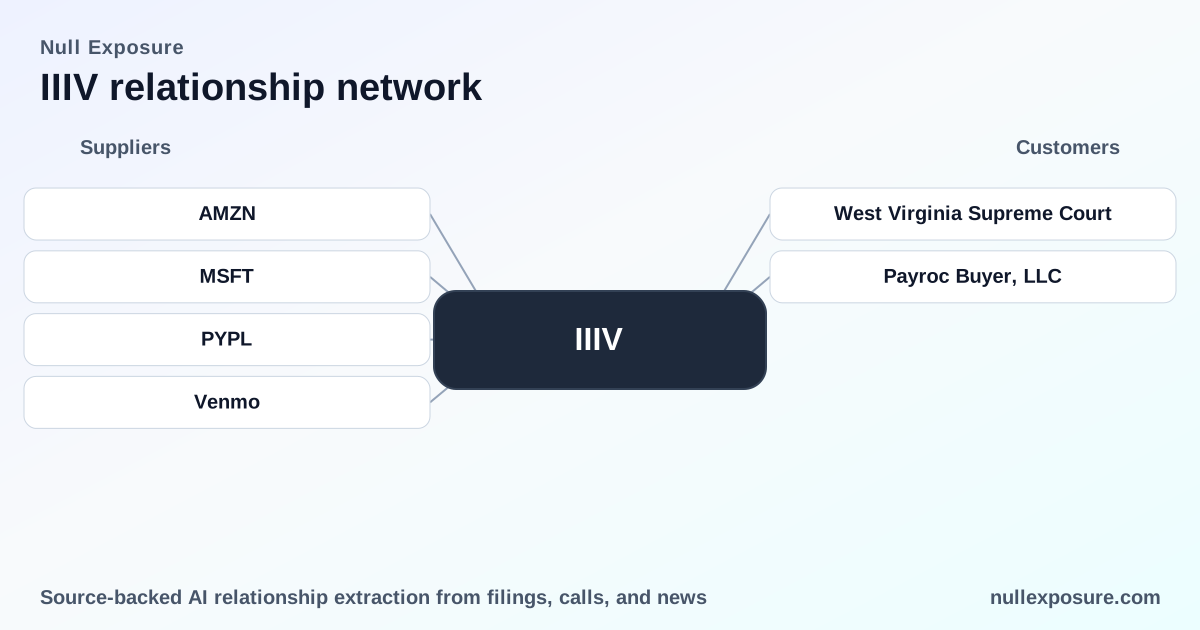
i3 Verticals (IIIV): Supplier relationships that power payments and SaaS distribution
i3 Verticals operates as a vertical-focused payments and software integrator that monetizes through payment facilitation, transaction processing spreads, and recurring software subscriptions sold into education, nonprofit, public sector, property management, and healthcare customers. The company’s economic model combines low-margin, high-volume payments flows with higher-margin software licensing and services; suppliers for cloud, payments rails, and security are therefore direct drivers of both topline scale and operational risk.
Explore supplier risk profiles and third‑party concentration at https://nullexposure.com/.
Financial posture frames supplier importance
i3 Verticals is a mid‑cap software-infrastructure company (market capitalization roughly $699M, revenue TTM $213.6M) with thin operating margins (operating margin TTM 0.025) and modest EBITDA (about $14.7M). These metrics make supplier continuity and cost control critical: payment processing partners and cloud vendors directly influence margins and availability. The market is pricing IIIV with a high trailing P/E (282x), so execution on its merchant and SaaS platforms is essential to justify valuation.
The supplier map: cloud platforms, payments rails, and security partners
i3 Verticals relies on a small set of enterprise-grade technology and payments partners to deliver its integrated products. Below I cover every relationship cited in public filings and news reporting in the available results, year by year, with direct sourcing.
AWS — FY2025
i3 Verticals emphasizes partnerships with Amazon Web Services as part of a cloud‑native, scalable architecture that underpins its SaaS and payments stack, supporting agile development and secure solutions. According to the company’s FY2025 10‑K as reported on TradingView (March 10, 2026), the AWS relationship is a foundational element of the firm’s platform strategy.
Microsoft Azure — FY2025
The company lists Microsoft Azure alongside AWS in FY2025 as cloud partners used to scale and secure its platform, reflecting a multi-cloud posture for resilience and centralized tooling. The FY2025 10‑K referenced on TradingView (March 10, 2026) explicitly cites Microsoft Azure in the discussion of technology development.
AWS (Amazon Web Services) — FY2024
In FY2024 i3 Verticals described a “cloud‑first” strategy that leverages AWS to host core services and to centralize cybersecurity controls, indicating consistency in platform choice across reporting periods. This characterization comes from the FY2024 10‑K content published on TradingView (March 10, 2026).
Microsoft (Microsoft Azure) — FY2024
The FY2024 filing also documents the use of Microsoft Azure and Microsoft security tools to centralize cybersecurity and support scalable SaaS delivery, reinforcing a dual‑vendor cloud architecture. The FY2024 10‑K text as reported on TradingView (March 10, 2026) outlines this posture.
PayPal — FY2024
i3 Verticals’ proprietary payment facilitation platform supports PayPal as one of the accepted payment methods, integrated into customer business management systems to enable card and online wallet acceptance. The FY2024 10‑K passage reported on TradingView (March 10, 2026) states PayPal as a supported payment method on the company’s platform.
Venmo — FY2024
Venmo is listed alongside PayPal as an accepted payment option on i3 Verticals’ payment facilitation platform, expanding consumer-facing digital wallet acceptance for customers processing payments through IIIV’s systems. This is documented in the FY2024 10‑K content published on TradingView (March 10, 2026).
What the constraints say about how the company operates
The filings and excerpts signal a clear operating model and supplier posture that investors should treat as company-level characteristics:
- Service provider orientation: i3 Verticals uses both internal and external resources for security assessments, penetration testing, and independent audits, demonstrating a vendor-managed security regime supplemented by third‑party testing and advisory relationships. This is described in the company’s security and audit disclosures.
- Payments concentration: The company uses a third‑party payment processor that facilitates the majority of proprietary payments revenue across fiscal years 2023–2025, signaling material dependence on upstream payment processors for core revenue flows.
- Cloud-first maturity: Multiple years of SEC commentary emphasize a cloud‑native, scalable platform using AWS and Azure, which indicates modern architecture but also exposes the company to commercial terms and operational risk from large hyperscalers.
- Security governance: Centralized cybersecurity using Microsoft tools and regular penetration testing suggests formalized controls, reducing but not eliminating supplier‑related security risk.
Risks and strategic implications for investors and operators
- Supplier concentration is a direct earnings lever. The payment processor that handles the majority of proprietary receipts represents a single point of failure and bargaining pressure on margins. This is the most material supplier risk.
- Hyperscaler dependence shifts variable cost structure. Using AWS and Azure accelerates product iteration and uptime but creates exposure to pricing and service availability imposed by those vendors.
- Security posture is institutionalized. Regular penetration testing and third‑party audits reduce operational risk and support customer trust, a necessary condition for growing payments volumes.
- Customer stickiness driver. Integration of payments into vertical-specific software increases switching costs for customers and supports recurring revenue growth when executed well.
If you want a deeper supplier risk scorecard and concentration dashboard for IIIV, visit https://nullexposure.com/ for tailored exposure analysis.
Practical takeaways for contract negotiation and monitoring
- Prioritize redundancy and contractual SLAs with your payment processor and cloud vendors; demand termination and transition clauses tied to processing availability.
- Insist on detailed PCI DSS attestations and third‑party penetration test reports during diligence to validate the claims disclosed in filings.
- Monitor pricing terms from AWS/Azure and payment processors; small percentage changes in processing fees materially affect low-margin payments economics.
Final verdict and action items
i3 Verticals has built a pragmatic supplier ecosystem: hyperscalers for platform scale, integrated digital wallets and processors for payment reach, and external security firms for control validation. The company’s commercial success depends on maintaining uninterrupted payment flows and controlling processing costs while expanding higher‑margin software sales.
For a deeper dive into supplier dependencies and to model the financial impact of vendor pricing shocks on IIIV’s margins, see the full exposure analysis at https://nullexposure.com/.
Key next steps for investors: validate third‑party processor concentration in diligence, review recent penetration test findings, and stress‑test margin sensitivity to processing fee increases. For operators: negotiate stronger SLAs and prepare contingency routing to mitigate processor outages.