Inspira Technologies Oxy BHN Ltd (IINN): supplier relationships that shape a nascent medical-device play
Inspira Technologies Oxy BHN Ltd develops a non‑invasive respiratory support device as an alternative to mechanical ventilation and monetizes primarily through device commercialization, manufacturing partnerships, and capital raises that fund commercialization and scale. The company is operating at a clinical-to-commercial inflection with minimal revenue (US$289k TTM) and negative EBITDA, relying on strategic external relationships to convert product development into volume manufacturing and market access. For investors and operator partners evaluating counterparty risk, these supplier and advisor linkages drive both upside potential and tangible concentration risk. Learn how these relationships map to operational risk at https://nullexposure.com/.
What investors should know about how Inspira runs the business
Inspira is a small-cap medical-device company (market cap roughly US$26M) with early commercial revenue and negative margins. The business model depends on three interlocking attributes:
- Capital markets dependency: Raising equity through registered direct offerings and private placements is a primary lever to fund production scale and go-to-market execution.
- Outsourced manufacturing: The company sources manufacturing capacity externally to scale output quickly without large fixed-capex commitments.
- Commercial immaturity: Revenue and gross profit are currently negligible relative to market valuation, so operational execution by partners will determine the short-term trajectory.
These characteristics translate into a contracting posture that is transactional and financing-driven, concentration risk around a small number of external providers, high operational criticality of those providers for volume production, and an overall immature supplier ecosystem that upgrades only as capital availability and market traction increase.
The relationships that matter — a concise ledger
Below are the supplier and advisor relationships surfaced in public reporting. Each entry is a compact, plain‑English statement and a source citation.
-
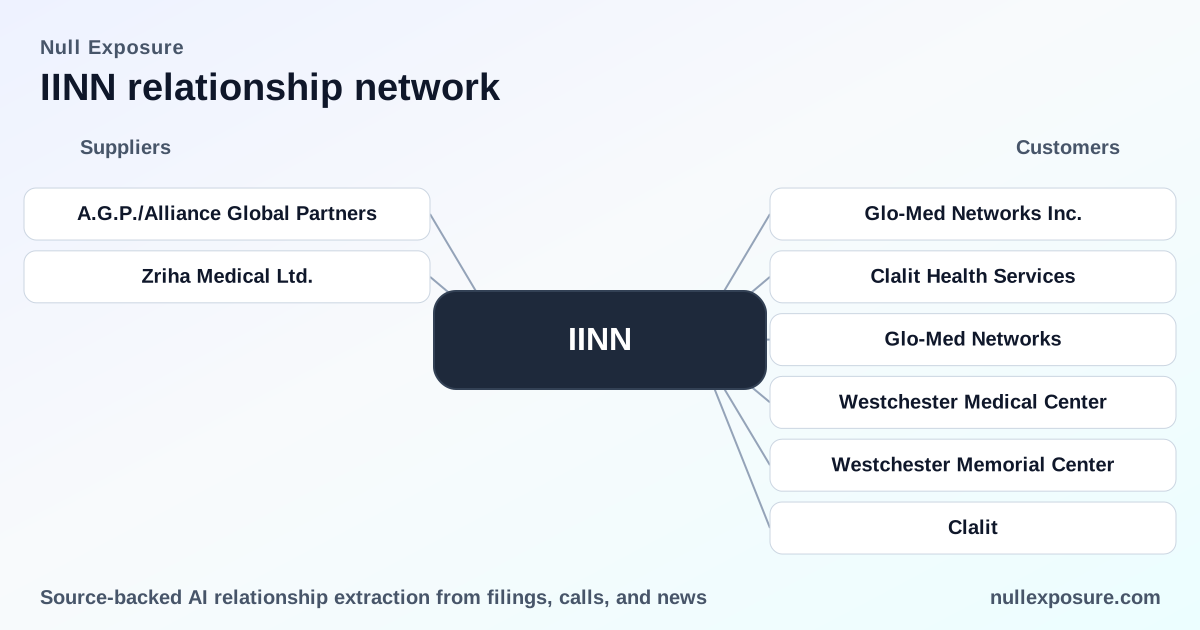
A.G.P./Alliance Global Partners: Acting as the sole placement agent for a registered direct offering and concurrent private placement priced at the market under Nasdaq rules, A.G.P. handled the capital raise that supports near-term scaling and working capital requirements. According to coverage of the offering in March 2026, A.G.P./Alliance Global Partners served as the sole placement agent for the transaction (news coverage via Yahoo Finance and GlobeNewswire/ManilaTimes, FY2026).
-
Zriha Medical Ltd.: Contract manufacturing partner enabling production scale of Inspira’s respiratory support system, Zriha provides international medical-device manufacturing capacity to support commercialization and candidate technologies. The company disclosed this collaboration in its full-year 2024 financial results and business update (PR Newswire, FY2025).
How these relationships influence operational risk and upside
Capital and manufacturing relationships together form the operational backbone for an early-stage med‑tech company. The A.G.P. placement role is a financing enabler: successful execution reduces liquidity risk and funds ramp activities. The Zriha manufacturing collaboration is the production enabler: external capacity allows faster scale without heavy capital expenditure.
- Concentration and single‑point risk: With a small revenue base and limited number of publicized partners, the company’s operational continuity depends on a narrow set of external counterparties. That structure creates execution leverage—good execution boosts growth quickly, but a single disruption creates outsized downside.
- Contracting posture: The use of a sole placement agent and a named manufacturing collaborator indicates a pragmatic, vendor-based operational model rather than vertically integrated manufacturing. This posture optimizes cash conservation but concentrates counterparty risk.
- Maturity and criticality: Commercial maturity is low, so supplier performance is highly critical to realization of future revenue; both financing and manufacturing partners are essential for near-term milestones.
Financial context that elevates supplier importance
Inspira shows very low sales and negative profitability metrics—Revenue TTM US$289k, Gross Profit TTM US$2k, EBITDA negative—while trading at steep valuation multiples (Price/Sales ~90x, EV/Revenue ~85x). Under these conditions, supplier and capital relationships are primary value drivers: they determine whether the company executes a revenue ramp or remains cash constrained.
Practical implications for counterparties and investors
Operators evaluating supplier relationships should treat Inspira as a high‑beta partner: contractual terms must protect suppliers against delayed payments and unexpected volume swings, while investors should underwrite execution risk through scenario analysis.
- For manufacturers and distributors: insist on clear production milestones, payment security provisions, and contingency plans for component sourcing and regulatory approvals.
- For potential investors: focus diligence on the company’s cash runway post‑placement, the manufacturing partner’s capacity to meet quality and volume targets, and any exclusivity or long‑lead commitments that could lock Inspira into suboptimal terms.
If you want a deeper relationship map or counterparty diligence tools, review the platform at https://nullexposure.com/ for an integrated supplier-risk view.
Constraints and company-level signals shaping supplier strategy
There were no explicit constraint excerpts provided in the public relationship data set, so constraints below are company-level signals derived from the operating profile and disclosed relationships:
- Capital intensity: The company’s reliance on registered direct offerings indicates recurring funding requirements; contracting will favor short‑term, performance‑linked engagements.
- Supplier concentration: Early-stage outsourcing suggests a small set of critical partners; this increases counterparty concentration risk across production and financing.
- Transactional contracting posture: Outsourced manufacturing and sole-placement financing point to pragmatic, transactional agreements rather than deep strategic alliances—appropriate for conserving cash but limiting integrated long-term support from partners.
- Maturity risk: Low revenue and negative profitability indicate the supplier ecosystem must deliver quickly to validate the commercialization thesis.
These signals should inform contract structure, credit terms, and contingency planning when partnering with or investing in Inspira.
What investors and operators should do next
- Validate the post-offering cash runway and use‑of‑proceeds disclosed in the March 2026 financing materials to quantify near-term liquidity risk. Review the offering coverage on major news wires for transaction details (news coverage via Yahoo Finance and GlobeNewswire/ManilaTimes, FY2026).
- Conduct operational diligence on Zriha Medical’s manufacturing capacity, quality certifications, and lead times referenced in Inspira’s FY2024–FY2025 disclosures (PR Newswire, FY2025).
- Structure contracts with clear milestone payments, volume guarantees, and exit options to mitigate concentration risk during the commercialization ramp.
For a consolidated supplier-risk profile and counterparty scoring that investors and operators use for diligence, visit https://nullexposure.com/ to see how relationship intelligence translates into actionable risk signals.
Bottom line
Inspira’s path to value is tightly coupled to two operational facts: securing financing to fund scale and executing outsourced manufacturing to convert product development into sales. Both the placement agent role and the manufacturing partnership are critical levers—they lift the company when aligned and create material single‑point failure risk if they do not. Investors and operator partners should prioritize capital-runway verification and manufacturing due diligence as the highest‑impact activities when assessing IINN.