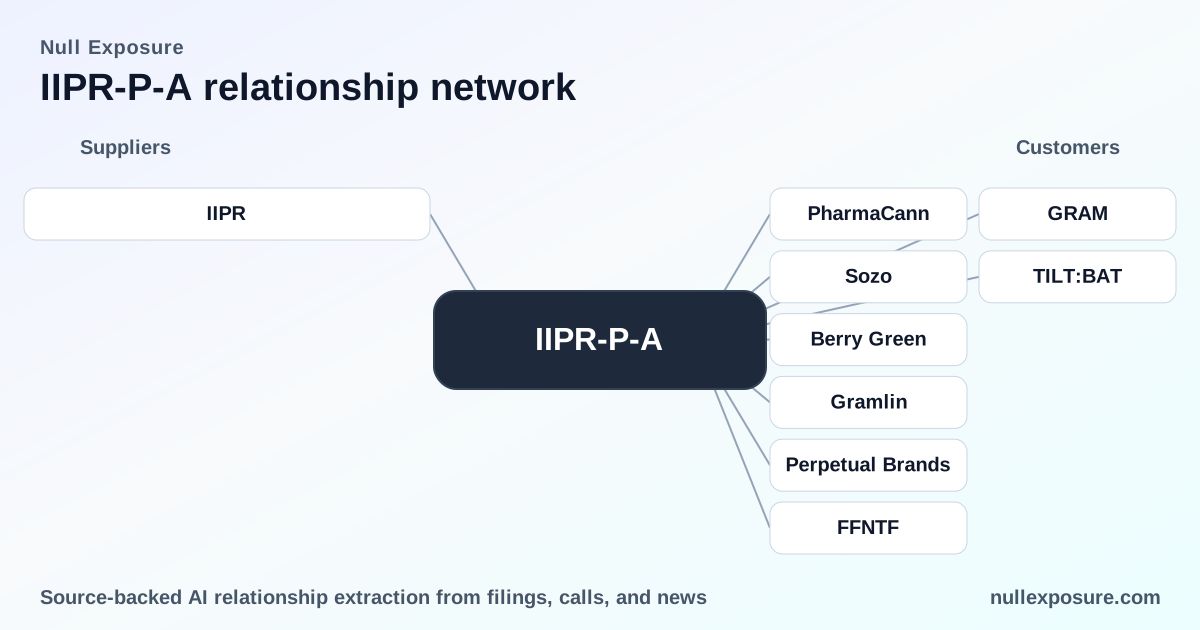
Innovative Industrial Properties (IIPR-P-A): A landlord play that monetizes cannabis real estate via yield securities
Innovative Industrial Properties issues a 9.00% Series A cumulative redeemable preferred and operates as a real-estate-focused vehicle that buys, develops and leases industrial properties to licensed cannabis operators; the company generates cash flow through long-term lease income and incremental financing arrangements tied to property development and tenant operations. For income-oriented investors and counterparties, IIPR’s preferred shares function as a fixed-income substitute backed by a specialized REIT cash flow profile rather than conventional corporate earnings. Learn more about supplier exposure and relationship signals at https://nullexposure.com/.
How IIPR makes money and where the leverage lives
IIPR’s core commercial model is straightforward: acquire or develop cannabis-ready industrial real estate and sign long-duration leases with licensed operators. Those leases often include credit protections, recovery rights and contract structures that allow the landlord to capture development upside (construction financing draws, lease amendments, or staged rent escalators). The Series A preferred is a capital-market instrument that monetizes the REIT’s stable lease cash flows into a high-coupon security, attractive to investors seeking above-market yield.
Operationally, this profile produces a mix of asset and credit risk:
- Contracting posture: predicated on long-term landlord-tenancy relationships and lease amendments that can include landlord-provided development funding or rent concessions tied to construction milestones.
- Concentration: tenant concentration is a structural feature—large, operator-specific facilities produce outsized exposure to single-license tenants.
- Criticality: properties are frequently mission-critical to growing/processing operations, enhancing landlord bargaining power but raising counterparty credit sensitivity.
- Maturity: the REIT legal and capital structure is conventional and mature; however, the underlying industry (regulated cannabis operators) imparts sector-specific regulatory and cash-flow variability.
What public relationship data reveals right now
The public record for supplier-scope relationships includes an item showing IIPR’s active role as landlord and financier of tenant development projects.
Innovative Industrial Properties, Inc. — Jushi / Pennsylvania Medical Solutions (PAMS)
- Jushi Holdings’ press release on an expansion project disclosed that PAMS amended its existing lease with Innovative Industrial Properties to make an additional $30 million available for the first phase of facility development, indicating a landlord-funded development mechanism embedded in the lease relationship. According to the Jushi press release (company news item), the lease amendment expanded funding capacity for property development in the referenced phase (source: Jushi Holdings press release, linked via Jushi investor relations).
- This entry demonstrates IIPR’s willingness to support tenant-capex through lease modifications that convert development capital into contractual landlord claims, reinforcing the REIT’s role as both property owner and project financier. (Source: https://ir.jushico.com/news-events/press-releases/detail/135/jushi-holdings-inc-announces-update-on-expansion-project)
Why that relationship matters for investors and operators
The reported lease amendment and $30 million funding availability are material operational signals:
- Credit and cash-flow linkage: When the landlord provides or structures development funding through the lease, rental income and tenant solvency are more tightly linked to the success of tenant capital projects.
- Enhanced landlord protections: Lease-funded development often converts what would be unsecured capital into secured landlord interests or contractual repayment obligations, improving recovery prospects in downside scenarios.
- Concentration trade-off: Funding a tenant’s initial phases can deepen the tenant-landlord relationship, increasing longevity and lock-in but also concentrating exposure to the financed operator’s ultimate commercial success.
These dynamics turn property leases into hybrid financing agreements—rent plus embedded project finance—which changes how investors should underwrite both the preferred security coupon and landlord counterparty risk.
Company-level operating signals (constraints and posture)
No independent constraint documents were provided with the relationship record; as a company-level assessment, the available signals indicate these characteristics:
- Contracting posture is proactive and capital-supportive. IIPR structures leases that can include amendments to fund tenant development, converting capital needs into contractual landlord claims.
- Concentration is an inherent risk. Large-format, purpose-built facilities lead to tenant concentration that requires active credit monitoring at the counterparty level.
- Criticality elevates bargaining power but also counterparty dependence. Facilities that host cultivation or processing are critical to tenant revenue generation, which strengthens landlord covenants but also increases the systemic impact of tenant distress.
- Operational maturity is established at the REIT level, while market maturity is variable. IIPR uses traditional REIT governance and capital instruments (including high-coupon preferred stock) against an industry still shaped by regulatory evolution.
Key risks investors should track
- Regulatory and legal risk: State and federal cannabis regulation remains the dominant sector hazard and directly affects tenant operations and property valuations.
- Tenant credit and concentration: The landlord’s recovery profile depends on operator credit; funding expansion through lease amendments increases exposure to operator execution risk.
- Liquidity and market pricing: Preferred-share investors must treat the Series A coupon as compensation for concentrated, sector-specific collateral rather than generic corporate credit.
- Contract complexity: Lease amendments that convert development finance into landlord claims require careful review of security, priority and enforceability across jurisdictions.
Place a watchlist on operators that receive landlord-funded development, track lease security terms, and monitor any changes in tenant licensing or cash-flow performance.
Explore supplier-level exposure and relationship analytics at https://nullexposure.com/ for deeper diligence.
Practical recommendations for investors and operators
- For preferred-share investors: underwrite the coupon against lease security and tenant concentration, not broad-market credit metrics. Verify the existence and priority of landlord liens tied to financed development.
- For lenders and counterparties: treat lease amendments as credit events—they alter collateral stacks and repayment pathways, and should be stress-tested under tenant downside scenarios.
- For operators negotiating with IIPR: recognize that landlord development funding is a trade-off—you gain capital and accelerated buildout in return for longer-term contractual commitments and potential encumbrances on property.
Bottom line
IIPR-P-A sits at the intersection of real estate yield and sector-specific credit. The documented lease amendment with Jushi / PAMS—introducing an additional $30 million for first-phase development—exemplifies IIPR’s model of monetizing tenant growth through lease-embedded financing and long-term rental contracts. That structure delivers attractive current income potential for preferred investors but requires rigorous counterparty and regulatory risk management.
For a deeper look at how supplier relationships influence capital structures and to monitor new developments, visit https://nullexposure.com/. Your due diligence should prioritize lease security, tenant concentration, and regulatory contingency planning when evaluating IIPR’s preferred securities and landlord exposures.