Inhibikase Therapeutics (IKT): supplier relationships, capital partners, and operational constraints investors should price in
Inhibikase Therapeutics develops and commercializes small‑molecule therapies for Parkinson’s disease and related disorders, monetizing through clinical-stage asset advancement and financing events rather than product revenue today. The company relies on external capital markets and a network of contract manufacturers, placement agents and service providers to fund and execute late‑stage programs, which concentrates operational risk in a handful of externally managed functions. Learn more about how these supplier linkages affect counterparty risk and funding optionality at https://nullexposure.com/.
Why suppliers and placement partners drive valuation today
Inhibikase is a clinical‑stage biotech with negligible product sales and negative operating margins; its short‑to‑medium term value accrues from successful trials and the company’s ability to execute financings. That creates two structural realities: manufacturing, CRO and distribution counterparty performance directly affect development timelines, and investment banks and placement agents determine dilution and runway. Both are value drivers for investors and operators.
- Capital partners set the pace of dilution: multiple entries in 2024–2025 show Inhibikase using placement agents, a private placement and a proposed registered offering to extend runway.
- Manufacturing and distribution are material to program timelines: the company outsources cGMP and formulation work across U.S. and China‑based CMOs.
For a deeper vendor‑risk readout and comparative supplier scoring, visit https://nullexposure.com/.
Who Inhibikase is working with — plain‑English vendor and placement summaries
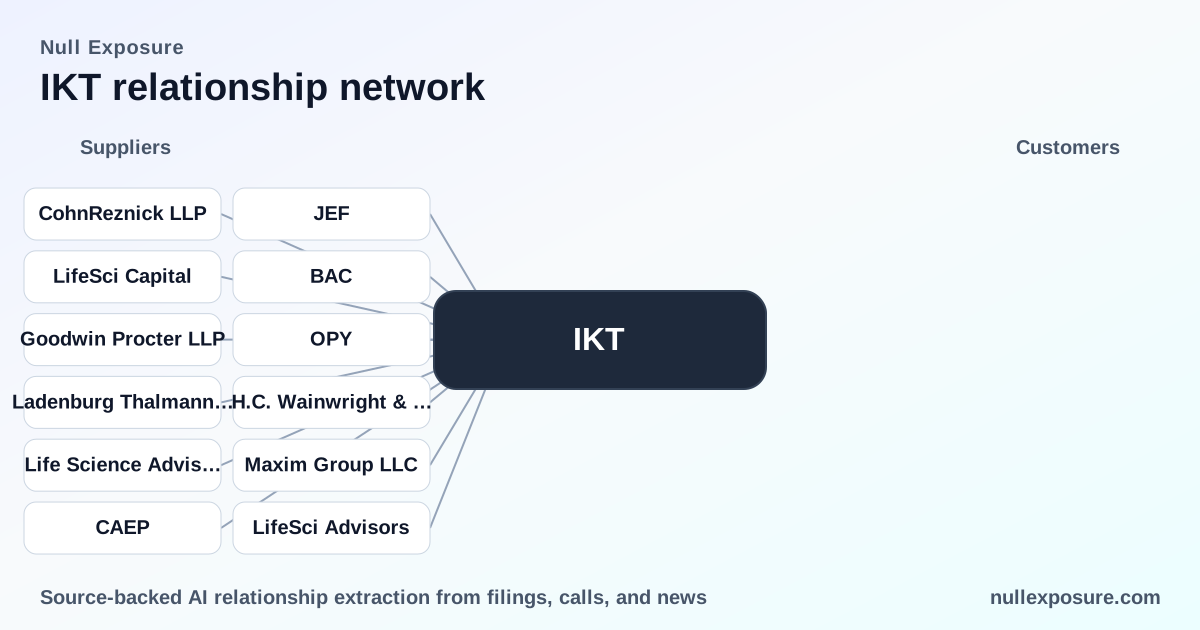
Below are every counterpart named in the reporting and press coverage assembled for IKT. Each line is a 1–2 sentence description with the original source referenced for investor diligence.
- Jefferies / Jefferies LLC — Jefferies has acted as the lead placement agent on past financings and as a joint book‑running manager on a proposed public offering, and TradingView coverage notes an ATM facility tied to Jefferies that could allow sales up to $185 million. According to a GlobeNewswire release (Oct 9, 2024) Jefferies led a $110M private placement; the company’s Nov 20, 2025 press release lists Jefferies as a joint book‑running manager, and TradingView reported ATM program details in March 2026.
- BofA Securities — Listed as a joint book‑running manager for the proposed November 2025 offering, positioning BofA as a core capital markets partner for the equity raise. (GlobeNewswire, Nov 20, 2025.)
- Cantor — Named among the joint book‑running managers for the proposed offering, signaling participation in the registered transaction syndicate. (GlobeNewswire, Nov 20, 2025.)
- Oppenheimer & Co. — Identified as a co‑lead manager on the proposed offering, indicating placement support beyond the lead banks. (GlobeNewswire, Nov 20, 2025.)
- LifeSci Capital — Appears as a co‑lead manager on the November 2025 offering and is referenced in company press materials as part of the syndicate handling the deal. (GlobeNewswire, Nov 20, 2025.)
- H.C. Wainwright & Co. — Serves as a co‑manager on the proposed offering, part of the wider placement syndicate used to access capital markets. (GlobeNewswire, Nov 20, 2025.)
- Ladenburg Thalmann & Co. Inc. — Named as a co‑manager on the proposed offering, participating in distribution of the registered deal. (GlobeNewswire, Nov 20, 2025.)
- Maxim Group LLC — Acted as a co‑placement agent on the October 2024 private placement, contributing to that financing’s syndication. (GlobeNewswire, Oct 9, 2024.)
- LifeSci Advisors / Life Science Advisors — Functions as the company’s investor relations advisor and press contact across multiple releases; Michael Moyer is listed as IR contact in the company’s 2024–2025 communications. (GlobeNewswire Nov 14 & Nov 20, 2025; SahmCapital Nov 15, 2025; GlobeNewswire Oct 9, 2024.)
- CohnReznick LLP — Identified as the independent auditor of Inhibikase’s financial statements, with published coverage noting the audit and the company’s attention to cybersecurity controls as part of risk management. (QZ.com coverage citing CohnReznick, 2026.)
- Goodwin Procter LLP — Provided a legal opinion filed as Exhibit 5.1 in connection with the ATM/offering update; this places Goodwin as legal counsel for securities work. (TradingView coverage, Mar 2026.)
What the supplier and market relationships imply about operational risk
The publicly disclosed relationships and constraint signals sketch a clear operating model for investors:
- Contracting posture: outsourced and dependent. Inhibikase outsources chemical manufacturing, formulation, clinical trial execution and distribution to third parties; investor diligence should treat supplier continuity as a principal operational risk.
- Concentration and geography: cross‑border manufacturing with APAC exposure. The company works with CMOs in China and the United States and expects manufacturing “in whole or in part” to occur in China, which concentrates geopolitical, regulatory and logistics risk across APAC and North America.
- Criticality and materiality: supplier failures delay development. Public disclosures state that loss of third‑party suppliers would likely delay trials and potentially be irreplaceable on acceptable terms, making these vendor linkages material to valuation.
- Maturity and engagement stage: active external management. Multiple disclosures show ongoing active engagements with CROs, CMOs, IR firms and legal/audit service providers — the vendor base is operationally integrated rather than ad hoc.
- Service provider security and governance signal. The company reports external IT vendor arrangements that include monthly risk assessments and vendor security reviews, indicating governance controls over outsourced IT and data handling.
Named CMOs and service vendors are explicitly referenced in company filings; investors should incorporate those specific counterparties into supplier due diligence when available.
Investment implications and near‑term watchlist
- Dilution risk is frontal: the mix of private placements, ATM mechanics and a proposed registered offering between 2024–2025 demonstrates a capital‑raising strategy that dilutes equity to fund trials; monitor syndicate activity from Jefferies, BofA, Cantor and co‑managers as signals of deal pricing and timing. (GlobeNewswire, Oct 2024 & Nov 2025; TradingView, Mar 2026.)
- Operational risk is binary: manufacturing or CMO disruption in China or the U.S. can push timelines materially; track contract manufacturing confirmations and regulatory filings for cGMP continuity.
- Governance and audit: positive baseline: a recognized auditor and retained securities counsel reduce legal and reporting uncertainty, but cybersecurity and vendor controls remain operational items to validate. (QZ.com; TradingView.)
If you need a tailored supplier‑risk brief or syndicate impact analysis on IKT, start here: https://nullexposure.com/.
Practical next steps for investors and operators
- Request counterpart contact lists and contract terms for CMOs and key CROs to verify exclusivity, lead times and continuity provisions.
- Monitor regulator filings and press releases for closing of the proposed offering and ATM activity to model dilution scenarios tied to Jefferies, BofA and the syndicate.
- Validate IT and data governance attestations from the external vendor noted in filings to reduce clinical data integrity and cybersecurity exposure.
For research partners and portfolio teams looking to operationalize these supplier signals, explore a subscription with our platform at https://nullexposure.com/ to get structured supplier intelligence and ongoing alerts.
Bottom line
Inhibikase’s value chain is financed and executed through a small, visible group of placement banks and outsourced manufacturers/service providers; capital partners control runway while CMOs and CROs control trial cadence. Active monitoring of placement syndicate activity and CMO continuity is essential for any investor underwriting upside or downside in IKT.