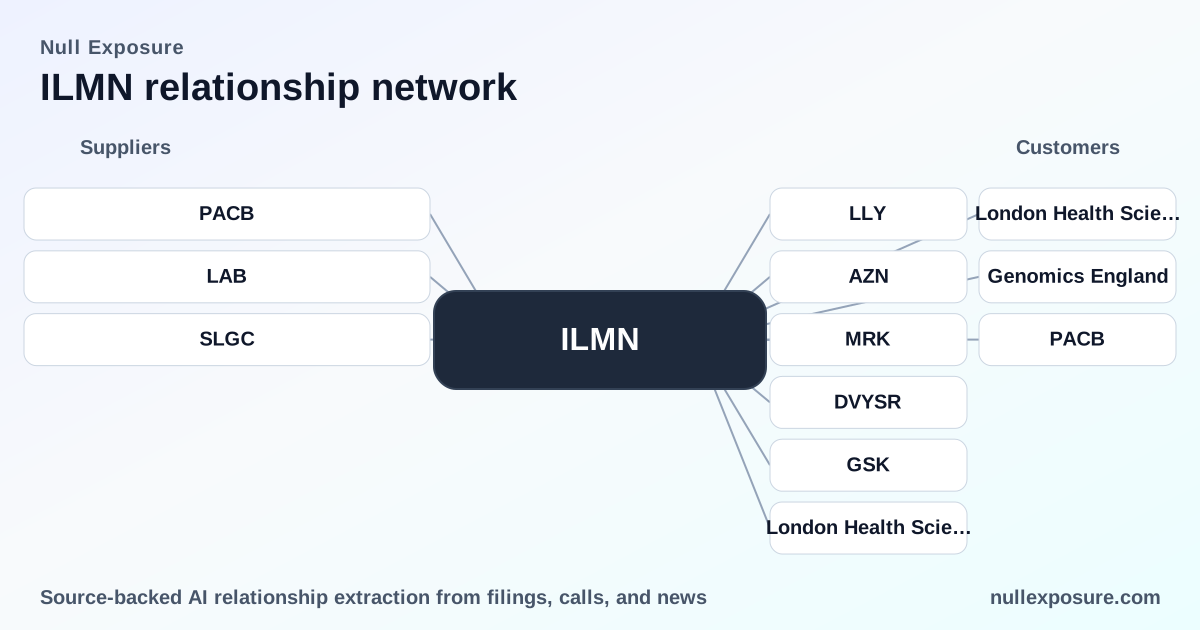
Illumina’s supplier footprint after a busy FY2026: what investors need to know
Illumina builds, sells, and services integrated systems for genomic analysis and monetizes through equipment sales, consumable reagents, software and services, and now increasingly through strategic acquisitions that expand its product and IP base. The company converts platform sales into recurring consumable revenue and uses targeted asset purchases to neutralize competitive gaps while protecting its reagent and detection franchises. This piece dissects recent supplier and acquisition-linked relationships that change Illumina’s supplier map and highlights the operational constraints investors should price into the stock.
If you need a concise supplier risk scorecard or portfolio monitoring for Illumina, visit https://nullexposure.com/ for tailored intelligence and relationship tracking.
Why these supplier moves matter to the P&L and margins
Illumina is a platform business: hardware sales are high-margin entry points, and consumables plus licensing drive predictable follow-on revenue. With Revenue TTM of $4.343 billion, EBITDA of $1.139 billion, and a 19.6% profit margin, the company has financial firepower to buy missing technologies and consolidate upstream IP that would otherwise erode consumables economics. The FY2026 transaction activity signals a deliberate strategy to internalize short-read and proteomics capabilities that feed the core sequencer + consumable revenue engine.
Key financial context: Market cap ~$18.2B with a Return on Equity of 33.4% suggests Illumina is positioning for durable returns by protecting its reagent and detection economics through acquisitions rather than competing in adjacent product markets indefinitely.
Recent supplier and asset relationships you must track
Below I cover every counterparty relationship surfaced in the FY2026 reporting and news cycle; each entry is a plain-English summary with a source reference.
Pacific Biosciences of California (PacBio / PACB)
Illumina acquired select intellectual property and other assets from PacBio related to short-read DNA sequencing and associated clustering, sequencing reagent, and detection technologies, a transaction reported as completed in March 2026; PacBio characterized the sale as the divestiture of short-read assets to Illumina (see TradingView and QuiverQuant coverage in March 2026). (TradingView, March 2026: https://www.tradingview.com/news/tradingview:c5faa7945db66:0-pacific-biosciences-of-california-signs-asset-purchase-agreement-with-illumina-cambridge/; QuiverQuant, March 2026: https://www.quiverquant.com/news/PacBio+Completes+Sale+of+Short-Read+Sequencing+Assets+to+Illumina+for+%2448.1+Million)
PacBio — additional context from earnings commentary
Illumina management specifically framed the PacBio IP acquisition as an opportunity to strengthen Illumina’s portfolio in short-read sequencing, underscoring that the IP is being integrated to protect and extend Illumina’s detection and reagent roadmap (earnings-call excerpt reported March 2026). (InsiderMonkey Q4 2025 earnings transcript summary, March 2026: https://www.insidermonkey.com/blog/illumina-inc-nasdaqilmn-q4-2025-earnings-call-transcript-1690265/)
Standard BioTools Inc. (LAB) — seller of SomaLogic
Standard BioTools completed the sale of SomaLogic to Illumina for $350 million cash up front plus up to $75 million in near-term earnouts and specified royalties, for aggregate cash consideration of up to $425 million, according to company press releases and news distribution in January–March 2026. This is a strategic acquisition that brings proteomics capabilities and royalty-bearing rights into Illumina’s portfolio. (GlobeNewswire / CityBiz / PR Newswire coverage, Jan–Mar 2026: https://www.globenewswire.com/news-release/2026/01/30/3229576/0/en/Standard-BioTools-Completes-Sale-of-SomaLogic-to-Illumina.html; https://www.citybiz.co/article/800407/standard-biotools-completes-sale-of-somalogic-to-illumina/; https://www.prnewswire.com/news-releases/illumina-completes-acquisition-of-somalogic-302674789.html)
Somalogic (SLGC) — the acquired technology and partnership history
Illumina described the SomaLogic acquisition as an important milestone that builds on a long-standing partnership; management emphasized integration of SomaLogic’s proteomic tools into Illumina’s broader molecular profiling roadmap (earnings commentary, FY2026). (InsiderMonkey Q4 2025 earnings transcript summary, March 2026: https://www.insidermonkey.com/blog/illumina-inc-nasdaqilmn-q4-2025-earnings-call-transcript-1690265/)
What these relationships mean for operations and supplier risk
These transactions are less about one-off purchases and more about shaping supply and IP flows that underpin Illumina’s consumable economics. Three practical operating-model takeaways for investors:
- Contracting posture is acquisitive and defensive. Illumina is using cash to internalize IP and capabilities that could otherwise become supply constraints or competitive threats, converting potential external suppliers into internal assets.
- Supplier concentration and criticality are shifting in Illumina’s favor. By owning specific short-read and proteomics IP, Illumina reduces dependency on external technology suppliers for those capabilities — a structural move to protect recurring reagent revenues.
- Maturity and integration risk are material but manageable. Acquiring established assets (SomaLogic; PacBio short-read IP) accelerates capability but requires integration of manufacturing, quality, and regulatory processes into Illumina’s platform business.
Constraints and company-level signals investors should price
The company-level constraints surfaced in FY2026 commentary are important context for counterparty and treasury risk:
- Counterparty selection bias toward large enterprises. Illumina states it mitigates credit and counterparty risk by selecting major financial institutions for hedging and other counterparties, suggesting a conservative counterparty posture (signal confidence ~0.75). This reduces financial counterparties as a source of operational volatility.
- Supplier/manufacturer dependency is a recognized point of failure. Management explicitly notes that disruption to component manufacturers could hinder manufacturing capability, indicating high operational criticality for manufacturing suppliers and the need for redundancy and active supply management (signal confidence ~0.80).
- Use of large financial institutions for hedging and services. Foreign-currency hedging activity exposes Illumina to counterparty credit risk, which the company addresses by limiting counterparties to major institutions; this is a sign of mature treasury controls but also shows dependency on banking partners (signal confidence ~0.75).
These constraints are company-level operating-model signals, not tied to any single relationship unless the original excerpt named that counterparty.
If you want a tailored briefing that scores Illumina’s supplier concentration and integration risk by business unit, see how we model these dynamics at https://nullexposure.com/.
Bottom line for investors and operators
Illumina is actively buying back critical IP and capabilities to defend its consumables-first profit model. The PacBio short-read assets and SomaLogic proteomics acquisition materially tighten Illumina’s control over upstream technologies that feed recurring revenue streams. That reduces certain supplier risks while increasing integration and execution risk — a trade-off that management is clearly choosing in pursuit of durable margins.
For a supplier risk dashboard, counterpart scoring, and real-time alerts that map exactly how these acquisitions affect your exposure, explore our services at https://nullexposure.com/.
Key takeaways:
- Acquisitions are strategic, not opportunistic — Illumina is consolidating IP that feeds consumables and detection margins.
- Company-level controls limit counterparty credit and FX exposure, but manufacturing supplier dependence remains a core operational risk.
- Execution risk from integration replaces some supplier risk; investors should watch integration milestones and any near-term capital or working-capital drawdowns.
Contact Null Exposure for a bespoke supplier risk assessment aligned to your investment or operating mandate: https://nullexposure.com/.