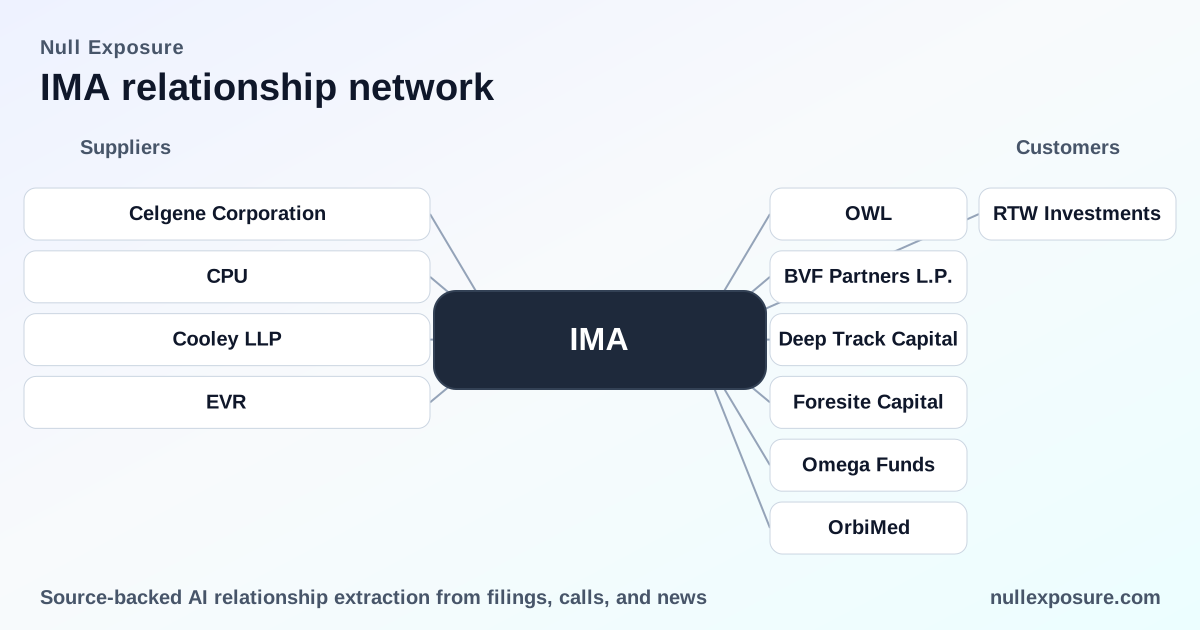
ImageneBio (IMA): supplier relationships and operational risk mapped for investors
ImageneBio is a clinical-stage biotechnology company that develops therapeutics for immunological and inflammatory diseases and currently monetizes through R&D collaborations, licensing of intellectual property, and the prospective collection of milestone and royalty payments upon commercialization. The company is capital-intensive and pre-revenue in scale—reported trailing revenue of $4.3 million and a market capitalization near $91.7 million—while relying heavily on third parties for manufacturing, clinical services, and strategic transactions that affect equity and financing. Investors should assess value through the lens of partnership optionality and supplier concentration rather than product cash flows today. For an investor-focused supplier map and monitoring tools, visit https://nullexposure.com/.
How ImageneBio operates: outsourcing, licensing, and transaction-driven liquidity
ImageneBio does not operate in-house manufacturing. The business model is built on licensing and third-party execution: licensed IP (including legacy university licenses), collaborations that can convert to exclusive commercial rights, and outsourced manufacturing and clinical trial delivery. Contracting posture is lean and cancellable in many service agreements—contracts typically do not include minimum purchase commitments and are often cancelable on short notice—while supplier concentration is high: the company relies on a small number of manufacturers for active pharmaceutical ingredients and formulations. According to the company’s 2024 Form 10‑K, ImageneBio depends on third parties for manufacturing and clinical development and expects to continue doing so if candidates progress toward commercialization (FY2024 filing).
The company runs clinical programs outside the United States, including the United Kingdom and Australia, signaling EMEA and APAC operational footprints that add regulatory and distribution complexity. For more detailed supplier relationship intelligence and monitoring, see https://nullexposure.com/.
Relationships that matter — what filings and press releases reveal
Bristol‑Myers Squibb / Celgene (legacy collaboration)
ImageneBio disclosed a collaboration agreement initiated in January 2019 with Celgene Corporation that, following Celgene’s acquisition, is referenced as the Bristol‑Myers Squibb Collaboration Agreement under which Bristol‑Myers Squibb could elect to exclusively license rights to develop and commercialize compounds. This is a strategic partnership framework that could convert R&D work into licensed commercial rights; it is documented in the company’s FY2024 Form 10‑K. According to the 2024 Form 10‑K, the agreement gives the partner discretion to move programs into exclusive commercialization arrangements (FY2024 filing).
Computershare (transfer/exchange agent for a corporate transaction)
Computershare is acting as the exchange agent in connection with the reverse stock split tied to the merger between Inmagene (ImageneBio’s predecessor identity in press) and Ikena Oncology, per transaction press coverage. News outlets reported that Ikena’s transfer agent, Computershare, served as exchange agent for the reverse stock split connected to the merger vote and closing (CityBiz, March 2026; GlobeNewswire, July 2025). These transfer‑agent duties are operationally routine but important to transaction execution and shareholder record accuracy (CityBiz, 2026; GlobeNewswire, 2025).
Cooley LLP (legal counsel to Imagene)
Cooley LLP served as legal counsel to Inmagene in the reported merger with Ikena Oncology, providing legal execution on deal terms, securities filings, and closing mechanics. The company’s press release on July 25, 2025, names Cooley as Inmagene’s counsel in the transaction, highlighting external legal support for corporate reorganization (GlobeNewswire, July 25, 2025).
Evercore (financial advisor)
Evercore served as the exclusive financial advisor to Inmagene in the merger and concurrent private placement described in the company’s July 25, 2025 release; this places Evercore in the role of structuring and validating the financing and deal valuation for investors and counterparties (GlobeNewswire, July 25, 2025).
What the constraints tell investors about operating risk
-
Licensing is a core element of the model. The company maintains an exclusive patent license with the University of Texas at Austin (the “UT Austin License”) initiated in 2015, establishing a foundational IP dependency and licensing posture (company disclosures). Treat university licenses as long-lived but legally encumbered assets that require maintenance and milestone compliance.
-
Contracts are often short-term and cancellable. Several excerpts state contracts typically have no minimum purchase commitments and can be canceled on ~30 days’ notice; this produces flexibility for the company but also low contractual lock‑in for suppliers and potential execution risk for clinical or commercial supply continuity.
-
Supplier concentration is material and operationally critical. The company relies on a small number of third‑party manufacturers for active pharmaceutical ingredients and formulated drugs; the third parties for APIs are identified as sole sources for certain inputs. Loss of a supplier would be a critical business interruption and a key downside risk for program timelines and valuation.
-
Service providers are the operational backbone. ImageneBio relies heavily on CROs, contract labs, investigators, and other third‑party service providers for clinical trials; this is an enduring and intentional outsourcing pattern that compresses fixed costs but raises vendor management and compliance requirements.
-
Geographic footprint increases complexity. Clinical programs are conducted in the U.K., Australia, and other foreign jurisdictions, reflecting an EMEA/APAC reach that expands regulatory touchpoints and distribution strategy needs.
-
Relationship stage is active. Multiple excerpts indicate ongoing clinical activities and active third‑party engagements, so operational diligence should focus on near‑term supplier deliverables rather than dormant contracts.
Investor implications and practical next steps
-
Monitor supplier concentration and backup plans. Investors should press management for visibility on sole‑source vendors, contingency manufacturing arrangements, and timelines to dual‑source critical APIs. Make supplier diversification a due‑diligence priority.
-
Track licensing milestones and counterparty election rights. The BMS/Celgene collaboration includes election rights that can materially change program ownership; investors should model scenarios where partners exercise or decline licenses and quantify retained economics.
-
Validate transaction execution around the Ikena merger. The Ikena transaction involved Computershare, Cooley, and Evercore; verify final filings and investor communications for residual dilution, escrow, and capital‑structure changes created by the merger and private placement (GlobeNewswire, July 2025; CityBiz, March 2026).
-
Operational governance matters. Outsourcing reduces capex but increases the need for robust vendor contracts, quality oversight, and regulatory compliance programs; insist on KPIs for supplier performance and audit rights.
For ongoing monitoring of supplier risk and partner exposure, consider using a dedicated supplier intelligence service like NullExposure to stay ahead of contract changes and material supplier events: https://nullexposure.com/.
Bottom line
ImageneBio’s value proposition is driven by licensed IP, external development partnerships, and outsourced delivery rather than in‑house manufacturing. That operating model delivers capital efficiency but concentrates execution risk in a small set of third‑party manufacturers and service providers; these relationships are material and, in some cases, critical to program progress. Investors should prioritize transparency on sole‑source suppliers, licensing election mechanics (BMS/Celgene), and the outcomes of corporate transactions executed by Computershare, Cooley, and Evercore. For structured supplier monitoring and alerts tailored to these relationships, visit https://nullexposure.com/.