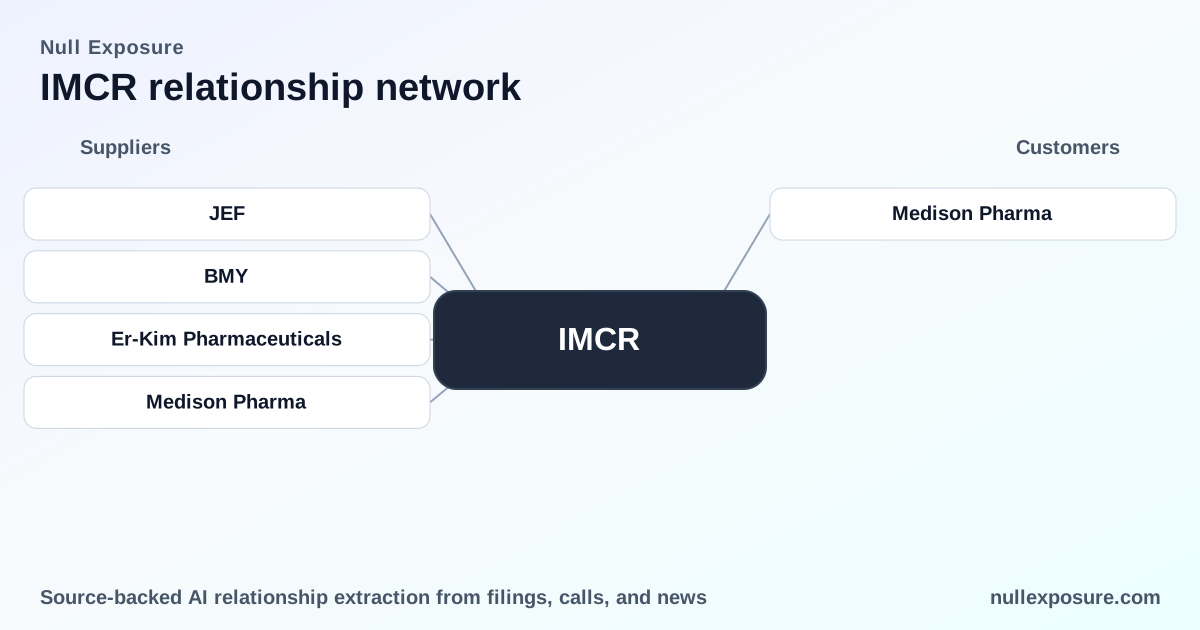
IMCR Supplier Map: Manufacturing, Underwriters, and Commercial Partners to Monitor
Immunocore Holdings Ltd (IMCR) is an advanced‑stage biotechnology company that monetizes through specialty oncology product sales, strategic collaborations, and capital markets activity. Its commercial engine today centers on the sale of KIMMTRAK while clinical collaborations, licensing, and the ability to access public markets (including an open market ADS facility) supply financing runway and optionality for pipeline advancement.
Explore more supplier and partner intelligence at https://nullexposure.com/ for a concise view of how these relationships translate into operating and commercial risk.
How Immunocore structures the supply chain and why that matters to investors
Immunocore operates a primarily outsourced manufacturing model, relying on contract manufacturing organizations (CMOs) for both drug substance and drug product. Company disclosures state that Immunocore does not own or plan to build manufacturing capacity; instead, it has a history of producing cGMP batches through third parties and retains manufacturing obligations that could total tens of millions in potential payments. These features create a contracting posture that is flexible and capital‑light, while exposing the company to counterparty operational risk.
- Geographic footprint: Key manufacturing operations for KIMMTRAK are located in Denmark and Germany with final packaging in the Netherlands, indicating a concentrated EMEA supply chain hub and logistics vector. (Company disclosures summarized in TradingView’s coverage of IMCR’s SEC 10‑K, March 10, 2026.)
- Cost profile and materiality: Management characterizes the cost of revenue for KIMMTRAK as currently immaterial, though it expects costs to rise with scale and inflationary pressure. This signals low gross‑margin volatility today, but rising manufacturing spend as commercial volumes increase. (IMCR FY2026 commentary via TradingView SEC 10‑K summary.)
- Contracting risks and maturity: Reliance on CMOs and third‑party diagnostics developers positions Immunocore with standard biotech outsourcing risks—capacity, quality, and regulatory compliance—but the firm points to an established cGMP manufacturing history as mitigation.
Capital markets partners that provide liquidity optionality
Immunocore maintains dealer relationships and underwriting history that support capital access. An open market sale agreement with Jefferies LLC allows issuance and sale of ADSs up to $250 million, although no draws under that facility were reported through the end of 2025. Separately, Goldman Sachs, J.P. Morgan and Jefferies served as underwriters for IMCR’s IPO, establishing a trio of top-tier investment banks with transaction familiarity. (Jefferies open market agreement reported in TradingView’s SEC 10‑K summary, March 10, 2026; underwriting noted in MarketBeat coverage, February 2026.)
For a platform view of these capital relationships and their implications for supplier and counterparty diligence, visit https://nullexposure.com/.
Commercial and clinical partnerships that expand reach and validation
Immunocore uses a hybrid commercialization model: an in‑house U.S. sales force augmented by contracted resources across the U.S. and Europe, and collaborations with regional partners—notably Medison Pharma and Er‑Kim Pharmaceuticals—to broaden market coverage in territories outside Immunocore’s direct footprint. (TradingView SEC 10‑K summary, March 10, 2026.)
On the clinical side, Immunocore has an active clinical trial collaboration with Bristol Myers Squibb (BMS) to test a bispecific TCR candidate combined with nivolumab in advanced melanoma, representing strategic alliance with a major oncology platform and potential clinical validation pathway. (TradingView SEC 10‑K summary, March 10, 2026.)
Market data and valuation touchpoints
Market data vendors and extended‑hours pricing providers—referenced in press coverage—play a supporting role in near‑term price discovery and investor visibility; MarketBeat cites Barchart Solutions as a market data host and Massive as an extended‑hours fair value provider in recent reporting on insider trades and coverage. These vendors are not commercial partners for product distribution but are relevant to investors tracking liquidity and price signals. (MarketBeat instant alerts, February–May 2026.)
Relationship roll call: every named supplier, banker, and partner in the record
- JEF — An open market sale agreement is in place with Jefferies LLC allowing issuance and sale of ADSs up to $250 million; no sales had been executed under the agreement as of the end of 2025, per TradingView’s summary of IMCR’s SEC 10‑K (March 10, 2026). (Source: TradingView SEC 10‑K coverage, 2026‑03‑10.)
- Jefferies LLC — Jefferies serves as the counterparty for IMCR’s $250 million open market ADS facility, providing a direct channel for capital raises if exercised; TradingView’s K‑report notes no draws through 2025. (Source: TradingView SEC 10‑K coverage, 2026‑03‑10.)
- Goldman Sachs — Listed among the underwriters for Immunocore’s IPO, positioning Goldman as a historical capital markets partner that underwrote the company’s public listing. (Source: MarketBeat instant alert on underwriting, 2026‑02.)
- Jefferies — Also named as an IPO underwriter alongside Goldman and J.P. Morgan, reinforcing Jefferies’ multi‑role as both underwriter and ADS placement agent. (Source: MarketBeat instant alert on underwriting, 2026‑02.)
- J.P. Morgan — Participated as an IPO underwriter, establishing a top‑tier banking relationship that supports institutional distribution of IMCR equity securities. (Source: MarketBeat instant alert on underwriting, 2026‑02.)
- Jefferies (duplicate entry) — See the Jefferies entries above; coverage reiterates both the underwriting role and the open market sales agreement in public filings. (Source: MarketBeat & TradingView, 2026.)
- Goldman Sachs (duplicate entry) — See above; MarketBeat references Goldman’s underwriting role in IPO activity for IMCR. (Source: MarketBeat, 2026.)
- J.P. Morgan (duplicate entry) — See above; referenced as an IPO underwriter in MarketBeat coverage. (Source: MarketBeat, 2026.)
- BMY — Bristol Myers Squibb is recorded as a clinical collaborator on a trial investigating a bispecific TCR candidate combined with nivolumab for advanced melanoma, a potentially meaningful clinical partnership. (Source: TradingView SEC 10‑K coverage, 2026‑03‑10.)
- Barchart Solutions — Cited by MarketBeat as the host for delayed market data used in reporting; relevant to investors for data latency and transparency rather than product commercialization. (Source: MarketBeat instant alert, 2026‑02‑19.)
- BMS (Bristol Myers Squibb) — Duplicate of BMY; TradingView names BMS as the clinical trial collaborator in the melanoma combination study with nivolumab. (Source: TradingView SEC 10‑K coverage, 2026‑03‑10.)
- Medison Pharma — Identified as a regional collaborator supporting market reach under Immunocore’s hybrid commercialization model in the U.S. and Europe. (Source: TradingView SEC 10‑K coverage, 2026‑03‑10.)
- Er‑Kim Pharmaceuticals — Listed as a commercial collaborator alongside Medison Pharma to help distribute and support product access in specific territories. (Source: TradingView SEC 10‑K coverage, 2026‑03‑10.)
- Massive (HUGE) — MarketBeat references Massive as the source of fair market value extended‑hours pricing used in some price reports; this affects valuation transparency for investors tracking intraday and post‑market moves. (Source: MarketBeat instant alert, 2026‑02‑19.)
Investment implications and what to watch next
- Counterparty concentration and geography: EMEA manufacturing for KIMMTRAK centralizes operational risk in Denmark/Germany/Netherlands; investors should monitor CMO capacity, regulatory inspections, and logistics disruption risk. (TradingView SEC 10‑K summary, March 2026.)
- Cost trajectory: Manufacturing is described as immaterial today, which cushions near‑term margin volatility, but investors must budget for increasing cost of goods sold if commercial volumes scale. (Company disclosures summarized in TradingView’s coverage.)
- Capital flexibility: The Jefferies ADS facility and the historical underwriting syndicate give Immunocore accessible capital routes without building a balance‑sheet manufacturing base. (TradingView & MarketBeat coverage, 2026.)
- Clinical validation through partners: The BMS collaboration is high‑value from a validation perspective; positive outcomes would materially de‑risk program economics and downstream commercial partnerships. (TradingView SEC 10‑K summary, March 2026.)
For a consolidated supplier and partner risk brief tailored to IMCR and comparable peers, visit https://nullexposure.com/ and request a supplier‑risk snapshot.
Bold takeaway: Immunocore’s outsourced manufacturing and tier‑one capital partners create a capital‑efficient model that transfers operational execution risk to third parties—this lowers fixed costs but concentrates supply‑chain and counterparty risk in EMEA CMOs and select commercial partners.