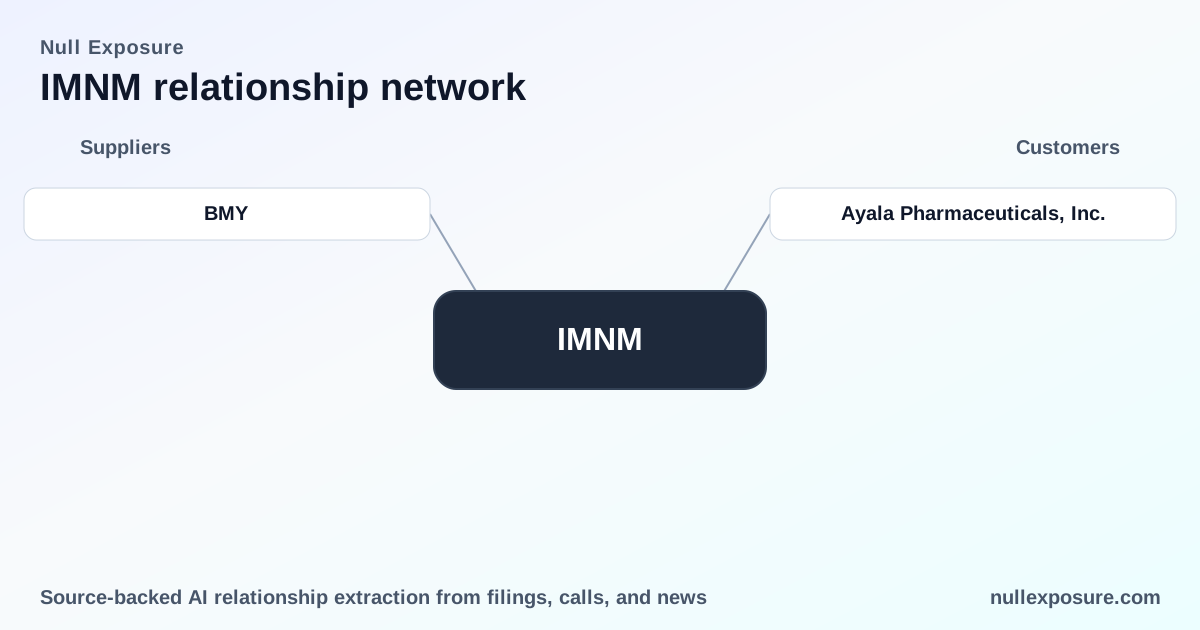
IMNM supplier profile: licensing-led development with concentrated manufacturing exposure
IMNM operates as a development-stage biopharmaceutical company that monetizes primarily through in‑licensing and sublicensing intellectual property and advancing clinical programs that depend on third‑party manufacturers. Revenue levers are structured around royalty‑bearing licenses and potential milestone or commercialization arrangements, while cost and operational risk concentrate in outsourced manufacturing, CROs and other service providers. According to IMNM’s FY2024 10‑K filing, the company assumed a material license from Bristol‑Myers Squibb in March 2024 and continues to rely on external manufacturers and service providers to advance its pipeline.
If you evaluate counterparty and supply risk for portfolio allocation or partnership diligence, start here: review IMNM’s license map, sole‑source exposure and the geographic footprints of its suppliers. For a consolidated view of supplier relationships and risk prioritization, visit https://nullexposure.com/.
What the Bristol‑Myers Squibb license actually gives IMNM
IMNM disclosed in its FY2024 10‑K that, following the closing of the Ayala Purchase Agreement in March 2024, it assumed the BMS License Agreement—a worldwide, non‑transferable, royalty‑bearing, exclusive and sublicensable license under certain BMS patent rights and know‑how. This is a transfer of IP rights that provides IMNM immediate access to BMS technology while preserving royalty obligations to BMS (IMNM 10‑K, FY2024).
A related, explicit license IMNM holds with Zentalis
In addition to BMS, IMNM documented entering a license agreement with Zentalis in January 2024 granting an exclusive, worldwide, royalty‑bearing, sublicensable license to Zentalis’ ADC platform technology and ROR1‑targeting assets—positioning IMNM as a licensee for ADC IP in its ROR1 programs (company filing, January 2024).
How these relationships fit together and what they signal
- Licensing is a core commercial mechanism. IMNM’s public disclosures repeatedly describe royalty‑bearing, sublicensable license structures—this is the company’s primary route to access and exploit third‑party IP rather than building equivalent platforms in‑house.
- Outsourcing is the operational backbone. IMNM relies on contract manufacturers and CROs for preclinical, clinical and (potential) commercial supply, which concentrates operational risk externally.
- Geographic supply and regulatory exposure is material. The company transfers personal data from Europe and notes potential impacts from U.S. trade restrictions on certain Chinese biotech and CRO partners, elevating legal and supply risk in EMEA and APAC regions.
For an investor, the combination of royalty obligations on licensed IP plus outsized dependence on third‑party CMOs/CROs creates a profile where margin upside is linked to successful commercialization but downside is concentrated in supplier continuity and contract terms.
The operational constraints that define counterparty risk
IMNM’s own disclosures enumerate several supplier‑related constraints that drive risk and valuation sensitivity:
- Contract type — licensing (high confidence). Multiple license agreements are royalty‑bearing and sublicensable, reflecting monetization through IP rights rather than asset ownership.
- Contract duration — long‑term orientation (moderate confidence). The company expects to continue using third‑party manufacturers and service providers for the foreseeable future.
- Relationship roles — manufacturer and service provider (high confidence). IMNM outsources manufacturing, clinical operations and cybersecurity services to third parties.
- Materiality — critical dependency (moderate confidence). The company explicitly states that third‑party manufacturing is critical and that replacing manufacturers could be difficult and resource‑intensive.
- Geography — EMEA and APAC exposures (high confidence). Disclosures highlight data transfers from Europe and potential trade/regulatory issues involving Chinese suppliers.
These constraints, taken together, indicate a contracting posture that prioritizes license capture and program advancement through partners rather than vertical integration, with attendant single‑point risks in supply and regulatory exposure (IMNM 10‑K, FY2024; company filings, Jan 2024).
Midway diligence step: if you need a consolidated supplier risk heatmap for IMNM, start your model by weighting exclusive license obligations and sole‑source manufacturing higher than typical for a development‑stage biotech. For additional intelligence, check https://nullexposure.com/.
Contracting posture and concentration — how to price IMNM’s supplier risk
IMNM’s operating statements show a deliberate tradeoff: acquire or assume IP through licenses and scale programs quickly via CMOs/CROs, rather than build manufacturing capability. That posture accelerates time‑to‑market but produces three investor realities:
- Revenue upside is leveraged to successful out‑licensing, milestones and future commercialization rights but is net of royalty streams owed to licensors (BMS, Zentalis).
- Operational continuity is concentrated. Sole‑source or limited‑number supplier relationships can create supply interruptions that have outsized clinical or commercial impact.
- Switching costs are high. Replacing qualified CMOs or revalidating manufacturing processes would require significant time and expense, per company disclosures (FY2024 10‑K).
Investors should therefore assign a higher probability to supply disruption scenarios and stress test valuation models for delays in Phase 3 and early commercial launch timing.
Geographic and regulatory implications to monitor
IMNM highlights two regional exposures that influence partner selection and resilience:
- EMEA: personal data transfers from Europe to the U.S. create compliance requirements with EU data protection regimes that can affect vendor contracts and cloud/service provider selection.
- APAC/China: potential U.S. trade restrictions and evolving Chinese regulation of biotech and CROs could constrain access to materials or services sourced from Chinese partners.
Both geographies require active counterparty governance and contingency planning to avoid development slowdowns (company filing, FY2024).
What investors and operators should watch next
- Track additional license or assignment filings that change royalty burdens or territory rights—new license terms materially alter gross economics.
- Monitor CMO diversification: look for announced multi‑sourcing, redundancy plans, or vertical capacity investments that reduce sole‑source risk.
- Watch public disclosures about manufacturing outages, batch failures, or regulatory inspections—these are near‑term catalysts for program delays.
- Keep an eye on APAC trade policy and EMEA data‑privacy litigation that could increase vendor compliance costs or limit supplier pools.
For a deeper supplier mapping and to monitor these triggers in real time, run a counterparty search at https://nullexposure.com/.
Bottom line — a concentrated supplier profile with licensing‑driven upside
IMNM’s model is license‑first, outsource‑dependent: the company advances programs by securing royalty‑bearing, sublicensable IP and delegating manufacturing and service delivery to third parties. That structure creates meaningful upside if programs advance to market, but investors must price a persistent, structural supplier risk—concentration, potential sole‑source dependencies and multi‑jurisdictional regulatory exposures—into any valuation or partnership thesis (IMNM 10‑K, FY2024; company filing, Jan 2024).
If you are evaluating supplier risk for exposure limits, partnership diligence or portfolio stress tests, begin with the BMS and Zentalis license terms and then map current CMO/CRO relationships against the geographic and regulatory constraints outlined above. For operationalized counterparty intelligence, visit https://nullexposure.com/.