Imunon Inc (IMNN): supplier footprint, financing partners, and what investors should price in
Imunon is a clinical‑stage biotechnology company that develops immune‑mediated therapies using its proprietary INFECT platform and monetizes primarily through collaborations, licensing and capital markets financing rather than product sales. With negligible product revenue to date, the company advances candidates through outsourced clinical and manufacturing partners while supplementing development cash needs through at‑the‑market programs and registered direct placements. Investors should price the stock as a development‑stage play where operational execution by third‑party manufacturers and placement agents materially determines runway and dilution.
Discover more supplier and counterparty intelligence at https://nullexposure.com/.
Why the supplier roster matters to an investor
For small biotechs like Imunon, supplier relationships are not administrative line items — they are execution nodes that determine whether a candidate reaches pivotal studies, regulatory filings and eventual commercialization. From the disclosed evidence we draw several company‑level operating signals:
- Contracting posture is short‑term and flexible. The company states it typically procures on purchase orders rather than long‑term minimum supply contracts, which preserves flexibility but increases exposure to availability and pricing volatility.
- Third‑party partners are operationally critical and material. Failure by a contract manufacturer, CRO or testing contractor to meet regulatory or quality standards can delay trials and approvals and would have a material adverse effect on the business.
- The relationship mix is service‑heavy and manufacturing‑dependent. The filings reference CMOs, CROs, clinical investigators, data managers and multiple named partners that supply facilities, technology development and lab space.
- Relationships are active but concentrated by stage. Imunon relies on outsourced partners for clinical trial supplies and program execution — a typical maturity profile for a clinical‑stage firm: active external management rather than internal scale.
Those operating characteristics translate into a specific risk/return profile: agility and lower fixed overhead, but higher counterparty and regulatory execution risk, and a financing dependence that amplifies dilution when clinical timelines slip.
Quick look: the named counterparties investors should know
Below I summarize each supplier/partner relationship disclosed in the available public notices and filings. Each item is tied to the source language cited in the company press releases or SEC filings.
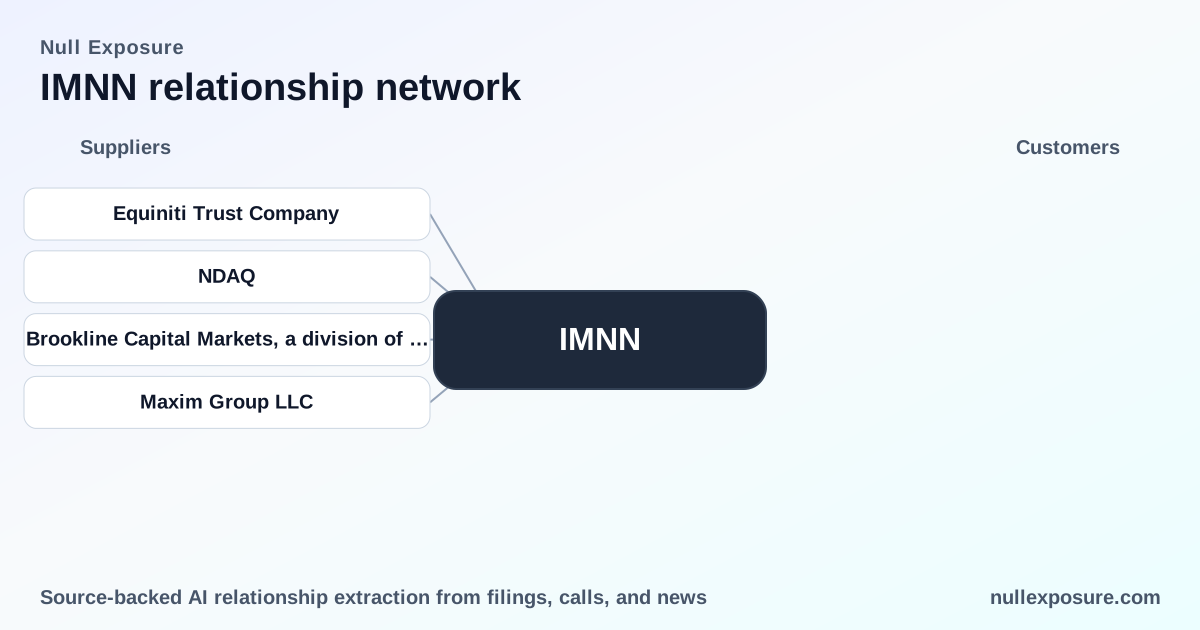
- Equiniti Trust Company — According to a GlobeNewswire press release on July 23, 2025, Equiniti is acting as Imunon’s transfer agent and is serving as the exchange agent for the company’s reverse stock split, responsible for sending instructions to registered certificate holders about exchanging old certificates for new ones. Source: GlobeNewswire, July 23, 2025 (company press release).
- The Nasdaq Capital Market — A GlobeNewswire announcement on July 23, 2025 confirmed that Imunon’s common stock will continue to trade on The Nasdaq Capital Market under ticker “IMNN” and that the company’s shares will trade under a new CUSIP (15117N701) following the reverse split. Source: GlobeNewswire, July 23, 2025 (company press release).
- Brookline Capital Markets (division of Arcadia Securities, LLC) — In a GlobeNewswire release on December 30, 2025 Imunon disclosed that Brookline Capital Markets acted as a co‑placement agent for a $7.0 million registered direct offering priced at the market under Nasdaq rules. This identifies Brookline as a capital markets intermediary supporting immediate financing needs. Source: GlobeNewswire, December 30, 2025 (company press release).
- Maxim Group LLC — The same December 30, 2025 GlobeNewswire release lists Maxim Group LLC as the lead placement agent on the $7.0 million registered direct offering, positioning Maxim as the principal underwriter/placement partner for that financing. Source: GlobeNewswire, December 30, 2025 (company press release).
These relationships reflect a mix of corporate services (transfer agent, exchange administration), listing venue continuity, and active financing partners used to raise near‑term capital.
Explore a broader map of counterparties and supplier risk at https://nullexposure.com/.
What the constraints and disclosures mean for risk and valuation
Read together, the constraint excerpts from Imunon filings produce a coherent operational portrait:
- Short‑term contracting increases execution volatility. The company routinely uses purchase orders and non‑dedicated capacity, which keeps fixed costs low but creates exposure to supplier scheduling and quality problems. This is a company‑level signal, not tied to any specific vendor.
- Manufacturing and clinical service risk is material. Filings explicitly state that failures by third‑party manufacturers, CMOs or testing contractors could delay trials, approvals and commercialization and would have a material adverse effect on the business. Investors must treat manufacturing/compliance risk as a valuation lever—delays translate to higher cash burn and larger financing rounds.
- Service provider reliance is broad and active. The company lists reliance on CROs, clinical investigators and data managers and references specific legal arrangements for product supply, lease and technology development. Named partners referenced in filings include Yakult Honsha Co., Ltd., the HudsonAlpha Institute of Biotechnology (lab/office lease) and Zhejiang Hisun Pharmaceutical Co. Ltd., providing historical context around the types of third‑party arrangements in place.
- There is seller activity in R&D sourcing. The company notes purchases from vendors such as Transomic for R&D inputs (delivery vectors), which signals operational sourcing across multiple specialty vendors and platforms.
Bottom line: Imunon’s value extraction depends on third‑party performance and access to capital. Any scenario analysis for upside should stress‑test timelines against CMO and CRO delivery, and downside should price in incremental dilution if clinical milestones slip.
Investment implications and next steps for diligence
- Operational risk is the primary non‑market variable. Underwriters and transfer agents (Equiniti, Nasdaq) are routine corporate infrastructure; the real value swing is governed by CMOs and CROs not fully enumerated in these notices. Investors should request the counterparty list, quality metrics and contingency plans for key manufacturing steps.
- Financing partners matter. Maxim and Brookline’s roles in the December 2025 registered direct offering signal active near‑term liquidity management, which investors should monitor for frequency and pricing of subsequent raises.
- Monitor regulatory and inspection disclosures closely. Given the materiality clause around manufacturing compliance, any FDA or foreign inspection outcome will be market‑moving.
If you want supplier mapping and counterparty exposure modeled against cash‑run scenarios, start here: https://nullexposure.com/.
Conclusion: price discipline and operational monitoring
For investors and operators evaluating Imunon, the thesis is clear: this is a development‑stage biotech where third‑party execution and capital markets access dominate risk and returns. Equiniti and Nasdaq provide corporate infrastructure, while Maxim and Brookline underwrote near‑term financing — together they reflect a company actively managing liquidity and corporate mechanics but still structurally exposed to manufacturing and trial delivery risk. Strong governance, transparent counterparty metrics and contingency plans around CMOs/CROs should be prioritized in any ongoing diligence.
For a deeper supplier analysis and prioritized counterparty watchlist tailored to your portfolio, visit https://nullexposure.com/.