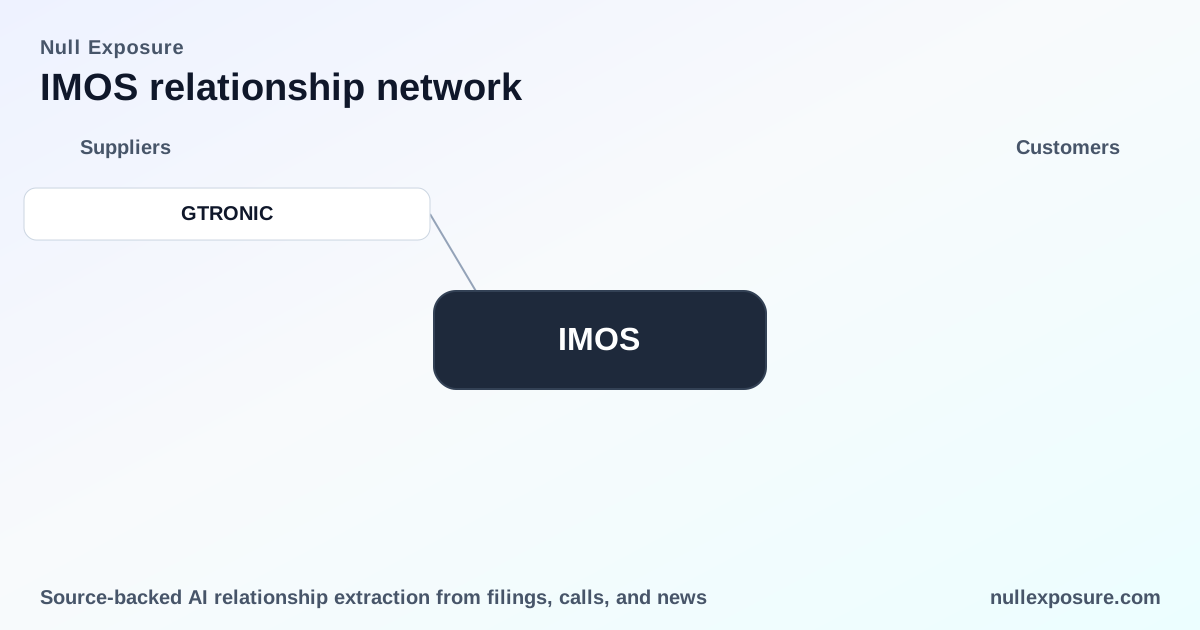
ChipMOS Technologies (IMOS): Supplier Map and Investment Implications
ChipMOS Technologies monetizes by providing contract semiconductor back-end services—IC packaging, testing and other backend manufacturing services—selling capacity and technical services to device manufacturers and other supply-chain counterparties. The company generates revenue through service fees and capacity utilization; its latest company filings show trailing twelve‑month revenue of roughly 23.93 billion with EBITDA and gross-profit levels that support an asset‑intensive back‑end operation (latest quarter through 2025-12-31). For investors and operators, the crucial questions are how ChipMOS sources third‑party capacity, how those supplier relationships affect margins and continuity of service, and whether counterparty exposure concentrates operational risk. Explore more supplier intelligence at https://nullexposure.com/.
Quick financial posture that matters to supplier risk
ChipMOS is a mid‑cap, exchange‑listed back‑end provider with market capitalization around $1.39 billion and an operational profile that blends low operating margins with sizable revenue scale. Key financial signals that influence supplier and counterparty analysis:
- Operational leverage and margins: Operating margin ~9.75% and profit margin ~2.07% indicate the business is sensitive to pricing on core services and to input or subcontracting costs.
- Capital intensity and valuation: EV/EBITDA of 7.41 and EV/Revenue ≈ 1.86 suggest the market prices a stable, capital‑heavy service provider rather than a high‑margin fabless company.
- Analyst context: Trailing P/E is elevated at 92.44 while forward P/E is materially lower at 11.38, reflecting a recent earnings inflection and investor expectation changes as of the latest filing period (2025-12-31).
These financials matter because supplier contracts for packaging and testing directly feed margins and capacity utilization; outsourcing decisions can turn fixed cost into variable cost and vice versa.
Supplier relationships: what we know
- Globetronics Technology Bhd — Globetronics signed a contract valued at RM145 million to provide integrated circuit packaging, testing and backend services to ChipMOS Technologies. According to The Edge Malaysia on March 10, 2026, the agreement covers IC product packaging, testing and backend services for ChipMOS in FY2025. This is a direct outsourcing arrangement where ChipMOS uses Globetronics as a back‑end supplier.
Source: The Edge Malaysia, March 10, 2026.
What the Globetronics deal signals for operators and investors
The RM145 million engagement with Globetronics signals several operational realities for ChipMOS:
- Outsourcing to manage capacity and capital deployment. Contracting with third‑party packagers/testers converts some fixed capital exposure into supplier costs, enabling ChipMOS to flex capacity without equivalent capex.
- Operational dependency on specialist suppliers. Outsourcing critical back‑end processes to external providers increases operational dependence; continuity and service levels with partners like Globetronics become critical to customer fulfillment.
- Commercial bargaining and margin pressure. Paying external suppliers for packaging/testing compresses gross margins unless ChipMOS captures pricing power through volume, technical differentiation, or pass‑through pricing to customers.
Source: The Edge Malaysia report, March 10, 2026.
Company‑level constraints and operating signals investors need to weigh
The constraints field for supplier relationships contains no explicit excerpts, so treat the following as company‑level signals derived from ChipMOS’s operating profile and filings through 2025‑12‑31:
- Contracting posture: ChipMOS operates as a buyer of external back‑end capacity when advantageous, indicating a flexible contracting posture that leverages third‑party suppliers to manage throughput spikes and reduce immediate capex.
- Concentration: Reported institutional ownership is relatively low (~6.2%), which translates into less herd‑driven scrutiny and potentially slower public discovery of supplier risk; operational disclosures on counterparties therefore matter more to direct investors and counterparties.
- Criticality: Back‑end services such as packaging and testing are mission‑critical to ChipMOS’s ability to deliver finished product to customers; any disruption at key suppliers will have immediate operational and revenue impact.
- Maturity: The company’s financial profile, listing status and scale suggest an established operator in the back‑end segment rather than an early‑stage vendor, implying mature contracting practices but also entrenched legacy cost structures that suppliers can exploit.
These company‑level signals instruct investors to prioritize contractual detail, service‑level commitments, and counterparty financial strength when assessing supplier risk.
Due diligence checklist for investors and operators
When evaluating IMOS supplier relationships, prioritize the following items to move from headlines to investable insight:
- Contract size, currency and payment terms — understand whether amounts like RM145 million are one‑off, multi‑year, or capacity‑reservation fees.
- Counterparty financial health — review Globetronics’ balance sheet and liquidity to assess continuity risk for outsourced services.
- Exclusivity and termination provisions — determine whether supplier agreements create single‑source exposure or allow ChipMOS to transfer volume under stress.
- Capacity and geographic dispersion — map where packaging/testing is performed and the logistics risk tied to those sites.
- IP, quality and warranty terms — ensure testing and packaging vendors accept liability and meet yield standards tied to ChipMOS’s customer contracts.
- Price pass‑through mechanics and margin impact — quantify how supplier costs flow to ChipMOS margins and final pricing.
These checklist items convert a signed contract into a clear operational and financial impact model.
Explore supplier analytics and scenario templates at https://nullexposure.com/ to accelerate due diligence.
Bottom line — investor implications and action items
The Globetronics engagement is material from an operational standpoint: outsourcing a substantial package of packaging and testing services aligns with ChipMOS’s approach to manage capacity without large incremental capex, but it also shifts operational risk onto third parties. For investors, the tradeoff is straightforward: flexibility and reduced capex versus increased counterparty and operational concentration risk.
Recommended actions for investors and operators:
- Request contract economics and term sheets for major supplier arrangements to quantify margin and cash‑flow impact.
- Monitor supplier financials and service‑level performance metrics; treat large supplier contracts as integral to ChipMOS’s capacity profile.
- Stress‑test revenue continuity under supplier disruption scenarios to estimate short‑term margin and delivery impacts.
For deeper supplier intelligence and workflow tools that speed contract analysis, visit https://nullexposure.com/.
Conclusion: ChipMOS’s use of external back‑end providers like Globetronics represents a deliberate operating choice that optimizes capital deployment but requires disciplined supplier governance. Investors should treat these supplier relationships as operationally critical line items, not peripheral footnotes, when evaluating IMOS’s earnings quality and execution risk.