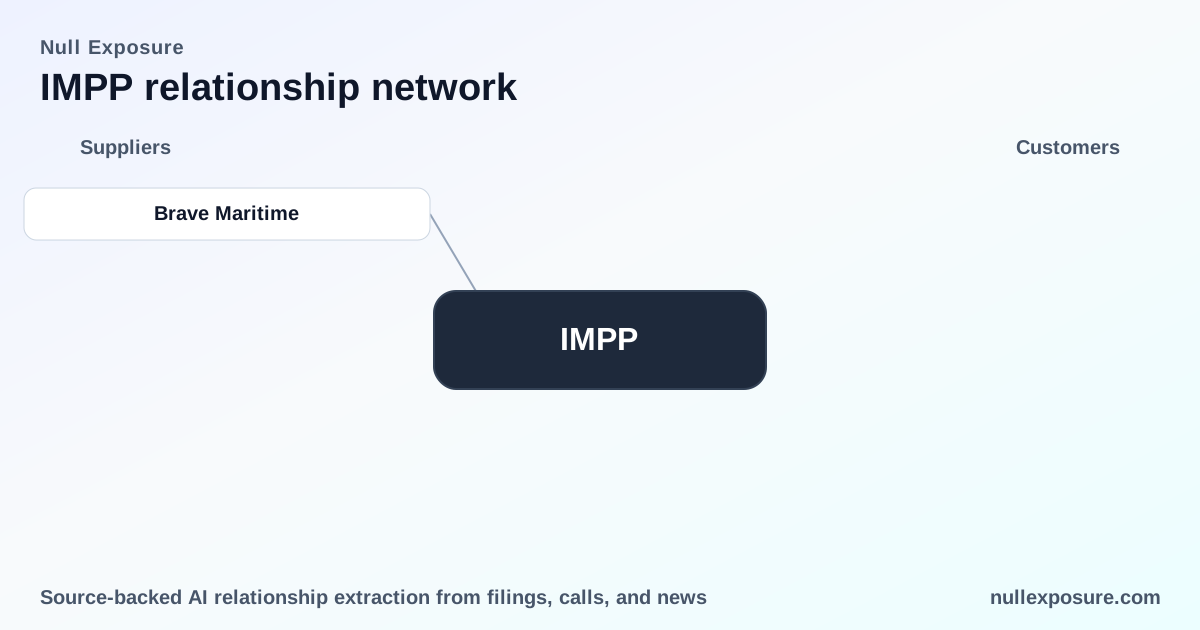
Imperial Petroleum (IMPP): Supplier relationships, strategy, and what the Brave Maritime deal reveals
Imperial Petroleum monetizes a fleet-centric business model: it acquires, modernizes, and operates tankers that transport refined petroleum and related products, generating revenue through shipping operations and contractual charters while extracting asset value via disciplined fleet purchases. The company's economics are driven by asset acquisition timing, utilization of vessels, and margin capture on voyage and charter revenues, supported by a compact capital structure (market cap ~$169M) and robust operating profitability (EBITDA margin and positive net margin). For investors and operators evaluating supplier and counterparty risk, the Brave Maritime transaction offers a concrete window into Imperial’s acquisition posture and operational playbook. Learn more at https://nullexposure.com/.
Quick take: why the Brave Maritime relationship matters for counterparties
Imperial completed an acquisition agreement with Brave Maritime to purchase two M.R. refined petroleum product tankers for an aggregate purchase price around $31 million, with delivery expected on a charter-free basis in May 2022. This is a classic asset-acquisition move that increases Imperial’s capacity and gives it immediate commercial control of the vessels, which supports higher utilization and revenue visibility. According to a GlobeNewswire press release dated March 8, 2022, the vessels were built in 2008 and 2011 with combined capacity near 97,000 dwt (https://www.globenewswire.com/news-release/2022/03/08/2399481/0/en/Imperial-Petroleum-Announces-Agreement-to-Acquire-Two-Product-Tankers.html).
The Brave Maritime relationship — what was reported
Brave Maritime sold two medium-range product tankers to Imperial for about $31 million total, delivering the vessels free of charter obligations and expanding Imperial’s transport capacity by roughly 97,000 deadweight tons. The sold vessels were built at SLS Shipbuilding (South Korea) in 2008 and Shin Kurushima Dockyard (Japan) in 2011, with expected delivery by end-May 2022 (GlobeNewswire, March 8, 2022 — https://www.globenewswire.com/news-release/2022/03/08/2399481/0/en/Imperial-Petroleum-Announces-Agreement-to-Acquire-Two-Product-Tankers.html).
What this relationship indicates about Imperial’s operating model
- Contracting posture: Imperial demonstrates an acquisition-first posture for fleet growth—securing second-hand vessels from specialist sellers and taking delivery free of existing charters to start commercial deployment immediately. That contracting pattern lowers short-term integration complexity and improves time-to-revenue for new tonnage.
- Concentration and criticality: The company’s growth through targeted purchases implies dependence on a small number of counterparties that supply suitable vessels; this raises supplier concentration risk if a limited pool of sellers controls available tonnage in the relevant vintage and class.
- Maturity and strategic clarity: Buying relatively young second-hand tonnage (2008/2011 builds) signals a prioritization of reliability and remaining asset life rather than speculative ultra-low-cost buys, consistent with a moderate-maturity fleet enhancement strategy designed to balance capex and operational uptime.
These are company-level operating signals derived from reported transactions and the firm’s stated focus on fleet modernization. For a snapshot of Imperial’s financial leverage and operating efficiency—useful for assessing supplier credit and payment risk—note the 2025 trailing metrics: Revenue ~$161.0M, EBITDA ~$64.9M, Profit Margin ~31%, Market Cap ~$169.2M, EV/EBITDA ~1.09 (company filings and market data). This profitability profile supports contract obligations to sellers and shipyards but also concentrates downside on freight-rate cycles.
Explore further supplier and counterparty intelligence at https://nullexposure.com/.
Financial posture and implications for supplier relationships
Imperial’s margins and cash flow generation—EBITDA of $64.9M on $161.0M revenue—create practical headroom for both capital spending and short-term supplier commitments. Key balance and market signals:
- Valuation and leverage: The company trades at a low EV/EBITDA multiple (≈1.09) and a modest price-to-book ratio (≈0.37), indicating the market prices in cyclicality and asset-intensity but also leaving upside if fleet utilization rises.
- Ownership and governance: Insider ownership (~29.7%) and institutional ownership (~36.8%) provide concentrated governance that can accelerate fleet decisions but also concentrate influence on counterparty selection.
- Operational risk drivers: Freight rate cycles, age profile of vessels, and availability of suitable sellers or shipyards determine near-term supplier negotiation leverage for Imperial and for firms contracting with Imperial for logistics.
For counterparties—shipyards, sellers, service providers—Imperial’s demonstrated willingness to transact for second-hand tonnage on a charter-free basis is an operational advantage: it reduces supplier exposure to legacy charter encumbrances and clarifies delivery expectations.
Supplier constraints and company-level signals
There were no supplier- or contract-specific constraints reported in the available supplier-scope coverage for IMPP. As a company-level signal, the absence of documented contractual constraints in the supplier results suggests open flexibility in Imperial’s supplier engagements—the company is operating with an acquisition-first, market-driven sourcing approach without disclosed long-term supplier exclusivities or restrictive covenants in public filings.
What investors and operators should watch next
- Monitor announcements for additional vessel acquisitions or disposals: recurring purchases from the same counterparties would increase concentration risk; a broader supplier base would reduce single-counterparty dependency.
- Track utilization rates and charter revenues quarter-to-quarter to validate that purchased tonnage delivers the projected incremental EBITDA.
- Watch freight-rate cycles and vessel age mix: those two inputs materially alter asset values and the economics Imperial captures from each acquisition.
If you want consolidated supplier intelligence and deeper counterparty profiles for investment or operational decisions, start with our homepage at https://nullexposure.com/.
Bottom line
Imperial Petroleum’s supplier activity, exemplified by the Brave Maritime purchase, reveals a deliberate asset-acquisition strategy designed to expand controllable capacity quickly and with immediate commercial flexibility. Financially, the firm’s strong margins and low EV multiples underline both operational profitability and cyclical exposure. For counterparties and investors, the key takeaway is that Imperial prefers clean, charter-free acquisitions that accelerate utilization—an approach that reduces integration risk for suppliers but increases counterparty concentration considerations for the buyer. For additional supplier-focused analysis and real-time relationship tracking, visit https://nullexposure.com/.