Imperial Petroleum (IMPPP): supplier relationships, capital partners, and what investors should know
Imperial Petroleum operates tankers and logistics services for petroleum and petrochemicals and monetizes through freight and terminal services while supporting corporate liquidity via capital-markets instruments — including publicly traded 8.75% Series A cumulative preferreds (IMPPP). The business combines recurring transport economics with periodic capital raises and share-based programs; investors evaluating supplier or counterparty relationships should focus on Imperial’s capital-raising counterparties, exchange listing status, and disclosure channels, all of which influence funding availability and refinancing cost. For a structured view of these relationships and implications, visit https://nullexposure.com/.
How Imperial makes money and why the preferred shares matter
Imperial’s operating profile is a classic energy-transport model: revenue is generated from freight and handling (Revenue TTM: $161.0M), with gross profit of $72.1M and an operating margin near 26.7%, producing positive cashflow characteristics for asset-backed transport operations. The company lists both common and preferred securities on the Nasdaq Capital Market; the Series A preferred (IMPPP) provides a fixed-income-like return for investors and functions as a permanent source of capital supporting fleet and working-capital needs. Market indicators such as EBITDA ($64.9M), return on equity (10.5%), and a modest institutional ownership (about 10.3%) give context to counterparty bargaining power and financing options. Learn more about supplier and counterparty implications at https://nullexposure.com/.
Capital-market counterparties: what the record shows
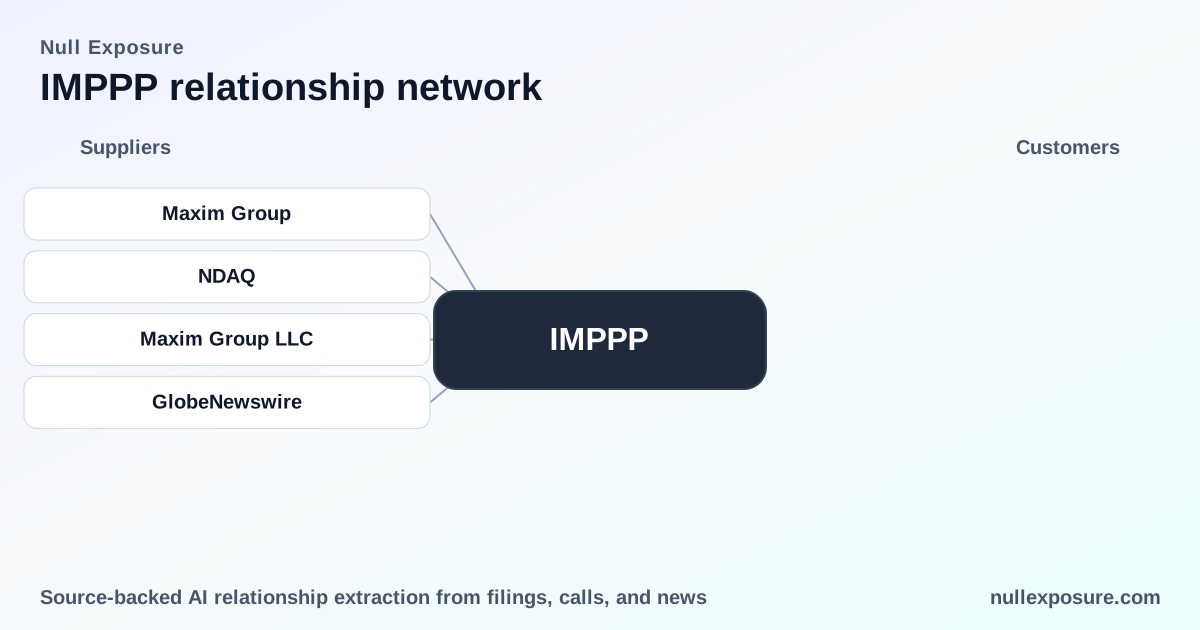
Imperial’s recent public disclosures and press coverage identify a small set of recurring capital-market counterparties and distribution channels that investors and suppliers should monitor closely. The evidence in filings and press releases shows repeated use of placement agents and Nasdaq listing references, which affects speed and certainty of capital access.
Maxim Group — sole book-running manager for an offering (FY2022)
InvestorPlace reported that Maxim Group acted as the sole book-running manager on a prior offering, indicating Imperial uses boutique investment-banking relationships for certain equity transactions. (InvestorPlace, May 2022: https://investorplace.com/2022/05/why-is-imperial-petroleum-impp-stock-down-35-today/)
Nasdaq — exchange listing and ticker disclosure (FY2026)
QuiverQuant cited Nasdaq disclosures confirming that Imperial’s common stock and its 8.75% Series A preferred trade on the Nasdaq Capital Market under “IMPP” and “IMPPP,” respectively, which ensures continuous market access and transparency obligations. (QuiverQuant/Nasdaq notice, FY2026: https://www.quiverquant.com/news/Imperial+Petroleum+Inc.+Announces+$10+Million+Share+Repurchase+Program)
Maxim Group LLC — sole placement agent for a registered direct offering (FY2025)
A GlobeNewswire release identified Maxim Group LLC as the sole placement agent in a $60.0M registered direct offering, reinforcing a pattern where Imperial relies on a single placement agent to distribute capital when executing registered financings. (GlobeNewswire, Nov 28, 2025: https://www.globenewswire.com/news-release/2025/11/28/3196306/0/en/Imperial-Petroleum-Inc-Announces-Pricing-of-60-0-Million-Registered-Direct-Offering.html)
Nasdaq Capital Market — repetition of listing and symbols (FY2025)
The same GlobeNewswire release restated that both common and preferred shares are listed on the Nasdaq Capital Market and identified the trading symbols, reinforcing the company’s reliance on a major exchange for liquidity and price discovery. (GlobeNewswire, Nov 28, 2025: https://www.globenewswire.com/news-release/2025/11/28/3196306/0/en/Imperial-Petroleum-Inc-Announces-Pricing-of-60-0-Million-Registered-Direct-Offering.html)
GlobeNewswire — press distribution flagged as AI-generated in secondary coverage (FY2026)
QuiverQuant noted that one press release distributed via GlobeNewswire was summarized by an AI-generated digest, a signal that secondary distribution channels and automated summarization are part of Imperial’s news flow, which investors should track for timing and fidelity of material disclosures. (QuiverQuant/GlobeNewswire note, FY2026: https://www.quiverquant.com/news/Imperial+Petroleum+Inc.+Announces+$10+Million+Share+Repurchase+Program)
What these relationships imply about Imperial’s operating posture
- Contracting posture and financing strategy: Repeated use of Maxim Group as sole placement agent/book-runner signals a deliberate reliance on a limited set of capital-market intermediaries for equity and registered-direct financings, which accelerates execution but concentrates placement risk.
- Concentration: The capital-raising distribution network is concentrated; a small number of intermediaries handle distribution. That concentration reduces transaction complexity but raises counterparty dependence for large raises.
- Criticality: Exchange listing on Nasdaq is a critical backbone for liquidity and market pricing; any change in listing status would materially impact access to public capital for both common and preferred holders.
- Maturity and disclosure channels: Use of GlobeNewswire and automated summaries indicates mature, broadcast-style disclosure practices, but reliance on third-party summarization increases the need for investors to verify original filings and full releases.
Note: there are no supplier-scope constraints recorded in the examined materials; that absence is a company-level signal indicating the public record did not flag contract redlines or supplier-specific encumbrances within the supplier relationship scope. Investors should nevertheless conduct contract-level diligence where counterparty concentration or critical supply links exist.
Investment implications — what investors and operators should prioritize
- Counterparty concentration is the primary operational risk. Reliance on a small number of placement agents and Nasdaq listing services concentrates execution risk for capital raises.
- Preferred stock is structurally important. The 8.75% Series A preferred (IMPPP) functions as long-dated capital with income characteristics that support operations; monitor call/redeem provisions and ex-dividend dates for cash-flow impact.
- Disclosure fidelity matters. Press distribution via GlobeNewswire and secondary AI summaries require investors to cross-check original filings to avoid information lag or summarization errors.
- Liquidity and market access are strong but not unlimited. Nasdaq listing provides ongoing liquidity, but institutional ownership is modest (~10.3%), so large blocks can move price and execution.
For a concise, actionable intelligence pack on counterparties and capital partners, visit https://nullexposure.com/.
Bottom line and next steps
Imperial Petroleum operates a capital-intensive shipping business financed in part through a publicly traded preferred and recurring registered offerings executed via a small set of placement agents, with Nasdaq as the liquidity venue. Key monitoring points for investors and supplier partners are capital-raising counterparties, placement concentration, and disclosure accuracy. For a deeper counterparty map and tailored supplier-risk briefings, see https://nullexposure.com/.
Conservative investors and counterparties should prioritize contractual due diligence on placement agreements and preferred-share terms, and track press-release provenance to ensure timely, accurate decision-making.