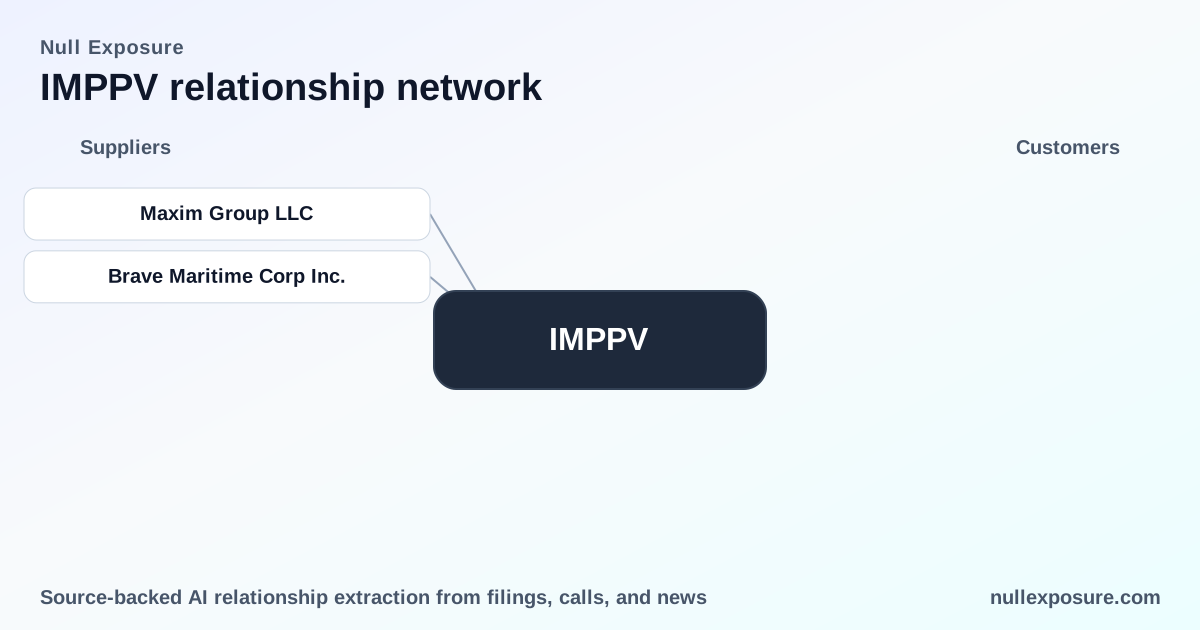
Imperial Petroleum (IMPPV) supplier relationships: what investors need to know
Imperial Petroleum monetizes through an asset-and-capital model: it grows and operates a fleet of product tankers and drybulk carriers that generate charter and freight revenue while financing expansion and working capital through securities offerings and warrant exercises. Revenue is therefore two-sided — operational income from vessels and periodic financing events sourced through capital markets partners — making supplier and placement relationships central to both growth and liquidity management.
Explore deeper supplier intelligence at https://nullexposure.com/ to track counterparties and transactional signals.
Why the supplier map matters to portfolio decisions
Imperial’s recent public record shows a dual operating posture: transactional maritime acquisitions sourced from third-party shipowners, and repeat engagement with a boutique capital markets firm for placement and advisory work. This mix creates a profile where operational performance is tied to vessel acquisition execution, but company survival and growth are equally dependent on access to capital. Concentration of capital services and counterparty selection for vessel deals therefore drive both upside and downside risk.
Key business-model implications:
- Contracting posture: Deals are executed on a deal-by-deal basis rather than through long-term exclusive supply contracts; vessel purchases and securities placements are executed as discrete transactions.
- Counterparty concentration: Recent public notices identify a single placement/advisory partner across multiple offerings, implying concentrated financial intermediation.
- Criticality: Capital markets relationships are critical — financing events underwrite fleet expansion and liquidity — while maritime vendors are critical to operational scale.
- Maturity of relationships: Publicly disclosed interactions are recent (2025–2026), indicating either renewed supplier sourcing or an early stage of formalized supplier disclosure.
No explicit contractual constraints were disclosed in the supplier relationship feed, which is itself a company-level signal that public contract restrictions or long-form supplier covenants are not present in the reviewed records.
Detailed list of every disclosed supplier relationship
Below I cover every relationship reported in the supplier results, with a one-to-two sentence plain-English summary and the original source.
-
Maxim Group LLC — warrant inducement agent and financial advisor in a warrant exercise (FY2022). According to Yahoo Finance reporting on March 10, 2026, Maxim acted as the warrant inducement agent and financial advisor in connection with Imperial’s warrant exercise process (https://finance.yahoo.com/news/imperial-petroleum-enters-warrant-exercise-124500385.html).
-
Maxim Group LLC — sole placement agent for a registered direct offering (FY2025). A GlobeNewswire release carried by The Manila Times on November 28, 2025, states that Maxim Group served as the sole placement agent for a $600 million registered direct offering, demonstrating a substantive capital markets engagement (https://www.manilatimes.net/2025/11/28/tmt-newswire/globenewswire/imperial-petroleum-inc-announces-pricing-of-600-million-registered-direct-offering/2233310).
-
Maxim Group LLC — sole placement agent for a $60 million securities offering with institutional investors (FY2025). Market reporting archived by Quiver Quant on the Imperial Securities Offering notes Maxim as the sole placement agent for a $60 million institutional securities placement (https://www.quiverquant.com/news/Imperial+Petroleum+Inc.+Announces+$60+Million+Securities+Offering+with+Institutional+Investors).
-
Brave Maritime Corp Inc. — affiliated sellers for vessel purchases (FY2025). Imperial announced on December 19, 2025, that it agreed to acquire one 50,000 dwt product tanker built in 2010 and three handysize drybulk carriers built in 2015–2016 from entities affiliated with Brave Maritime Corp Inc., with aggregate purchase consideration disclosed in the press release (https://www.theglobeandmail.com/investing/markets/stocks/IMPP/pressreleases/36731698/imperial-petroleum-to-add-four-vessels-in-2026-fleet-expansion-deal/).
What these relationships reveal about operational leverage
The supplier map shows two dominant vectors of company activity:
-
Capital markets dependence, concentrated through Maxim Group. Repeated use of Maxim as placement agent and advisor signals a structured go-to-market for equity/debt raises. This concentrated relationship increases execution risk if the firm’s capital access narrows, but also reduces friction if the bank continues to underwrite Imperial’s raises.
-
Third-party vessel sourcing from maritime groups such as Brave Maritime. Purchases from Brave-affiliated entities expand fleet capacity quickly, which accelerates revenue potential but also increases leverage against funding outcomes. Operational scale is therefore tightly coupled to financing cadence.
Investor-focused risks and considerations:
- Liquidity risk if placement activity pauses or pricing deteriorates.
- Counterparty risk concentrated in a small set of financial intermediaries.
- Execution risk on vessel integration, where timing between acquisition and chartering determines near-term cash flow.
Tactical signals to watch next
For active investors and operators evaluating supplier exposure, monitor these items closely:
- Timing and terms of future placement events with Maxim, including pricing and dilution metrics.
- Any shift from Maxim to alternative placement agents or an expansion of the bank roster.
- Operational performance of the recently acquired vessels (charter rates, utilization, and voyage profitability).
- Disclosure of any contractual covenants tied to vessel sellers or financing partners.
If you track counterparties or need a consolidated view of supplier signals for IMPPV, start with a centralized supplier intelligence hub at https://nullexposure.com/ to maintain continuous monitoring.
Bottom line and next steps for investors
Imperial Petroleum’s growth is financed and operationalized through a tight chain of capital-market placement services and third-party vessel sellers. That structure generates optionality when markets are receptive, and concentration risk when capital availability tightens.
Actionable steps:
- Prioritize monitoring of placement activity and Maxim’s ongoing role.
- Stress-test cashflows to account for potential delays between vessel acquisition and revenue generation.
- Review counterparty concentration as a core component of downside risk.
For a comprehensive supplier relationship briefing and live monitoring on IMPPV, visit https://nullexposure.com/ and request the Imperial Petroleum supplier dossier.