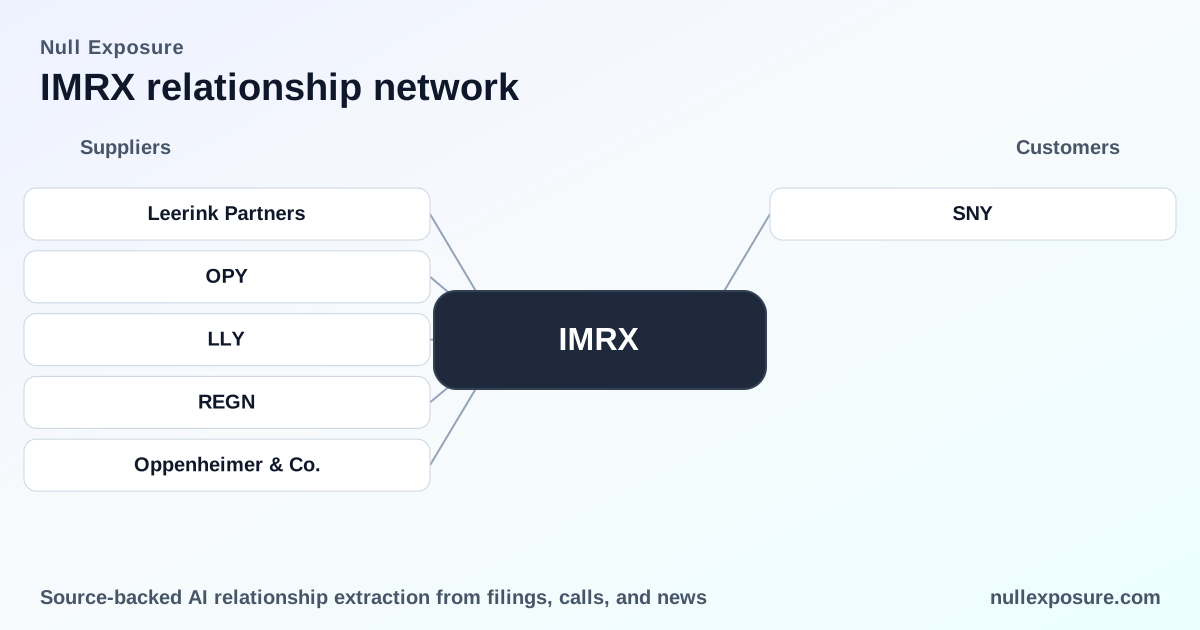
Immuneering (IMRX) supplier and partner landscape — what investors need to know
Immuneering (IMRX) commercializes precision oncology by converting computational biology and machine learning outputs into drug candidates and then partnering to advance those candidates through clinical development and supply. The company monetizes through equity financing, licensing/partnering deals, and strategic clinical-supply arrangements that de‑risk development while preserving upside in promising assets. Key revenue and capital events are executed via investment banks and placement agents, while drug development relies on third‑party CROs/CMOs and large pharma collaborators for trials and clinical supply. For a concise company intelligence hub on supplier relationships, see the NullExposure homepage: https://nullexposure.com/.
How Immuneering runs its business and pays for it
Immuneering operates a platform-driven biotech model: internal discovery and optimization feed a pipeline of candidates that are advanced via clinical partnerships and external manufacturing. The company finances development through public offerings and targeted private placements, and it uses third‑party manufacturers and CROs for preclinical, clinical and (potentially) commercial supply, keeping fixed real-estate commitments for lab capacity while maintaining short‑term service flexibility for some corporate functions.
- Capital strategy: Public offerings and private placements are central to funding. Investment banks act as joint bookrunners and placement agents for equity raises that support R&D spend.
- Development strategy: Collaborations with major pharmas secure clinical supply and combination trial access that accelerate regulatory paths and clinical validation.
- Operational posture: Mixed contract terms — long‑term real‑estate leases to 2032 for lab space and short‑notice service agreements for some corporate offices — create a hybrid fixed‑plus‑flex cost base.
Explore more supplier intelligence at NullExposure: https://nullexposure.com/.
The partner list — every relationship found in the record
Below are plain‑English summaries of every partner and supplier relationship captured in the source set, with citations to the underlying public notices and reporting (FY2025 context unless noted).
Leerink Partners
Leerink Partners acted as a joint bookrunner and placement agent for Immuneering’s public offering and concurrent private placement to strategic investors including Sanofi, supporting a capital raise in FY2025. According to a GlobeNewswire release distributed via Manila Times in FY2025, Leerink and Oppenheimer served as the underwriters and placement agents for the transactions.
Oppenheimer & Co. / Oppenheimer & Co. Inc.
Oppenheimer & Co. served alongside Leerink as a joint bookrunner and placement agent for the same FY2025 public offering and private placement, executing the equity financing that underwrites near‑term development programs. The Manila Times/GlobeNewswire notices in FY2025 list Oppenheimer in the underwriting syndicate for pricing and offering communications.
Eli Lilly and Company (Lilly)
Immuneering secured a clinical supply agreement with Eli Lilly for olomorasib, the company’s second‑generation KRAS G12C inhibitor, enabling combination studies and supply continuity for relevant trials. A QuiverQuant report and a FY2025 article in The Scientist documented the Lilly collaboration as part of Immuneering’s combination‑therapy strategy.
Regeneron Pharmaceuticals (Regeneron)
Immuneering entered a clinical trial agreement with Regeneron to evaluate atebimetinib combined with Regeneron’s anti‑PD‑1 therapy Libtayo in advanced non‑small cell lung cancer, providing trial access and a route to test combination efficacy. This agreement is cited in a QuiverQuant news piece and was discussed in The Scientist in FY2025.
What the constraint signals tell investors about IMRX’s supplier risk profile
The company‑level constraints present a coherent operating picture that guides risk assessment and vendor management priorities.
- Contracting posture — mixed maturity: Immuneering carries long‑term leases (office/lab space in San Diego through 2032) while maintaining short‑term service agreements for smaller offices that are terminable on 30 days’ notice. This creates a fixed lab footprint with flexible corporate services.
- Concentration and criticality — outsourcer‑dependent: The company relies substantially on CROs and CMOs for preclinical work, clinical trials and clinical‑supply manufacturing; these relationships are core to regulatory filings and program timelines, making supplier performance directly critical to value creation.
- Spend scale — modest but meaningful: Lease obligations disclosed (total future lease payments and yearly commitments) imply supplier/operational spend band in the $1M–$10M range for contractual obligations, suggesting routine vendor spend rather than large, single‑vendor commercial manufacturing contracts at this stage.
- Geographic posture — US‑centric operations: Primary offices and leased lab space are in Cambridge, San Diego and New York, indicating North American operational concentration and regulatory primacy in the US market.
- Contract types — licensing and open‑source dependencies: Immuneering uses third‑party licensed and open‑source software components for its platform, requiring standard license compliance controls, but not changing the core strategic supplier picture.
What this means for investors and operators
The partner roster and constraint signals create a structured risk/reward profile for IMRX investors.
- Upside drivers: Collaborations with Lilly and Regeneron accelerate clinical validation and broaden the addressable combinations for atebimetinib and KRAS programs; these alliances materially shorten time to informative clinical readouts and raise the company’s strategic value to big‑pharma partners.
- Execution risks: Heavy dependence on CROs/CMOs makes quality, capacity and data integrity the largest operational vulnerabilities. A delayed or flawed clinical supply arrangement will directly impair timelines and valuation.
- Capital dependency: The involvement of Leerink and Oppenheimer as bookrunners and placement agents signals active reliance on equity markets for financing. Monitor financing cadence and underwriter terms as leading indicators of runway and dilution risk.
- Cost structure: Long‑term lab leases combine with short‑term service contracts to create a semi‑fixed cost base; lease obligations through 2032 raise breakeven risk if program timelines lengthen.
Key checklist for monitoring:
- Clinical supply and manufacturing milestones with Lilly/Regeneron.
- CRO performance and data quality for upcoming filings.
- Timing and terms of future capital raises handled by investment banks.
- Lease renewals and facility utilization vs. headcount/capex plans.
For deeper supplier mapping and real‑time alerts on partner changes, visit NullExposure: https://nullexposure.com/.
Bottom line — investor actionables
Immuneering’s model combines platform discovery with strategic externalization of development and supply. Pharma collaborations provide the most direct path to de‑risking assets and creating optionality, while underwriting partnerships signal continued access to public capital. The principal investor focus should be on execution of combination trials with Lilly and Regeneron, the stability of CRO/CMO relationships, and the cadence of equity financings.
To stay ahead of supplier shifts and partner developments for IMRX, use NullExposure’s supplier intelligence portal: https://nullexposure.com/.