Indigo Acquisition Corp.: supplier map and what it means for investors
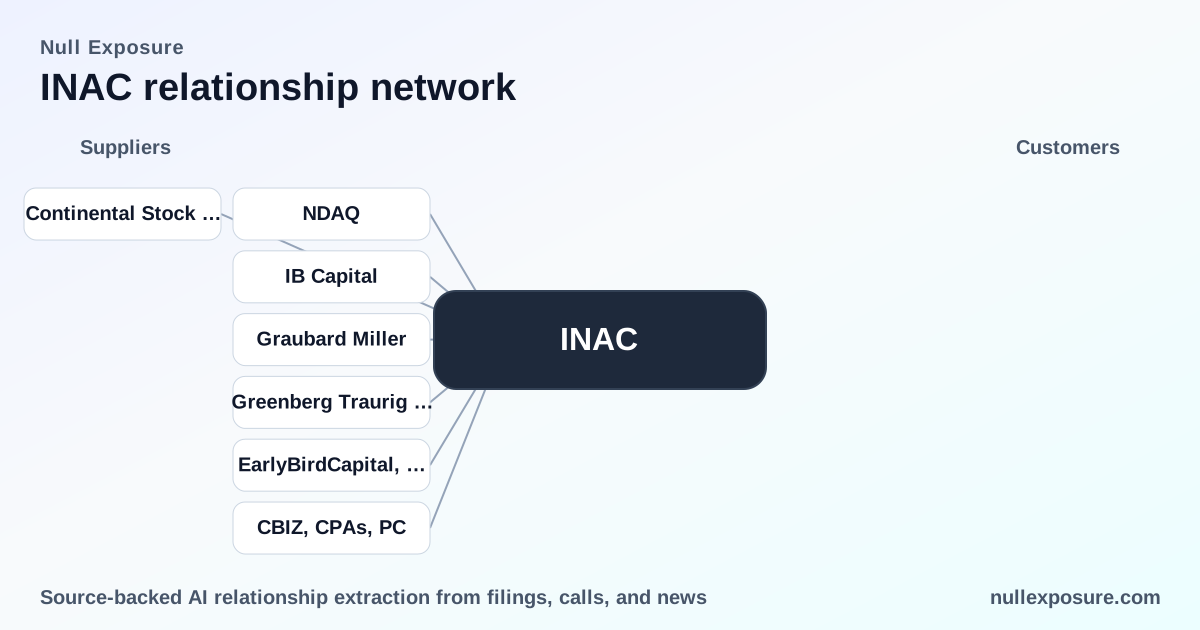
Indigo Acquisition Corp. is a Nasdaq-listed special-purpose acquisition company that raised capital through a $100 million IPO of units and now operates as a blank‑check vehicle seeking a business combination. The company’s economics are typical of modern SPACs: it monetizes by deploying IPO proceeds into a target and by realizing sponsor and public‑market value at the point of combination or liquidation. For investors and operators evaluating counterparty exposures, Indigo’s supplier relationships reveal a conventional SPAC operating model built on market infrastructure (exchange listing, underwriters, counsel, auditor, transfer agent and trustee) rather than on complex vendor dependencies.
For a deeper supplier-impact analysis and ongoing counterparty tracking, visit https://nullexposure.com/.
Business model and operating posture: what the supplier list tells you
- Indigo’s supplier roster is standardized and transaction‑oriented. The named providers support capital markets execution (underwriters, counsel, exchange) rather than ongoing operational delivery, which implies low operational vendor criticality but high transaction concentration around the IPO and any subsequent deal process.
- Concentration risk is concentrated in a few roles: the book‑runner and co‑manager for the offering, the audit firm, and the trustee are single points of failure for compliance and capital flows during SPAC lifecycle events.
- Maturity and contracting posture skew toward transactional, short‑term engagements rather than long‑dated outsourcing arrangements; legal, audit and transfer agent relationships are mission‑critical for filings, escrow mechanics and shareholder servicing.
- No supplier‑level constraints were reported in available results; as a company‑level signal, Indigo operates without disclosed vendor restrictions that would materially change contracting flexibility.
Counterparties and roles investors should map Below I cover every relationship disclosed in the collected reporting. Each entry is a concise, plain‑English description with the cited source.
-
Nasdaq (NDAQ): Indigo’s units trade on the Nasdaq Global Market under the ticker INACU, tying the company to Nasdaq’s listing standards and reporting cadence. According to a press release published on Yahoo Finance, Indigo’s units are listed on the Nasdaq Global Market and trade under INACU (FY2025).
Source: Finance Yahoo press release on Indigo’s closing (FY2025). -
EarlyBirdCapital, Inc.: Served as the book‑running manager for Indigo’s $100 million IPO, establishing the principal banking relationship that priced and distributed the offering. SPACInsider and GlobeNewswire reporting confirm EarlyBirdCapital acted as book‑running manager for the offering (FY2025).
Source: SPACInsider and GlobeNewswire coverage of the IPO (FY2025). -
IB Capital: Acted as co‑manager on the IPO, providing syndicate support and distribution muscle alongside the book‑runner. Reporting from SPACInsider and GlobeNewswire identifies IB Capital as co‑manager for the offering (FY2025).
Source: SPACInsider and GlobeNewswire (FY2025). -
Graubard Miller: Engaged as issuer’s counsel, responsible for the SPAC’s offering documents and securities work—an essential legal function for regulatory compliance. SPACInsider notes Graubard Miller served as issuer’s counsel for the transaction (FY2025).
Source: SPACInsider (FY2025). -
Greenberg Traurig LLP: Served as underwriter’s counsel, representing the underwriting syndicate on legal and deal‑structuring matters tied to the IPO. SPACInsider reports Greenberg Traurig as underwriter’s counsel (FY2025).
Source: SPACInsider (FY2025). -
CBIZ, CPAs, PC: Named as the auditor, providing the financial review and opinion necessary for the SPAC’s registration and reporting package. SPACInsider and press coverage list CBIZ as the auditor for Indigo (FY2025).
Source: SPACInsider coverage and headline reporting (FY2025). -
Continental Stock Transfer & Trust Company: Acts as trustee / transfer agent, the operational node for share issuance, escrow mechanics and shareholder recordkeeping—critical for redemption processing and post‑deal ownership tracking. SPACInsider identifies Continental Stock Transfer & Trust Company as the trustee (FY2025).
Source: SPACInsider (FY2025).
What these relationships imply for investor due diligence
- Regulatory and execution risk is front‑loaded. The identified counterparties (exchange, underwriters, counsel, auditor, trustee) are the infrastructure that governs IPO proceeds, redemptions and the business‑combination process. Service failure in any of these roles can disrupt filings, delay closings or create redemption processing errors.
- Concentration is a tactical risk. EarlyBirdCapital is the book‑runner; IB Capital is the co‑manager. If the underwriting syndicate is narrow, market distribution and pricing flexibility are constrained, which matters in volatile markets or complex PIPEs.
- Operational dependency is limited but material. Unlike operating companies with technology vendors or supply chains, Indigo’s counterparty exposures are transactional. However, the trustee/transfer agent and auditor are mission critical—their continuity and independence are essential to value preservation through the SPAC lifecycle.
- Legal counsel alignment matters. Issuer and underwriter counsel (Graubard Miller and Greenberg Traurig) manage disclosure and conflicts. Investors should review engagement letters and related‑party disclosures in filings to assess any conflict risk.
Mid‑report action item Review the IPO closing and offering documents filed around the FY2025 period—pay particular attention to underwriting fees, sponsor shares/warrants, auditor tenure and transfer agent agreements. For tracking counterparties across an investment portfolio, consider the supplier intelligence tools at https://nullexposure.com/.
Risk checklist for operators and investors
- Confirm auditor tenure and scope for any accounting or going‑concern issues.
- Validate trustee/transfer agent operational readiness for redemptions and shareholder communications.
- Scrutinize underwriter syndicate concentration and pricing mechanics to understand distribution risk.
- Read issuer and underwriter counsel disclosures for potential conflicts and indemnities.
Bottom line and recommended next steps Indigo Acquisition Corp. presents the typical SPAC counterparty footprint: exchange listing, a small underwriting syndicate, issuer and underwriter counsel, an auditor, and a trustee. That footprint produces low operational vendor complexity but concentrated transactional risk—success depends on execution at financing, escrow, and closing stages rather than on ongoing vendor performance. For investors, the practical workstreams are document diligence (filings and offering circulars), confirmation of counterparty roles and continuity, and monitoring any announcements about target mergers or PIPE financing.
If you want continuous tracking of these supplier relationships and bespoke counterparty alerts, explore NullExposure’s supplier intelligence platform at https://nullexposure.com/. For a targeted supplier due‑diligence engagement or to map supplier concentration across a portfolio, start here: https://nullexposure.com/.