Intelligent Bio Solutions (INBS): Supplier relationships that determine scale and margin
Intelligent Bio Solutions (INBS) develops non‑invasive drug‑screening hardware and biomarker technologies and monetizes through device sales, strategic product licensing/collaborations, and recurring clinical and laboratory services tied to its intelligent fingerprinting and wearable screening products. Revenue growth and margin expansion are directly contingent on manufacturing scale and clinical validation — the company outsources both production and portions of its clinical program, and it funds expansion through at‑market equity placements. For investors evaluating supplier risk, the headline: manufacturing partnerships, a small group of material suppliers, and a small number of critical service providers control INBS’s path to commercial scale. Learn more at https://nullexposure.com/.
Why supplier relationships are the lever for valuation here
INBS is a product‑led medtech company with limited in‑house scale. That operating model produces clear supplier characteristics: contracting posture is partnership‑driven rather than captive; supplier concentration is meaningful; a small set of service providers are critical to regulatory progress; and several relationships are recent and therefore operationally immature. The company’s December 2025 manufacturing tie‑up with Syrma Johari is the clearest example: management positioned that deal as a path to scale and a driver of margin improvement. According to a GlobeNewswire release on December 31, 2025, INBS announced the strategic manufacturing partnership to support production of its Intelligent Fingerprinting Drug Screening Reader and to strengthen global production capacity. News coverage has since highlighted expectations of substantial cost reductions and the receipt of initial shipments that validate commercial readiness (GlobeNewswire, Dec. 31, 2025; TS2.tech reporting, March 2026).
A practical investor takeaway: manufacturing execution and clinical milestones are the primary short‑to‑medium‑term value drivers. See more analysis and relationship detail at https://nullexposure.com/.
Relationship-by-relationship: who INBS works with and why it matters
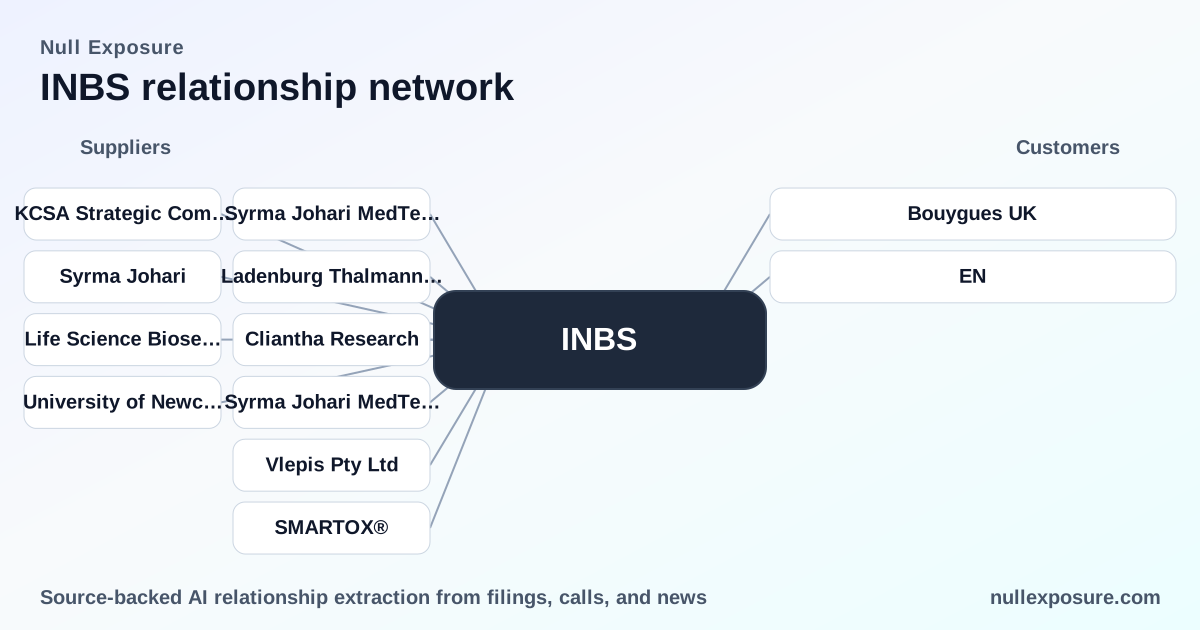
- Syrma Johari / Syrma Johari MedTech Ltd. — INBS signed a strategic manufacturing partnership to scale production of its Intelligent Fingerprinting readers and reported the successful receipt and deployment of the first shipment, a milestone management said validates commercial readiness and supports U.S. market entry (GlobeNewswire press release, Dec. 31, 2025; TS2.tech and Bitget reporting March 2026).
- Cliantha Research — INBS engaged Cliantha Research as a clinical research organization to run additional clinical studies in support of an FDA 510(k) submission, leveraging Cliantha’s regulatory and trial expertise (GlobeNewswire news release, Jan. 28, 2026).
- Ladenburg Thalmann & Co. Inc. — Ladenburg acted as the exclusive placement agent for INBS’s at‑market private placements used to fund operations and clinical programs, including a $10.0 million placement announced in early January 2026 (GlobeNewswire press release, Jan. 2, 2026; Manila Times Jan. 1, 2026 summary).
- Vlepis Pty Ltd — INBS entered a non‑exclusive strategic alliance with Australian firm Vlepis to evaluate sensing and wearable patch technologies and cloud/mobile connectivity that could broaden INBS’s consumer and remote monitoring addressable market (GlobeNewswire release, Dec. 18, 2025).
- KCSA Strategic Communications — KCSA functions as the company’s investor and media relations provider, listed as the contact for investor/media inquiries in multiple press releases and conference notices (GlobeNewswire and Sidoti conference release, FY2025; Manila Times summary, FY2025).
- SMARTOX® — INBS added the SmarTest® Patch, developed by SMARTOX®, to its product portfolio as a wearable continuous‑detection offering for sweat‑based drug monitoring, per disclosures included in the FY2025 SEC 10‑Q reporting summarized by TradingView (SEC 10‑Q / TradingView coverage, FY2025).
- Life Science Biosensor Diagnostics Pty Ltd — The company previously worked with Life Science Biosensor Diagnostics for intellectual property and biosensor platform development, but that entity entered liquidation and INBS said development of the Biosensor Platform was postponed as a result (SEC 10‑Q / TradingView coverage, FY2025).
- University of Newcastle — INBS noted that intellectual property associated with certain technologies reverted to the University of Newcastle pending completion of liquidation proceedings and licensing arrangements, creating a contingent IP pathway that requires resolution before platform commercialization (SEC 10‑Q / TradingView coverage, FY2025).
Each relationship above is drawn from contemporaneous company releases and market reporting; for primary release context see INBS press distributions on GlobeNewswire (Dec 2025–Jan 2026), and regulatory filings summarized in TradingView’s coverage of the company’s FY2025 10‑Q.
What the constraints tell you about operating risk
The company‑level constraints provided by INBS’s disclosures are material to evaluation:
- Critical service dependency: INBS relies on third‑party laboratory service providers for confirmation testing and has “relatively few alternatives,” which elevates operational risk for validation and regulatory timelines. This is a company‑level signal from management’s disclosure of reliance on outside labs.
- Supplier concentration: INBS disclosed that its largest suppliers comprised 19.4% and 30.7% of purchases for FY2025 and FY2024 respectively, demonstrating meaningful concentration that leaves procurement and price exposure concentrated in a few vendors.
- Single‑source manufacturing risk: Management states dependence on a limited number of single‑source suppliers for components of the IFP system, which increases vulnerability to supply shortages and price inflation.
- Service providers and payables: The company has multiple service relationships (clinical CROs and sales agencies). One named contract in public filings is with CenExel for a method‑comparison clinical study under which milestone payments are due; that contract is explicit in filings and represents a quantified near‑term payable.
- Contracting posture and maturity: Several partnerships are recent (late 2025/early 2026) and non‑exclusive, indicating INBS is building a supplier network rather than vertically integrating — a faster path to market but one that amplifies counterparty and execution risk.
These constraints position suppliers as both enablers and near‑term risk factors; monitoring supplier performance, payment terms, and any single‑supplier interruptions should be part of any active monitoring plan.
Red flags, catalysts, and what to watch next
- Catalyst: Syrma Johari’s initial shipments and the company’s statements about cost reductions are immediate potential margin drivers; track manufacturing yields, unit costs, and shipment cadence reported in upcoming filings and investor updates. (GlobeNewswire, Dec. 31, 2025.)
- Regulatory catalyst: Progress on the FDA 510(k) pathway depends on clinical results run by Cliantha and other labs; completion dates and confirmation testing outcomes will be binary value inflection points (GlobeNewswire, Jan. 28, 2026).
- Risk: Supplier concentration and single‑source component exposure create vulnerability to input price shocks and supply interruptions; the liquidation of a prior biosensor partner and IP reversion to a university point to possible platform delays (SEC 10‑Q, FY2025).
- Balance sheet watch: The use of at‑market private placements (Ladenburg as placement agent) is funding growth but dilutes investors; investors should track cash burn against shipments and milestone receipts (GlobeNewswire, Jan. 2, 2026).
If you want a consolidated supplier risk profile and ongoing alerts for INBS counterparties, visit https://nullexposure.com/ for tailored monitoring.
Bottom line
INBS’s commercial upside is directly coupled to supplier execution. The Syrma Johari manufacturing partnership and CRO relationships are constructive near‑term steps toward scale and FDA submission, but supplier concentration, single‑source components, and reliance on third‑party confirmation testing are meaningful operational risks that will determine whether growth translates into durable margins. Investors should prioritize operational updates on manufacturing throughput, clinical milestone completion, and any public disclosure of supplier diversification plans.
For detailed supplier tracking and to receive alerts when counterparty risk profiles change, go to https://nullexposure.com/.