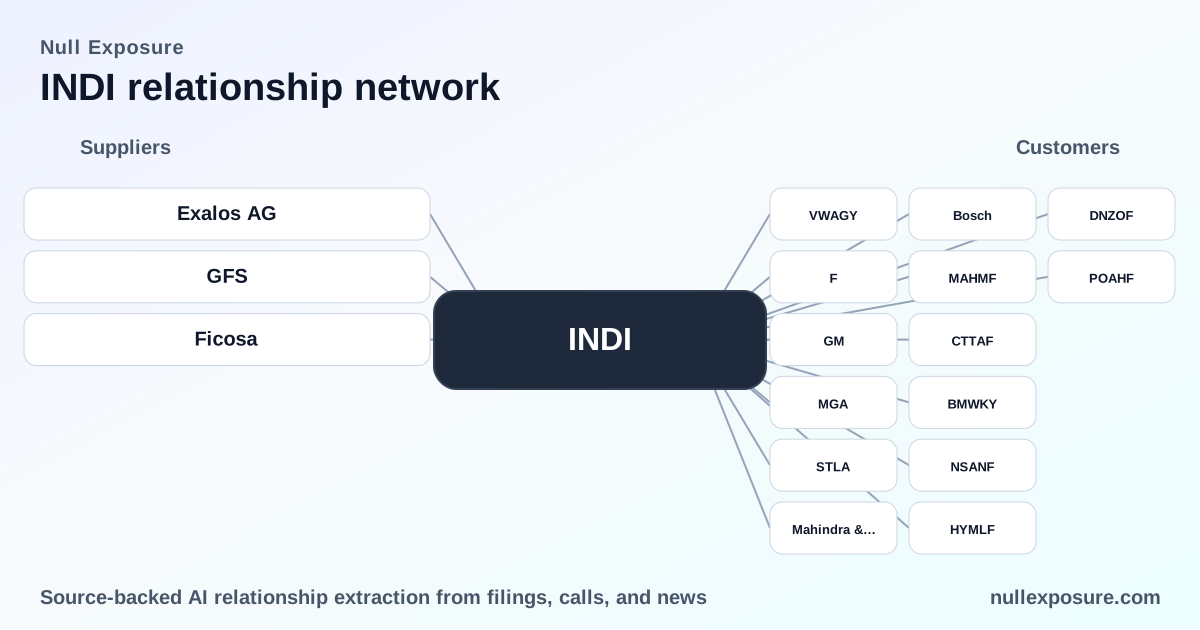
indie Semiconductor (INDI): supplier relationships that shape product roadmaps and risk exposure
Indie Semiconductor is a factory‑less semiconductor designer that monetizes by selling custom mixed‑signal SoCs for automotive, medical, industrial and consumer customers and by partnering with manufacturing and systems suppliers to industrialize those chips at scale. Revenue derives from product sales and strategic manufacturing partnerships that turn Indie’s chip designs into automotive‑grade radar and vision solutions. For investors evaluating supplier risk and strategic upside, the relationships below define both Indie’s path to revenue and its principal operational dependencies. Learn more about supplier mapping and counterparty risk at https://nullexposure.com/.
How Indie’s operating model translates into supplier exposure
Indie runs a classic fabless manufacturing model: design and IP ownership in-house; manufacturing and test outsourced to foundries and third‑party service providers. That contracting posture implies high leverage to foundry capacity and subcontractor reliability rather than to captive manufacturing assets.
- Concentration and criticality. Indie identifies a small set of primary foundry partners — X‑FAB, HHGrace, TSMC and GlobalFoundries — which creates concentrated supplier exposure around advanced process availability and capacity. The explicit naming of GlobalFoundries as a primary foundry elevates GF from a routine vendor to a strategic capacity partner for certain radar SoCs.
- Geographic footprint signal. The company discloses that the majority of its subcontractors are located in Asia, which concentrates logistics, geopolitical and pandemic risk in that region and gives procurement teams a clear area of focus.
- Service‑provider reliance. Indie uses external test houses such as Sigurd and Terepower and engages external cyber and risk experts, indicating mature third‑party governance but continued operational dependence on specialized service providers.
- Maturity and vertical moves. The completed acquisition of Exalos AG signals a progression from pure fabless design toward selective vertical integration or capability expansion, shifting the supplier map to include acquired assets and their internal supply relationships.
Key takeaway: Indie’s business model substitutes capital‑intensive fabs for strategic supplier relationships; the quality and terms of those relationships determine product cadence, margins and execution risk.
Strategic partnership with GlobalFoundries — what changed
Indie announced a strategic collaboration with GlobalFoundries to accelerate automotive radar adoption and to manufacture 77 GHz and 120 GHz radar SoCs on GF’s 22FDX® platform, positioning Indie to scale next‑generation radar products that address ADAS and adjacent industrial markets. This collaboration was publicized in March 2026 via GlobalFoundries’ press release and independent coverage in Embedded and EENews Europe. According to the GF announcement, the program targets high‑performance radar SoCs manufactured on GF’s 22FDX node, making GF a named primary foundry in Indie’s supply chain and a critical execution partner for automotive radar volume. (GlobalFoundries press release and March 2026 industry coverage.)
Acquisition of Exalos AG — a strategic capability play
Indie completed the acquisition of Exalos AG on September 18, 2023, as disclosed in Indie’s FY2024 Form 10‑K. That transaction represents a consolidation of capabilities under Indie’s corporate umbrella that changes supplier dynamics: acquired entities bring internal suppliers, IP and integration timelines that procurement and operations must assimilate into the broader vendor ecosystem. (Indie FY2024 10‑K filing.)
Partnership with Ficosa on vision systems — strengthening systems integration
Indie and Ficosa announced a partnership to combine Indie’s vision processing technology with Ficosa’s high‑volume vision solution capabilities to deliver improved in‑camera object detection for edge sensing. Coverage by SiliconCanals reported the collaboration as focused on AI‑based automotive camera solutions that pair Indie’s processing IP with a Tier‑1 supply chain reach. This relationship is strategic for system‑level integration and for getting Indie’s vision SoCs into OEM programs via a high‑volume supplier. (SiliconCanals coverage, March 2026.)
Other supplier signals investors should track
The company’s public disclosures and filings include other supplier‑related facts that shape risk and opportunity:
- Indie engages subcontractors primarily in Asia, concentrating production and logistics exposure in that region (company disclosures).
- Primary foundry partners include X‑FAB, HHGrace, TSMC and GlobalFoundries, which points to a multi‑foundry sourcing strategy but with a limited set of service providers that handle volume transitions (company disclosures).
- Indie uses test services from providers such as Sigurd and Terepower and engages third‑party experts for cybersecurity and risk assessment, reflecting reliance on external specialists for quality and compliance (company disclosures).
These are company‑level signals for procurement and legal teams to model into supplier scorecards and contingency planning.
What this means for risk, revenue and valuation
- Execution risk is concentrated on foundry and test partners. Because Indie is fabless, delays or capacity constraints at GF, TSMC or the other named foundries will directly affect product shipments and revenue timing. The March 2026 GF collaboration raises the revenue upside for radar SoCs but also deepens dependence on GF‑managed process ramp economics.
- Geographic concentration increases supply‑chain tail risk. With the majority of subcontractors in Asia, logistics disruptions or regional policy shifts create outsized downside scenarios that should be stress‑tested in forecasting models.
- Partnerships accelerate market access but require tight program management. The Ficosa engagement creates a route to OEM systems, and the Exalos acquisition internalizes capability; both support revenue scale but require integration capital and management bandwidth.
- Mature vendor governance is visible but not exhaustive. Use of external test houses and third‑party cyber experts is a positive sign of process discipline; investors should still seek detail on supplier contracts, capacity commitments and alternative supplier plans in subsequent filings.
For a practical supplier‑risk playbook and ongoing monitoring of Indie’s counterparty map, see our platform at https://nullexposure.com/.
Practical next steps for investors and operators
- Demand clarity on foundry capacity commitments and long‑lead procurement terms tied to the GF collaboration and to any TSMC or X‑FAB engagements.
- Require supplier concentration and country‑level exposure metrics in quarterly updates, specifically the share of subcontracted manufacturing located in Asia.
- Track integration milestones and synergies from the Exalos acquisition to determine whether the move reduces external dependency or adds near‑term integration costs.
- Stress‑test revenue and margin scenarios with both foundry disruption and successful GF ramp cases to bracket valuation assumptions.
For further intelligence on supplier relationships and targeted counterparty monitoring for Indie, visit https://nullexposure.com/ for detailed supplier maps and alerts.
Bottom line: Indie’s value creation is tightly coupled to a small set of manufacturing and systems partners; the GlobalFoundries agreement and the Exalos acquisition materially reshape that supplier landscape and are the two dynamics investors must monitor closely.