Indaptus Therapeutics (INDP) — supplier relationships that shape financing and clinical progress
Indaptus Therapeutics develops next‑generation immunotherapies and monetizes through clinical advancement, strategic collaborations, and capital markets transactions that fund development until product licensing or commercialization. The company currently relies on third‑party manufacturers and clinical service providers for drug supply and trial execution, and uses placement agents and outsourced investor relations to access capital and manage market communications. For investors evaluating supplier risk and counterparty exposure, the interplay between short‑term supply contracts, outsourced CRO/manufacturing relationships, and periodic capital raises defines near‑term operational runway and dilution risk. Learn more at https://nullexposure.com/.
How Indaptus operates day‑to‑day: third parties run the lab and the message
Indaptus is an early‑stage biotech with no reported revenue and negative EBITDA, which forces the company to operate with a financing posture: outsource clinical manufacturing, rely on CROs for trials, and use placement agents to raise cash. The company’s clinical programs require adherence to cGMP, GCP and GLP standards across jurisdictions, which makes third‑party suppliers operationally critical rather than optional. According to company filings, Indaptus “relies upon third‑party CROs, medical institutions, clinical investigators and contract laboratories” to run its preclinical and clinical programs (company filing, FY2025). The supply chain footprint includes short‑term commercial arrangements tied to specific combination studies and regional partners, notably a Supply Agreement executed to support a combination study with BeiGene Switzerland GmbH in EMEA (October 2024 disclosure).
Supplier relationships on the public record
Below are every supplier/partner mention captured in the provided results and what each relationship means for investors.
-
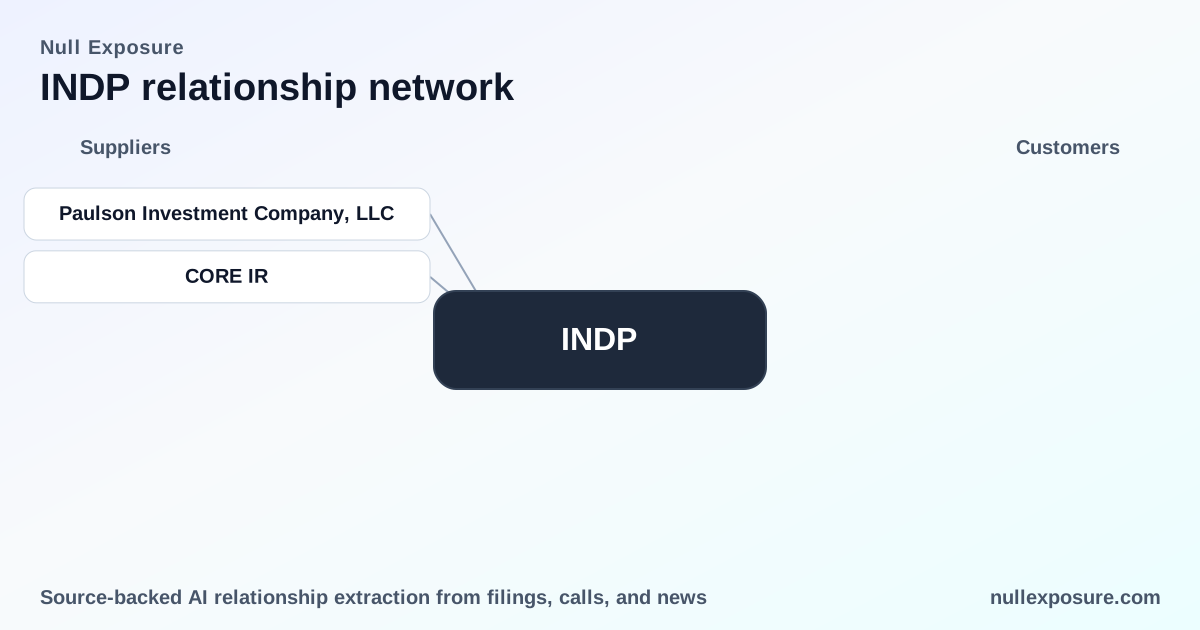
Paulson Investment Company, LLC — Paulson acted as the exclusive placement agent for a $2.25 million at‑the‑market private placement, indicating Indaptus uses third‑party capital markets intermediaries to raise working capital rather than tapping large strategic investors. (Press release: GlobeNewswire, January 13, 2025: https://www.globenewswire.com/news-release/2025/01/13/3008484/0/en/Indaptus-Therapeutics-Inc-Announces-2-25-Million-Private-Placement-Priced-At-The-Market-Under-Nasdaq-Rules.html)
-
CORE IR — CORE IR is listed as the company’s investor relations contact in multiple corporate disclosures, reflecting outsourced IR support that controls market messaging and investor outreach; the same contact appears in both the January 13, 2025 financing announcement and the November 12, 2025 quarterly update. (Press releases: GlobeNewswire, January 13, 2025 and November 12, 2025: https://www.globenewswire.com/news-release/2025/01/13/3008484/0/en/Indaptus-Therapeutics-Inc-Announces-2-25-Million-Private-Placement-Priced-At-The-Market-Under-Nasdaq-Rules.html; https://www.globenewswire.com/news-release/2025/11/12/3186262/0/en/Indaptus-Therapeutics-Reports-Third-Quarter-2025-Financial-Results-and-Provides-Corporate-Update.html)
What those relationships actually mean for risk and execution
-
Capital access is outsourced and transactional. Using Paulson as an exclusive placement agent for an at‑the‑market private placement demonstrates Indaptus’s reliance on episodic equity raises rather than sustained institutional financing. That increases execution risk if market windows close.
-
Investor communications are managed externally. CORE IR’s repeated role as the IR contact indicates a continued dependence on a vendor to shape investor expectations and control disclosures, which is standard for small biotechs but concentrates messaging control outside the internal team.
-
Clinical and manufacturing suppliers are operationally critical. Company disclosures state reliance on third‑party CROs and contract manufacturers for clinical programs and drug supply; these relationships are active and strategic, not peripheral. Any disruption to cGMP/GCP‑compliant supply or CRO performance will directly impact timelines.
(If you want a consolidated view of supplier exposures and how they affect valuation, see https://nullexposure.com/.)
Constraints that drive commercial posture and counterparty exposure
Indaptus’s supplier constraints — drawn from company disclosures — form a coherent operating signal:
-
Contracting posture: Short‑term, study‑linked agreements. The Supply Agreement tied to the Combination Study with BeiGene terminates on the earlier of one year after the final clinical study report or study termination, establishing a limited contractual horizon that prioritizes flexibility over long‑dated commitments.
-
Geographic footprint: EMEA‑specific commercial arrangements plus global regulatory obligations. The Supply Agreement with BeiGene Switzerland GmbH covers the Combination Study in EMEA, while the company and its vendors are required to meet cGMP/GCP/GLP standards enforced by the FDA, EMA and comparable authorities — a global compliance burden.
-
Relationship roles: Active service provider and manufacturer reliance. Indaptus both purchases services from CROs/manufacturers and functions as a seller for Decoy20 in the combination trial; the company pays trial costs (except BeiGene’s product) and supplies Decoy20 for the study, establishing reciprocal obligations.
-
Segment exposure: Manufacturing and services are the dominant external spend categories. The company-level signal is clear: operational progress depends on vendor manufacturing and clinical services, not internal mass production capability.
These constraints imply a highly tactical supplier posture: short, critical contracts with third parties whose performance drives timelines, paired with a financing model that uses placement agents for capital.
Investment implications and what to watch next
-
Track clinical milestones and supply agreement renewals closely. Clinical readouts or an extended supply agreement with BeiGene would re‑rate operational certainty. Company disclosure of the Supply Agreement in October 2024 is the baseline; subsequent amendments or broader licensing would be material.
-
Monitor financing cadence and underwriter activity. Future at‑the‑market offerings or exclusive placements signal funding pressure; the January 13, 2025 placement shows the company will use market windows to fund operations.
-
Watch vendor performance and regulatory disclosures. Any GCP/cGMP compliance flags from CROs or manufacturers will be immediate red flags because Indaptus lacks internal manufacturing redundancy.
-
Governance and ownership: insiders control a meaningful portion of shares while institutional ownership is low, which concentrates decision authority and impacts strategic partner negotiating posture.
For a concise dashboard that aggregates supplier disclosures and event‑driven risks, visit https://nullexposure.com/.
Bottom line — how supplier relationships shape valuation
Indaptus operates as a capital‑intensive, development‑stage biotech whose supplier relationships are integral to trial execution and near‑term survival. Short‑term, high‑criticality contracts with CROs and manufacturers, a study‑linked supply agreement with BeiGene in EMEA, and dependence on placement agents for financing create a profile where operational continuity and access to capital determine valuation more than clinical promise alone. Investors should treat supplier performance and financing cadence as first‑order risks and read every press release for changes in placement agent activity, IR engagements, and supply agreements.
If you want a supplier‑focused risk brief tailored to your model or a monitoring setup for Indaptus, start here: https://nullexposure.com/.