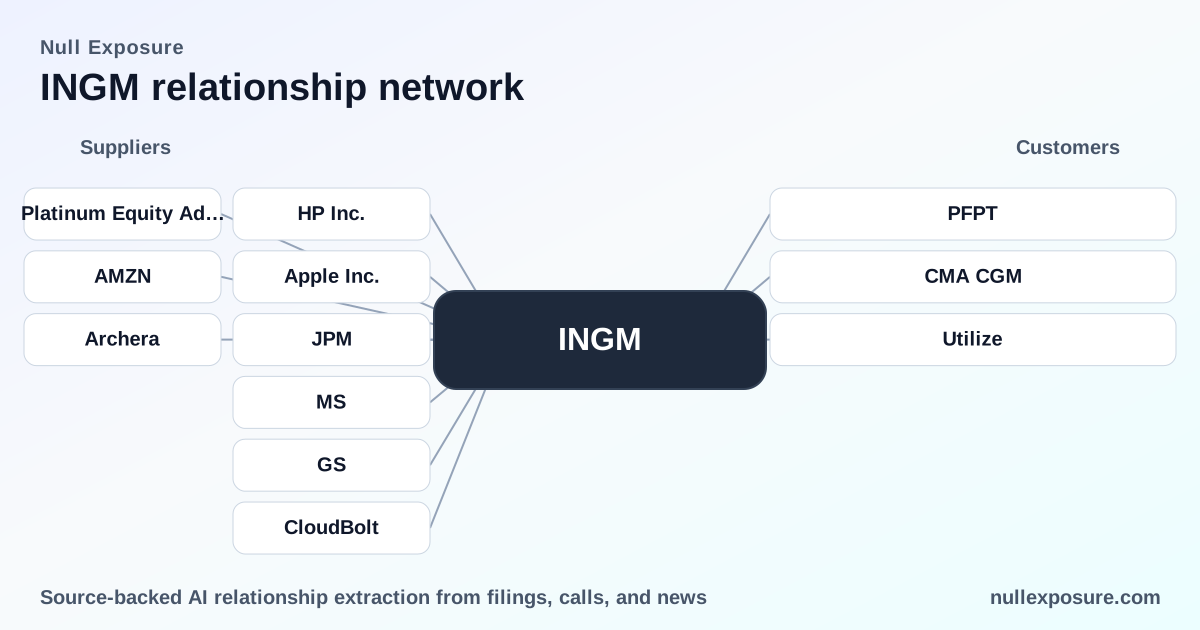
Ingram Micro (INGM): supplier map and what it means for investors
Ingram Micro is a global technology distributor that monetizes by buying and reselling hardware, software and cloud services through an extensive partner and reseller network, while layering margin-accretive services such as cloud enablement, logistics and FinOps tooling. Revenue is driven by high-volume product flows from a concentrated set of vendor relationships and by accelerating services-led growth in cloud and managed offerings. For institutional investors assessing supplier risk and upside, the focus is supplier concentration, strategic cloud partnerships, and the transition from PE-led governance to a public-company capital markets posture. Learn more on the platform that surfaces these supply-chain signals: https://nullexposure.com/.
Operational characteristics and the supplier base
- Ingram Micro operates as a high-throughput distributor with tight vendor dependency on a handful of large suppliers for a meaningful share of sales, while simultaneously expanding higher-margin services linked to cloud and software consumption.
- The business mixes hardware, software and cloud services—hardware drives transactional volume, software and services drive recurring margin expansion and FinOps-led productization.
- Contracting posture is typical of large distributors: vendor agreements are commercial-forward, inventory-intensive, and rely on scale economics, which increases exposure to supplier pricing and supply continuity.
- Concentration is material and measurable: a single software/hardware vendor contributes double-digit shares of consolidated net sales, which translates to supplier negotiation leverage and single-vendor demand risk.
- The company’s supplier relationships and advisory arrangements are mature and institutional—underwriting syndicates and legacy private-equity advisers have shaped strategic decisions during the IPO process, reducing execution risk on public-market transitions.
Key supplier and advisor relationships — the details investors need Below are every relationship captured in the public results, with a concise explanation and source for each entry.
-
HP Inc. — Ingram Micro purchased roughly 10% of its consolidated net sales in FY2024 from HP product purchases, signaling a meaningful concentration in hardware supply that affects inventory turns and margin exposure. According to Ingram Micro’s FY2024 10‑K filing (filed Dec 28, 2024), HP accounted for approximately 10% of consolidated net sales in FY2024. (ingm-2024-12-28)
-
Apple Inc. — Apple drove approximately 19% of consolidated net sales in FY2024, representing the largest single-vendor revenue concentration and an obvious strategic dependency for both consumer and enterprise device flows. This is disclosed in Ingram Micro’s FY2024 10‑K filing. (ingm-2024-12-28)
-
J.P. Morgan — J.P. Morgan served as a lead underwriter on Ingram Micro’s IPO and related offerings, indicating strong investment-banking support during the public offering process. A news report on the company’s earnings/IPO commentary noted J.P. Morgan among the lead underwriters (intellectia.ai, March 2026). (https://intellectia.ai/news/stock/ingram-micro-to-hold-q4-2025-earnings-call-on-march-2-2026)
-
Morgan Stanley — Morgan Stanley acted as a lead underwriter and joint book-running manager for Ingram Micro’s offering, reflecting top-tier underwriting support for market access and subsequent share actions. Multiple press reports list Morgan Stanley as a leading underwriter (intellectia.ai and Platinum Equity press material, 2024–2026). (https://intellectia.ai/news/stock/ingram-micro-to-hold-q4-2025-earnings-call-on-march-2-2026; https://www.platinumequity.com/news/ingram-micro-begins-trading-on-nyse/)
-
Morgan Stanley (press release) — Platinum Equity’s announcement of Ingram Micro’s NYSE listing explicitly names Morgan Stanley, Goldman Sachs and J.P. Morgan Securities as the offering leaders, confirming the syndicate for the transaction. (Platinum Equity press release, FY2024). (https://www.platinumequity.com/news/ingram-micro-begins-trading-on-nyse/)
-
Goldman Sachs — Goldman Sachs is part of the lead underwriting group and supported the IPO, signaling institutional market confidence in the offering and in the company’s public-market readiness. Media coverage of the IPO lists Goldman Sachs among the book-runners (intellectia.ai and Platinum Equity, 2024–2026). (https://intellectia.ai/news/stock/ingram-micro-to-hold-q4-2025-earnings-call-on-march-2-2026; https://www.platinumequity.com/news/ingram-micro-begins-trading-on-nyse/)
-
J.P. Morgan (CRN coverage) — CRN’s coverage of the IPO confirms J.P. Morgan’s role as a joint book-running manager, reinforcing the public-market sponsorship from major banks. (CRN, FY2024). (https://www.crn.com/news/cloud/2024/ingram-micro-files-for-ipo-ingm-share-price-undecided)
-
Morgan Stanley (CRN coverage) — CRN also lists Morgan Stanley among the joint book-running managers for the proposed offering, consistent across industry reporting. (CRN, FY2024). (https://www.crn.com/news/cloud/2024/ingram-micro-files-for-ipo-ingm-share-price-undecided)
-
CloudBolt — Ingram Micro entered a distribution alliance to provide resellers and MSPs access to CloudBolt’s cloud management and FinOps platform, extending Ingram’s services stack for cloud optimization. This distribution agreement was reported by InsiderMonkey (FY2025). (https://www.insidermonkey.com/blog/ingram-micro-holding-announces-distribution-agreement-with-cloudbolt-1581515/)
-
Platinum Equity Advisors, LLC — Under a Corporate Advisory Services Agreement (CASA), Platinum Advisors provided financial and managerial consulting; that advisory agreement was terminated upon consummation of the IPO, transferring advisory responsibilities away from the private-equity sponsor. Ingram Micro disclosed the terminated advisory arrangement in its Q3 FY2025 press materials and filings. (ir.ingrammicro.com press release, FY2025)
-
J.P. Morgan Securities — J.P. Morgan Securities is identified in public announcements as one of the underwriters leading the offering, confirming its role within the IPO syndicate. (Platinum Equity NYSE announcement, FY2024). (https://www.platinumequity.com/news/ingram-micro-begins-trading-on-nyse/)
-
AWS (Amazon Web Services) — Ingram Micro received multiple AWS partner awards in 2025, including Global Distributor Partner of the Year, which underscores its strategic positioning in the cloud channel and likely revenue leverage from AWS-related services. Industry coverage notes the awards and their implications for cloud ecosystem pull (Simply Wall St commentary, FY2025). (https://simplywall.st/stocks/us/tech/nyse-ingm/ingram-micro-holding/news/ingram-micro-holding-ingm-valuation-check-after-dual-2025-aw)
-
Archera — Archera expanded collaboration with Ingram Micro to push cloud cost optimization and insured commitment products in the US and Canada, enhancing Ingram’s FinOps and cloud-managed service offerings. This partnership was reported in Simply Wall St coverage tied to FY2026 developments. (https://simplywall.st/stocks/us/tech/nyse-ingm/ingram-micro-holding/news/assessing-ingram-micro-holding-ingm-valuation-after-expanded)
Concentration, criticality and governance implications for investors
- Supplier concentration is a primary risk and a lever for margin performance: Apple and HP alone accounted for substantial shares of FY2024 sales (Apple ~19%, HP ~10%), which creates both volume advantage and single-vendor demand sensitivity. The 10‑K confirms these concentration figures. (ingm-2024-12-28)
- Cloud partnerships reduce single-vendor product risk by growing recurring services, with AWS awards and platform partnerships (CloudBolt, Archera) accelerating higher-margin cloud and FinOps revenue streams; this is a deliberate strategic offset to hardware dependency. (Simply Wall St; InsiderMonkey, 2025–2026)
- Governance moved away from Platinum Equity advisory control on IPO close—Platinum Advisors’ CASA was terminated at IPO, reducing PE advisory fees but also removing a direct sponsor advisory channel. Ingram Micro disclosed the termination in press filings (ir.ingrammicro.com, FY2025).
- Underwriting strength is supportive of capital markets access: Morgan Stanley, J.P. Morgan and Goldman Sachs led the offering, which indicates strong market placement and institutional confidence during the transition back to public markets. (CRN; Platinum Equity; Intellectia, 2024–2026)
What investors should monitor next
- Track gross margin mix shift: continued growth in cloud and software services should increase recurring revenue mix and reduce vulnerability to single-vendor hardware cycles.
- Watch supplier contract renewals and payment terms with Apple and HP—any deterioration would compress working capital and margin.
- Monitor execution on cloud partnerships (AWS, CloudBolt, Archera) for measurable ARR/bookings impact.
For a deeper view of supplier exposures and timely relationship signals visit https://nullexposure.com/ for the full intelligence platform.
Bottom line: investable strengths and headline risks Ingram Micro combines scale distribution economics with a deliberate pivot into cloud and FinOps services, giving it a two-pronged revenue engine: high-volume hardware flows (concentrated by vendor) and higher-margin cloud services. Primary investor risks are supplier concentration and inventory/working-capital cycles; mitigating positives are strong underwriting support at IPO and expanding strategic cloud partnerships. For investors evaluating supplier relationships as investment signals, the company offers clear, monitorable touchpoints—vendor concentration ratios, partner awards, and the post-IPO governance change are immediate items to price into risk/reward. Explore more supplier intelligence and portfolio signals at https://nullexposure.com/.