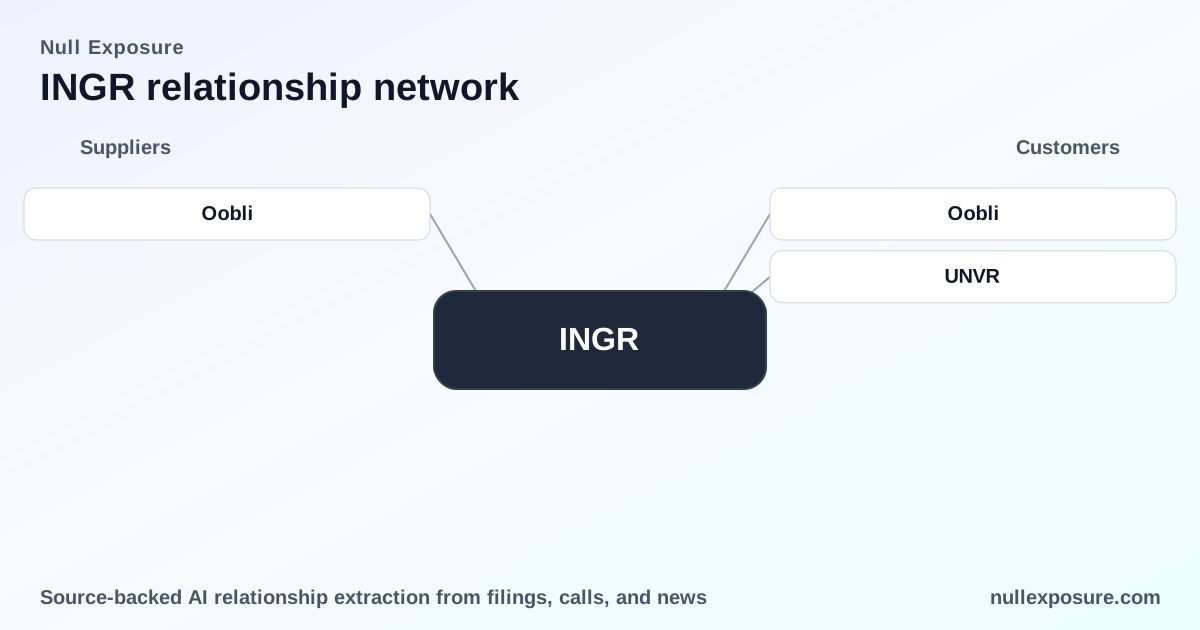
Ingredion (INGR) — supplier relationships and strategic signals for investors
Ingredion operates as a global ingredients company that produces and sells starches, sweeteners and specialty ingredients to food, beverage and industrial customers, monetizing through volume-driven ingredient sales, value-added formulation services, and incremental margin capture on innovation products. With roughly $7.22 billion in trailing revenue, $1.26 billion of EBITDA and a market capitalization near $7.12 billion, Ingredion’s cash flow profile combines commodity exposure with higher-margin innovation plays that drive incremental profitability. For a concise portal to supplier and partner intelligence, visit https://nullexposure.com/.
How Ingredion sources and contracts — a concise operating thesis
Ingredion’s procurement and production model is both global and hedged. The company explicitly sources corn and other commodities across North America, Latin America and other global regions and ties procurement economics to major exchanges: the Chicago Board of Trade for U.S. corn and B3 for Brazilian purchases. This is a deliberate contracting posture that combines spot purchases with exchange-referenced pricing to stabilize input costs and to preserve gross margins.
- Geographic sourcing is diversified: disclosures name the U.S., Brazil and other regions as primary corn origins, which reduces single-country exposure but introduces cross-border execution complexity.
- Pricing is exchange-linked: using CBOT and B3 references communicates a procurement strategy built around market-transparent benchmarks rather than bespoke supplier pricing.
- Outsourced production and logistics are standard: Ingredion leverages tolling manufacturers for some production and contracts trucking companies for bulk deliveries, indicating an operational model oriented to scale through partnerships rather than sole reliance on proprietary plants.
These company-level signals come directly from Ingredion’s public disclosures, which state that “corn is grown in many areas of the world” and explain pricing references to the Chicago Board of Trade and B3 for Brazil. The disclosures also note the use of tolling manufacturers and third‑party trucking for distribution.
What the constraint signals imply for investors
These constraints imply a mature, industrial procurement posture rather than an ad-hoc sourcing approach. Key takeaways for investors:
- Concentration vs. diversification: Global sourcing dilutes country-level risk but keeps the firm sensitive to multiple regional crop cycles and currency movements.
- Commodity volatility management: Exchange-referenced pricing supports hedging programs and transparent cost pass-through, reducing earnings surprise risk relative to unhedged peers.
- Outsourcing and service contracts: Tolling and third‑party logistics reduce fixed capital intensity but increase counterparty and operational-service risk; contract terms and counterparty credit matter.
For a curated view of supplier exposures and partner profiles, see https://nullexposure.com/.
Strategic relationship: Oobli
Ingredion is advancing a commercial partnership with Oobli to develop a proprietary sugar‑reduction taste modulation platform, positioning Ingredion to market taste-modulation technology alongside its sweetener portfolio. According to an earnings-call transcript published in March 2026 on InsiderMonkey, the company said, “we are advancing our proprietary sugar reduction taste modulation platform in collaboration with Oobli through a strategic commercial partnership.” (InsiderMonkey, Q4 FY2025 earnings call transcript, March 2026).
Why this relationship matters: Oobli provides a taste‑modulation capability that complements Ingredion’s existing sweetener and reformulation offerings, enabling Ingredion to sell a combined ingredient-plus-technology solution that targets sugar-reduction demand across consumer packaged goods customers.
Commercial and financial implications of the Oobli tie-up
The Oobli collaboration is strategically additive to Ingredion’s innovation-led monetization:
- It extends the company’s product set from basic sweeteners to a technology-enabled service offering that supports customer reformulation agendas.
- The partnership supports margin expansion potential because formulation technology often commands higher pricing than commodity ingredients.
- The relationship is not a raw-material dependency; it is an innovation partnership that increases go-to-market differentiation.
This collaboration was disclosed in the FY2026 earnings-call transcript and is presented as a strategic commercial initiative rather than a passive research trial (InsiderMonkey, March 2026).
Operational risks and valuation context investors should weigh
Ingredion’s financials and operational design produce a balanced risk/return profile:
- Commodity exposure: Corn and sweetener feedstock volatility remains a primary operational risk; exchange-linked procurement reduces but does not eliminate price exposure.
- Logistics and counterparty risk: Heavy reliance on tolling and trucking contracts shifts some operational risk to third parties; contract enforcement, service reliability and freight-cost inflation are material to margin stability.
- Valuation and returns: At a trailing P/E near 10.0 and EV/EBITDA around 6.5, the market values Ingredion at a modest multiple consistent with a cash‑generative, cyclical consumer‑defensive manufacturer with steady cash returns (dividend yield ~2.9%).
Actionable investor signal: treat Ingredion as a value‑oriented exposure to ingredient demand with an improving innovation runway, but underwrite commodity-cycle risk and logistics counterparty quality into any valuation.
Operational maturity: what the contract posture reveals
Ingredion’s disclosures convey a company with established procurement and contracting sophistication:
- Use of exchange references for pricing demonstrates institutional risk management of commodity inputs.
- Reliance on tolling manufacturers indicates a willingness to scale through partner capacity versus incremental capital spending.
- Standardization of trucking contracts for bulk deliveries points to repeatable logistics operations that favor scale economics.
Investor governance and ownership structure also reinforce maturity: institutional holders represent roughly 97.5% of the float, while insider ownership is low, signaling a widely held stock with professional investor scrutiny.
Bottom line and recommended next steps
Ingredion combines commodity-scale manufacturing with targeted innovation partnerships (exemplified by the Oobli collaboration) to transition some revenue toward higher-margin, technology‑enabled solutions while retaining exposure to global feedstock cycles. For investors evaluating supplier and partner risk, focus diligence on: contract terms with tolling partners, hedging policies tied to CBOT/B3 references, and the commercial rollout cadence for the Oobli platform.
For centralized supplier intelligence and deeper relationship mapping, visit https://nullexposure.com/.
To review complementary supplier profiles and cross-reference partner exposure, go to https://nullexposure.com/.
Overall, Ingredion is a structurally defensive industrial ingredient business with a clear pathway for margin enhancement through innovation partnerships and a procurement model that systematically manages but does not eliminate commodity risk.