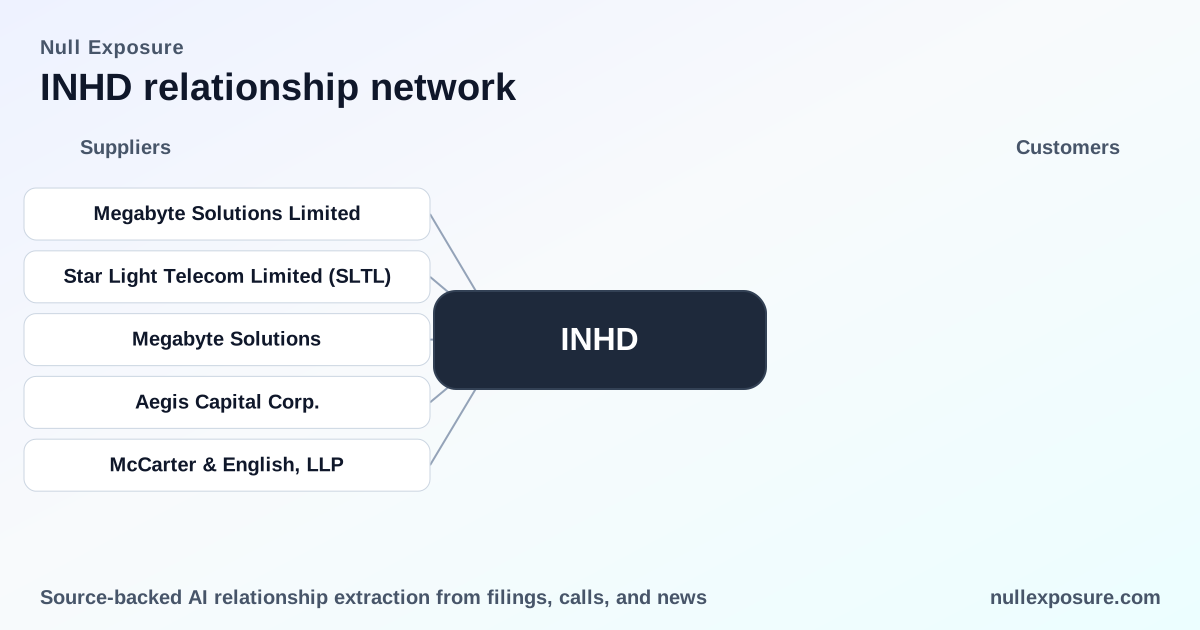
INHD supplier map: who supplies Inno Holdings, how relationships drive value, and what investors must watch
Inno Holdings (INHD) operates a B2B technology and marketplace business that monetizes through platform services and transactional fees tied to its upcoming marketplace, supplemented by service contracts and capital raises. The company is positioning Web3 infrastructure and localized logistics partners as core enablers of its market expansion while using at‑the‑market and registered direct offerings to fund growth and operations. Investors should evaluate INHD as a small‑cap, capital‑intensive operator whose near‑term value depends on a handful of external suppliers and financing relationships. Read more on the supplier map at https://nullexposure.com/.
How to read INHD’s supplier posture: concentration, criticality and contracting
INHD’s supplier footprint displays three defining business model characteristics that matter for underwriting risk and operational resilience:
- High concentration and critical dependence. Company disclosures indicate two suppliers accounted for 100% of purchases for the year ended September 30, 2025, which signals tight vendor concentration and operational leverage to a small number of partners.
- Active, operational relationships. The firm relies on ongoing supplier relationships that collect devices, provide logistics and deliver Web3 infrastructure for its marketplace and supply‑chain modules; these are described as current, active partnerships supporting market entry and platform build‑out.
- Finance-driven maturity and contracting posture. The company is in a capital formation phase, using ATM programs and registered direct placements to manage liquidity; legal counsel and placement agents are formalized, suggesting conventional corporate contracting even as core operations scale.
These are company‑level signals: INHD is operationally dependent on very few vendors, contracting in a conventional corporate manner, and financing relationships are a primary lever for near‑term survival and growth.
Where technology and logistics come from (what each partner does)
Megabyte Solutions / Megabyte Solutions Limited — Web3 infrastructure provider (FY2025)
Megabyte is described as the provider of the Web3 infrastructure for Inno’s B2B marketplace, responsible for blockchain‑based logistics and supply‑chain modules that underpin the platform’s security and transactional architecture. According to a TS2 Tech report and a StockTwits summary in March 2026, Megabyte will deliver the secure Web3 service framework for INHD’s marketplace (FY2025; TS2 Tech and StockTwits, March 10, 2026).
Star Light Telecom Limited (SLTL) — local logistics and market entry partner (FY2025)
SLTL will provide logistics, localized resources and compliance support to help Inno enter markets across the Middle East, Europe and Africa, effectively acting as the regional operational arm for market expansion. This role is described in company commentary captured by TS2 Tech in March 2026 (FY2025; TS2 Tech, March 10, 2026).
Aegis Capital Corp. — placement agent and ATM sales agent (FY2025)
Aegis Capital is acting as the exclusive placement agent for a $7.2 million registered direct offering and is serving as exclusive sales agent for a $50 million at‑the‑market (ATM) equity program, giving INHD formal capital markets distribution and execution capability. QuiverQuant and TS2 Tech reported these financing arrangements and Aegis’s role in March 2026 (FY2025; QuiverQuant and TS2 Tech, March 10, 2026).
McCarter & English, LLP — U.S. legal counsel (FY2025)
McCarter & English is serving as U.S. counsel to INHD for the announced equity offerings, providing the legal and compliance support that underpins registered and ATM transactions. This engagement was disclosed in QuiverQuant’s March 2026 coverage of the company’s capital raises (FY2025; QuiverQuant, March 10, 2026).
(Each of the above relationships is documented in the company reporting and media coverage for FY2025; citations noted inline.)
What the supplier map implies for investors and operators
The combination of small market capitalization (approximately $9.5 million), negative EBITDA (roughly -$4.27 million TTM), and a revenue run‑rate under $5 million amplifies the operational importance of these supplier and financing relationships. Key takeaways for underwriting INHD:
- Concentration risk is elevated. Two suppliers accounted for all company purchases in the fiscal year to September 30, 2025, establishing single‑point dependencies that can disrupt operations if either relationship weakens. This is a company disclosure and should be treated as a material operational vulnerability.
- Operational capability is outsourced and strategic. The core platform functionality and market entry mechanics depend on third‑party Web3 infrastructure (Megabyte) and regional logistics/compliance partners (SLTL), which converts technology and distribution vendors into strategic assets rather than incidental contractors.
- Financing relationships are execution critical. Aegis’s dual role as placement agent and ATM sales agent, together with U.S. counsel from McCarter & English, signals that INHD is actively raising capital through equity markets to sustain operations and execution. QuiverQuant and related coverage confirm these formal arrangements in March 2026.
- Contracting maturity is mixed. The presence of established legal and capital advisors indicates corporate contracting discipline, but vendor concentration and outsized reliance on a small set of suppliers leave limited margin for renegotiation or supplier failure.
Operational constraints and an addendum on spend signals
Company disclosures and management comments point to an active supplier base with concentrated spend. For the year ended September 30, 2025, two suppliers represented 100% of purchases — a critical materiality flag. The company also reports reliance on suppliers that collect pre‑owned consumer electronic devices and provide prefab materials; prepayments to one named supplier, Baicheng Trading LLC, were previously disclosed as material in prior periods, implying non‑trivial historical spend relationships (company filings for FY2024–FY2025). These excerpts are company‑level signals that underline both operational dependency and historical related‑party exposure in procurement.
What investors should do next
- Review the contractual scope and termination terms for Megabyte and SLTL to assess switching costs and continuity risk.
- Model dilution scenarios tied to the $50 million ATM and the $7.2 million registered direct placement, given INHD’s modest revenue and negative EBITDA. Reporting on these financings is available via QuiverQuant and related press coverage from March 2026.
- Monitor operational KPIs once the marketplace launches: transaction volume, take rate, and vendor retention will determine whether infrastructure investments translate to sustainable monetization.
For a concise supplier risk brief and ongoing tracking of INHD relationships, visit https://nullexposure.com/ and subscribe for alerts. If you need a tailored supplier‑risk memo for underwriting or operations planning, request one through https://nullexposure.com/ — we produce investor‑grade supplier maps and scenario analyses.
Conclusion: INHD is executing a capital‑intensive go‑to‑market that outsources core platform and regional capabilities to a handful of suppliers while leaning on equity markets to fund the plan. The company’s value proposition is only as resilient as these suppliers and its ability to access capital; investors should treat vendor concentration and financing execution as primary drivers of near‑term downside and upside.