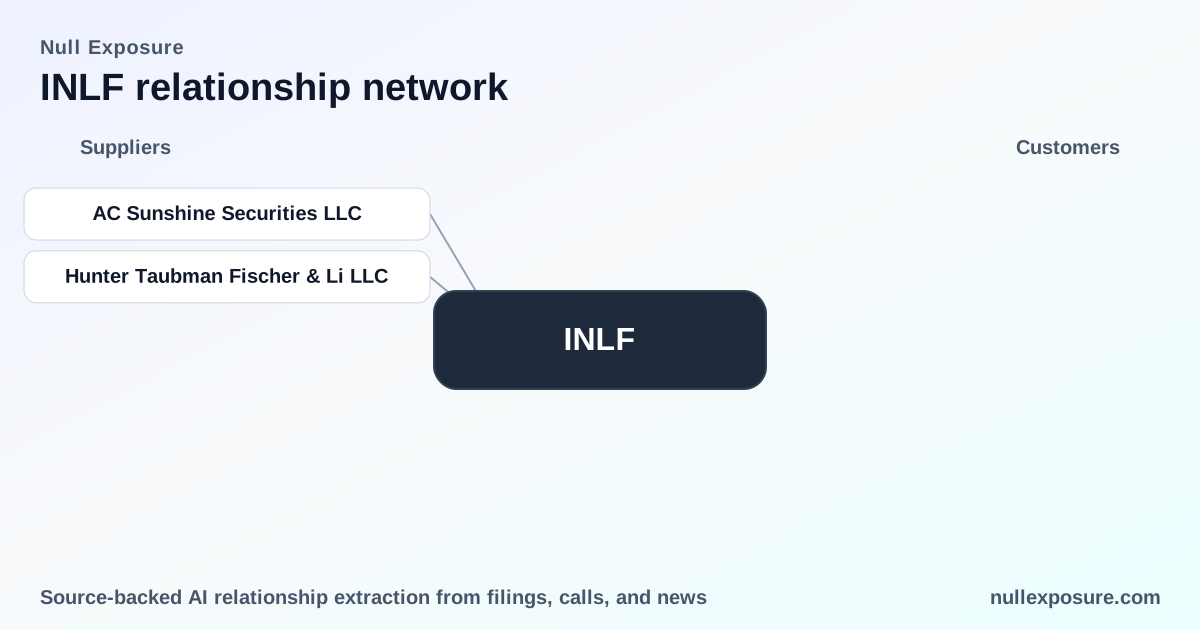
INLIF Limited (INLF) — supplier relationships, financing cues, and what investors should price in
INLIF Limited manufactures and sells injection-molding machine manipulators under the iNLIF brand in China and monetizes through direct product sales of capital equipment to plastics and manufacturing customers. The company’s cash flow profile is driven by equipment order cycles and any associated aftermarket or installation services, while equity investors should treat public market activity—capital raises and associated advisors—as a critical lever for near-term liquidity and growth funding. For an up-to-date scan of INLF’s third‑party relationships and strategic read-throughs, visit https://nullexposure.com/.
A compact company profile with structural implications
INLIF is a small-cap industrial manufacturer listed on NASDAQ. Revenue TTM stands at $18.4M against a negative operating margin of -46.1% and a net profit margin of -29.6%, signaling that the business is still absorbing scale and margin pressures. Market capitalization is roughly $70.7M and insiders hold about 6% of the float while institutional ownership is essentially negligible. This is a capital‑intensive, early public-stage industrial supplier with fragile profitability and significant dependence on financing and operational scale to reach sustainable margins.
From a contracting and commercial posture perspective, INLIF operates as a transactional equipment supplier with cadence tied to OEM and plastics industry capital expenditure cycles. The company’s small scale and low institutional ownership point to high concentration risk on a few customers and limited capital market sympathy without demonstrable margin improvement. Analyst coverage and sell‑side guidance are absent, which increases the importance of observable third‑party relationships—underwriters, legal counsel, and financing partners—as signals of financing ability and governance quality.
For more detailed signals and relationship monitoring, see https://nullexposure.com/ — the portal consolidates filings, news, and supplier linkages for investors.
Documented third‑party relationships (complete)
The public record returned two vendor/advisor relationships tied to a financing event. Both relationships are drawn from the same company announcement.
-
AC Sunshine Securities LLC acted as the underwriter for INLIF’s offering, indicating the firm engaged an underwriter to execute an equity financing transaction that supports near‑term liquidity. According to a Yahoo Finance press release dated March 10, 2026, AC Sunshine served in that underwriting role (Yahoo Finance, Mar 10, 2026 — https://finance.yahoo.com/news/inlif-limited-announces-closing-us-200000403.html).
-
Hunter Taubman Fischer & Li LLC served as U.S. securities counsel to INLIF for the same offering, providing legal support for the company’s U.S. securities disclosure and transaction mechanics. The role is documented in the same Yahoo Finance release on March 10, 2026 (Yahoo Finance, Mar 10, 2026 — https://finance.yahoo.com/news/inlif-limited-announces-closing-us-200000403.html).
These entries exhaust the supplier/advisor relationships surfaced in the most recent collection of news signals and filings.
What these relationships signal about capital strategy and governance
The combination of an underwriter and U.S. securities counsel tied to a specific offering sends two clear operational signals:
-
Financing dependence: INLIF used public equity markets to raise capital, which is consistent with a small industrial issuer that requires external funding to bridge negative operating cash flow while pursuing growth or working capital needs. The presence of an underwriter confirms a formal capital raise rather than informal or private funding routes.
-
Cross-border compliance posture: Retaining U.S. securities counsel indicates the company is conducting transactions that implicate U.S. regulatory and disclosure regimes, increasing compliance demands and legal costs but also offering a standardized route to U.S. investor capital.
Because constraint metadata returned no supplier constraints, treat the absence of targeted constraint flags as a company-level signal: the most material external relationships disclosed to date are capital-market and legal advisers rather than operational suppliers, which increases the emphasis investors should place on financing runway and execution against production scale rather than third‑party operational dependencies.
Explore deeper relationship analytics and filings at https://nullexposure.com/ to track changes to these signals.
Key risks investors should price in
- Liquidity and financing risk: The company’s negative profitability and modest cash-generating capacity make future financings likely; underwriting activity underscores that reality.
- Execution and scale risk: Small revenue ($18.4M) and negative operating margins indicate product-market fit and scale economics are not yet proven; order volatility will drive earnings variability.
- Governance and information risk: Minimal institutional ownership and no sell‑side coverage increase the probability of information gaps and greater price volatility around news events.
- Concentration risk: Public metrics suggest a narrow customer base typical for capital equipment OEMs; loss of even a few large orders could materially impact near-term revenue.
Monitor: cash balance and burn, follow-on financing terms and dilution, order backlog updates, and any disclosure of major customer contracts or supplier commitments.
Bottom line and recommended investor actions
INLIF is a small, growth-stage industrial equipment supplier where equity holders are effectively underwriting both product execution and financing execution. The recent disclosure of an underwriter and U.S. securities counsel confirms capital markets are the immediate mechanism for funding the business, making transaction terms, dilution, and timing the primary drivers of short‑term valuation.
Actionable next steps for investors and operators:
- Prioritize updates on cash runway, the size and timing of financings, and any covenants or lock-ups tied to new capital.
- Track order backlog and gross margin trendline as the earliest operational proof points toward de‑risking the business model.
- Use specialist relationship and filing aggregation to flag shifts in underwriter, counsel, or strategic partners that could presage new financing or M&A activity — a curated hub is available at https://nullexposure.com/.
INLIF is a company where financing events are as consequential as manufacturing orders; investors should evaluate both in tandem.