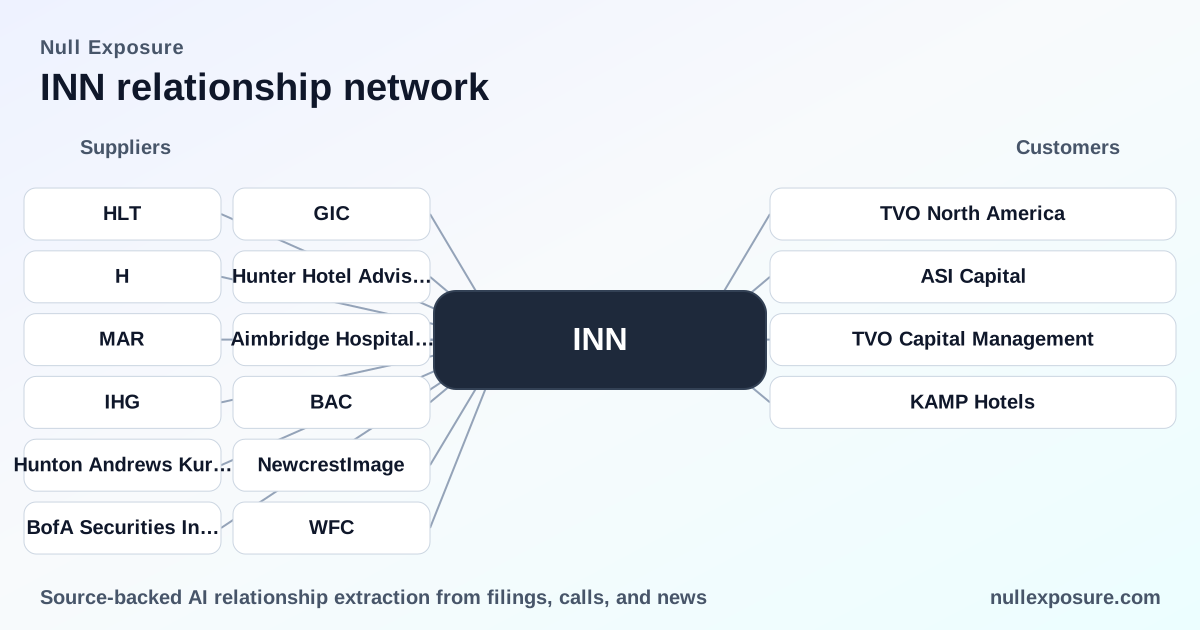
Summit Hotel Properties (INN) — who supplies the rooms, capital and services that drive cash flow
Summit Hotel Properties operates and monetizes as a hotel-focused REIT that owns premium-brand, predominantly franchised and third‑party managed hotels; it generates income through room and ancillary revenues while outsourcing brand and operations through long-term franchise and management contracts, and sources acquisition financing from major banking and institutional partners. For investors evaluating supplier risk and strategic resilience, the important signals are contract tenor, fee structure to franchisors, the role of third‑party managers, and the concentration of capital partners. Learn more or explore the company profile at https://nullexposure.com/.
What the operating model actually looks like — quick, investor‑grade view
Summit’s business model is driven by three consistent mechanics: (1) long‑dated franchise relationships that deliver brand distribution and loyalty pool access in exchange for recurring franchise and marketing fees; (2) third‑party property management that runs day‑to‑day operations under fee schedules and variable tenure; and (3) capital partnerships that finance acquisitions and portfolio growth through bank debt and institutional joint ventures. The company’s public metrics show a leveraged, asset‑heavy REIT with high institutional ownership and reliance on a small set of financial and brand counterparts.
- Franchise economics are predictable but fee‑sensitive: franchise fees of roughly 3–6% of room revenues plus marketing fees up to 4% are explicit cost lines in the operating model.
- Management agreements are critical to operations: management contracts (month‑to‑month to 12 years) convert operator capability into cashflow stability, with base fees tied to revenue.
- Capital relationships are strategic and material: large financing commitments and joint ventures underpin acquisitions and balance sheet leverage.
Visit https://nullexposure.com/ for a concise supplier risk checklist and primary-source links.
The full roster of supplier and partner relationships (each one covered)
Below are every counterpart referenced in the results, with a plain‑English summary and a concise source note.
-
GIC — GIC invested as a 49% JV equity partner in Summit’s portfolio acquisition, providing institutional capital that materially reduces Summit’s cash equity burden on the deal. — Hotel Business / PR Newswire (FY2022 / March 2026).
-
Hunter Hotel Advisors — Hunter Hotel Advisors has acted as a transaction advisor and broker on asset sales involving Summit affiliates, executing off‑market dispositions and divestitures. — El Paso Times (2017) and HotelManagement (2025).
-
Aimbridge Hospitality — Aimbridge was named as the successor manager for a NewcrestImage portfolio after Summit’s acquisition, indicating Summit’s reliance on professional third‑party managers to operate acquired assets. — Hotel Business (FY2022).
-
Bank of America — Bank of America provided a material portion of a $410 million financing commitment that served as primary debt financing for Summit’s portfolio acquisition. — PR Newswire / Hotel Business (FY2022).
-
NewcrestImage — NewcrestImage acted as seller of the acquired portfolio in the transaction with Summit and GIC, transferring assets and associated management rights through the JV structure. — PR Newswire / Mingtiandi (FY2021–FY2022).
-
Wells Fargo Bank — Wells Fargo co‑committed to the $410 million financing package alongside Bank of America, demonstrating bilateral banking support for Summit’s acquisition financing. — PR Newswire / Hotel Business (FY2022).
-
Hilton (franchisor) — Hilton is one of the major franchisors under which Summit’s properties operate, providing reservation systems, loyalty access and brand marketing in exchange for franchise and marketing fees. — The Globe and Mail / MarketBeat (FY2025–FY2026).
-
Hyatt (franchisor) — Hyatt supplies brand and distribution for a subset of Summit’s portfolio through franchise arrangements that deliver access to loyalty demand but impose recurring fees. — The Globe and Mail / MarketBeat (FY2025–FY2026).
-
Marriott (franchisor) — Marriott is a prominent franchisor in Summit’s roster; several properties operate under its flags, enabling centralized reservations and loyalty bookings. — The Globe and Mail / MarketBeat (FY2025–FY2026).
-
IHG (franchisor) — IHG flags appear in Summit’s portfolio mix, contributing to a multi‑brand strategy that balances demand channels and brand‑specific fee schedules. — MarketBeat (FY2026).
-
Hunton Andrews Kurth (legal counsel) — Hunton Andrews Kurth served as legal counsel to Summit on the NewcrestImage acquisition, providing transaction legal services. — Hotel Business / PR Newswire (FY2022).
-
BofA Securities, Inc. (financial advisor) — BofA Securities acted as financial advisor to Summit on the acquisition, coordinating financing and transaction execution. — Hotel Business / PR Newswire (FY2022).
Each relationship above is directly referenced in public reporting and press coverage tied to Summit’s acquisitions, financing, and ongoing portfolio activity.
What the constraints tell investors about Summit’s supplier posture
The disclosed constraints and excerpts paint a clear picture of Summit’s supplier and contract dynamics:
-
Contract tenor is long and structural. Franchise agreements generally run 10–30 years with extension provisions, creating durable brand access and predictable fee obligations that are baked into operating forecasts. (Company filing evidence, Dec 31, 2024.)
-
Franchise/licensing economics are explicit line items. Franchisors take 3–6% of room revenues for franchise fees and up to 4% for marketing, which systematically reduces net room yield and should be modeled as fixed percentage expense across revenue scenarios. (Company filing excerpts.)
-
Management coverage is third‑party and active. All lodging properties are operated under professional third‑party management agreements with terms from month‑to‑month up to 12 years; management fees are generally a percentage of total property revenues, making manager selection a direct driver of NOI realization. (Company filing excerpts.)
-
Transaction and financing partners are concentrated and material. The $410 million financing commitment from Bank of America and Wells Fargo and the BofA advisory role demonstrate heavy reliance on a small set of bank and advisory partners for growth transactions. (PR Newswire / Hotel Business, FY2022.)
-
Corporate flexibility exists through equity consideration. When Summit purchases properties, its operating partnership can issue units to sellers, enabling tax‑efficient deal structures and non‑cash consideration options that affect dilution and balance‑sheet composition. (Company filing excerpt.)
These constraints are company‑level operating signals; where franchisors are explicitly named (Hilton, Marriott, Hyatt, IHG) those entities represent licensed brand relationships with known fee schedules and reservation system access.
Visit https://nullexposure.com/ to download a supplier‑risk checklist tailored to REIT franchisor and management exposures.
Investment implications and operator takeaways
-
Revenue stability is brand‑dependent. Long franchise tenors and centralized reservations support occupancy stability, but franchise and marketing fees compress margins and reduce upside from revenue growth.
-
Management partners are operating leverage. Third‑party managers convert top‑line into EBITDA through performance; operator selection and contract terms materially affect NOI capture.
-
Capital counterparties determine deal capacity. The involvement of GIC, Bank of America and Wells Fargo indicates access to institutional capital, but also concentration risk if those partners withdraw or reprice credit.
-
Governance and execution risk live in the contracts. With many agreements long‑dated, contract amendment pathways, extension rights and termination provisions are key value levers for investors and asset operators.
Bottom line and next steps
For investors and operators evaluating Summit as a supplier counterparty or portfolio holding, the essential conclusion is: Summit operates a capital‑intensive, brand‑levered hotel model that depends on long‑term franchise licenses, third‑party management, and concentrated financing partners; those relationships are durable but fee‑structured, and they dominate margin dynamics.
If you need an integrated view of Summit’s supplier network and contractual levers, review the company profile and primary documents at https://nullexposure.com/ or contact our team for a tailored supplier‑risk briefing.