INN-P-F: Preferred Exposure to a Franchise-Driven Hotel REIT
Summit Hotel Properties’ INN-P-F represents a series of preferred shares that give investors an income-focused claim on a portfolio of upper-upscale and upscale hotels across the United States. The company monetizes real estate through hotel ownership and long-standing commercial arrangements with major lodging brands—collecting rent and fee income while relying on franchisor distribution, loyalty programs, and brand standards to drive occupancy and ADR (average daily rate). For investors evaluating supplier risk, the most consequential dynamic is that over 99% of guestrooms operate under premium franchise brands, concentrating operational dependency on a small group of global hotel companies. For deeper supplier and counterparty context visit https://nullexposure.com/.
Why franchise partners define cash flow for INN-P-F holders
Summit is a classic owner-operator REIT in hospitality: the company’s returns come from renting rooms and capturing ancillary revenues, but the commercial engine that fills those rooms is largely outsourced to franchise brands. That means brand relationships are not peripheral vendor links — they are core revenue drivers whose marketing, reservation systems, and loyalty programs determine demand and pricing power for Summit’s assets. For preferred shareholders, this translates into a revenue profile that is stable when brand distribution is healthy and concentrated when brands are under pressure.
- Concentration risk: A small number of premium brands dominate the portfolio’s guest-facing exposure.
- Operational coupling: Brand standards and franchise agreements influence capital expenditure and renovation cadence.
- Distribution criticality: Loyalty programs and global reservation platforms materially affect occupancy and yield.
If you're mapping counterparty exposure for a preferred-holders’ assessment, start with the franchisors. For an expanded supplier map, see https://nullexposure.com/.
Relationship-by-relationship breakdown: who Summit partners with and why it matters
Below are the supplier relationships identified in the company’s FY2025 disclosures and associated reporting. Each relationship is summarized in plain language with source context.
-
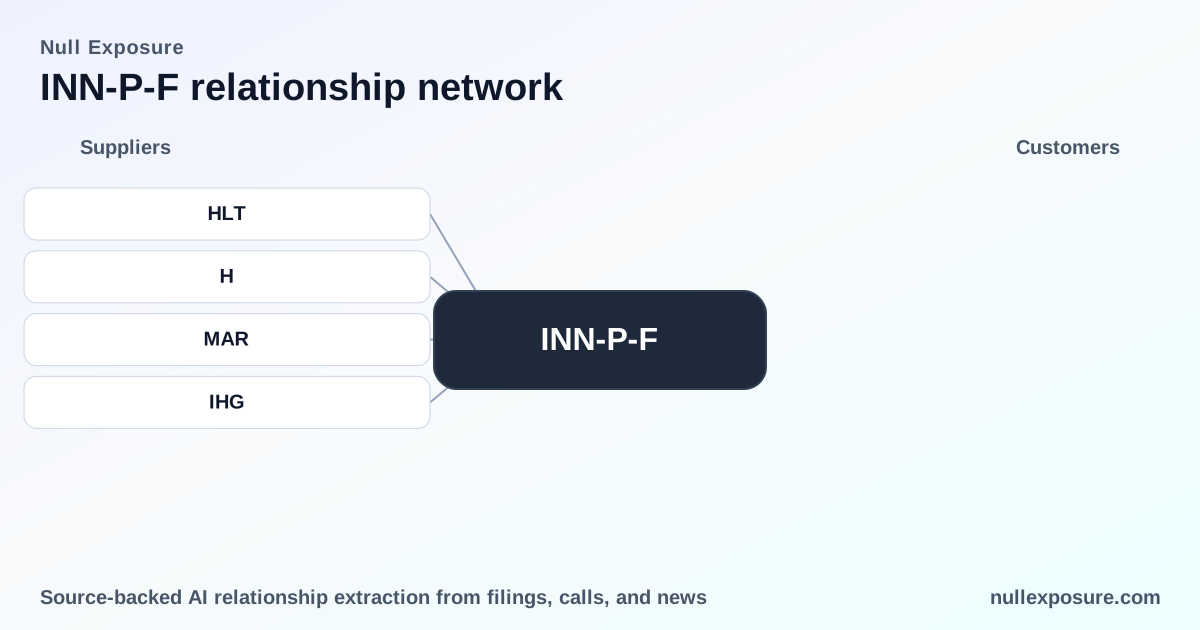
Hilton — Summit’s portfolio operates significant inventory under Hilton’s premium brands, meaning Hilton’s global distribution and loyalty channels are a primary source of guests for Summit’s properties. According to a TradingView summary of Summit’s SEC filing (FY2025), over 99% of guestrooms operate under premium franchise brands such as Hilton. (TradingView coverage of Summit Hotel Properties SEC 10‑Q, March 10, 2026).
-
Hyatt — Hyatt brands are also part of the franchised mix, contributing to the portfolio’s upper-upscale positioning and exposure to group and corporate demand channeled through Hyatt’s systems. The same FY2025 trading report notes Hyatt among the premium brands covering the vast majority of guestrooms. (TradingView coverage of Summit Hotel Properties SEC 10‑Q, March 10, 2026).
-
Marriott — Marriott-branded hotels are a material operating lever for Summit, leveraging Marriott’s scale and loyalty program to support occupancy and pricing power across key markets. The FY2025 disclosure aggregated by TradingView lists Marriott among the premium franchise brands accounting for over 99% of guestrooms. (TradingView coverage of Summit Hotel Properties SEC 10‑Q, March 10, 2026).
-
IHG — IHG-branded properties complete the quartet of dominant franchisors in Summit’s portfolio, supplying another major global channel and brand standard set that shapes guest mix and operating margins. TradingView’s synopsis of Summit’s FY2025 filing includes IHG in the group of premium franchise partners representing the overwhelming majority of guestrooms. (TradingView coverage of Summit Hotel Properties SEC 10‑Q, March 10, 2026).
Each of these relationships is described in the company’s FY2025 disclosure summarized in the TradingView news item; the common theme is a concentrated reliance on a small set of franchisors to produce demand and standardize operations.
Operating model signals and business-model constraints (company-level)
The supplier-scope data contains no explicit contractual constraint excerpts, so the following are company-level signals inferred from the relationship profile rather than relationship-specific contractual text:
-
Contracting posture: Franchise and management agreements typically govern brand use, standards, and reservation access. That implies recurring obligations for capital upgrades and compliance expenditures, which are a line-item pressure on free cash flow available to shareholders.
-
Concentration: Very high concentration in premium brands is a double-edged sword — it enables steady demand through powerful channels but creates single-point vulnerability if one or more franchisor relationships fracture.
-
Criticality: Brand partners are critical distribution and revenue drivers, not optional suppliers; any disruption to brand relationships has outsized influence on occupancy and revenue per available room (RevPAR).
-
Maturity and predictability: Franchise relationships in institutional hotel portfolios are typically long-dated and operationally mature, which supports predictability in routines (marketing, reservations) while locking in certain cost and capital commitments.
Because the constraints dataset returned no named contractual limits, these characteristics should be treated as structural signals about how Summit operates rather than legally specific risk disclosures.
Key investment implications and risk checklist
-
Upside driver: Premium-brand affiliation supports higher ADRs and yields better group/corporate penetration than independent hotels. That structural demand profile supports preferred dividend coverage when occupancies normalize.
-
Downside exposure: Counterparty concentration across a handful of franchisors increases systemic supplier risk. Disputes over brand standards, changes to loyalty economics, or a franchisor-wide demand shock would transmit quickly to Summit’s cash flows.
-
Operational leverage: Franchise agreements often require capital expenditures to maintain standards; that obligation reduces discretionary cash available to service preferred distributions during cyclical downturns.
-
Recoverability: Brand distribution advantages accelerate recovery in demand cycles, which works in favor of preferred shareholders if management preserves liquidity and asset quality.
Use these signals as a framework for assessing distributor stability, covenant cover, and preferred dividend resilience.
For a detailed supplier risk map and comparative analysis across REIT exposures, visit https://nullexposure.com/ — the platform consolidates counterparty footprints relevant to income investors.
Final thoughts and recommended next steps for investors
Summit Hotel Properties’ preferred issue INN-P-F provides exposure to a hotel portfolio whose economics are intimately tied to a small group of premium franchisors (Hilton, Hyatt, Marriott, IHG). That structure delivers a potent mix of distribution strength and concentration risk: brands amplify revenue potential but also centralize counterparty dependency. Investors in INN-P-F should prioritize monitoring franchisor relationships, brand program changes, and the company’s capital expenditure cadence as primary risk controls.
If you want a structured supplier-risk brief or a cross-portfolio comparison of franchisor concentration for income allocations, start here: https://nullexposure.com/.
Bold claims:
- Over 99% of guestrooms operate under premium franchise brands (TradingView summary of Summit’s FY2025 SEC filing).
- Franchisor concentration is the primary supplier risk for INN-P-F holders given the portfolio’s dependency on global brand distribution.
Convene these observations with credit terms, dividend coverage, and balance-sheet liquidity to form a holistic view of INN-P-F’s hold-or-sell decision. For actionable supplier intelligence and follow-up analysis, return to https://nullexposure.com/.