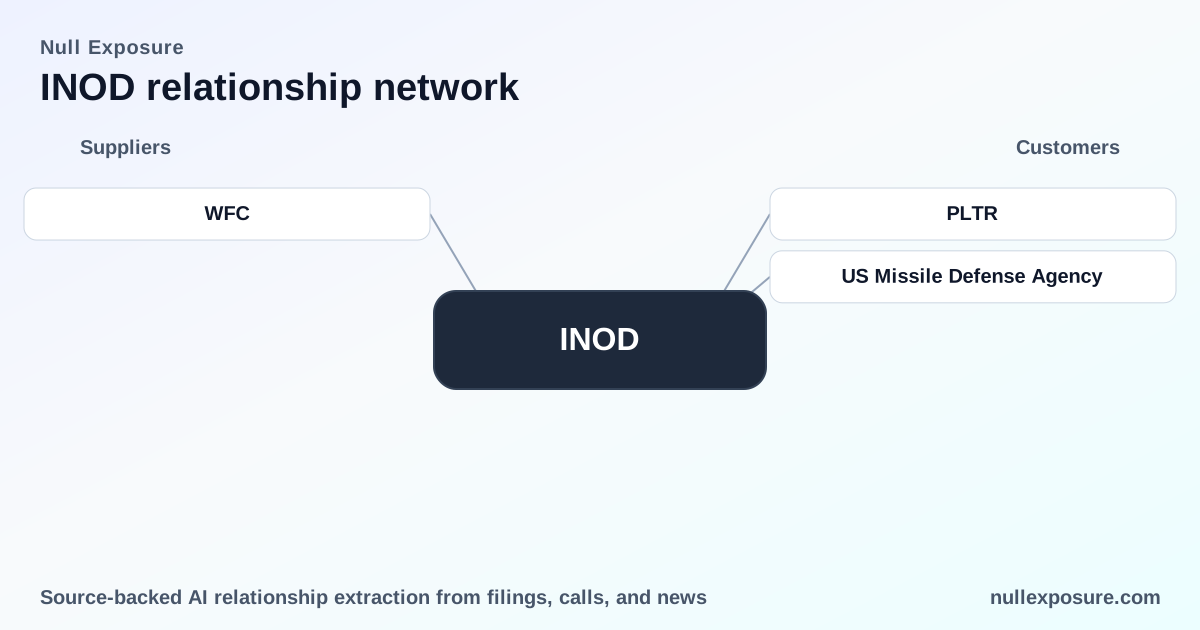
Innodata (INOD): A supplier-focused read for investors and operators
Innodata is a global data engineering services company that monetizes by converting raw content into structured information and delivering managed data products and monitoring services to enterprise customers. Revenue comes from a mix of recurring managed services (news and social monitoring, content enrichment) and project work that aggregates, normalizes and licenses information — with operating leverage arising from scale in engineering and platformized workflows. For an investor or procurement lead, the critical facts are a mid-market revenue base (~$252M TTM) supporting positive margins and a capital-light model that depends on third-party data inputs and short-term credit optionality. Learn more on the home page: https://nullexposure.com/
What the business looks like in practice
Innodata combines a services-led commercial footprint with platform components that standardize content ingestion, transformation and distribution. Key financial anchors: Revenue TTM $251.7M, Gross Profit $101.0M, Market Cap ~$1.44B, and positive operating margins (Operating Margin TTM ~15%). The company trades at a premium multiple (Trailing P/E ~48) reflecting growth expectations and a high beta profile (2.48) that rewards execution on recurring contracts and margin expansion.
- Monetization: recurring managed services and licensed information products, plus project-based data engineering.
- Capital posture: low fixed-asset intensity, reliance on working capital and committed credit lines for optional liquidity.
- Investor implications: premium valuation requires continued client retention, margin preservation and reliable third-party data supply.
Supplier and financing relationships you need to know
Below I cover every supplier/credit relationship mentioned in the available intelligence so you can evaluate counterparty exposure and operational optionality.
Wells Fargo — short-term credit facility
Innodata reported during the Q4 2025 earnings call transcript that it did not draw down on a $30 million Wells Fargo credit facility, indicating the facility exists as standby liquidity but was unused at that reporting point. This is a direct signal of available committed borrowing capacity that management elected not to access (InsiderMonkey transcript, Q4 2025 earnings call, reported March 10, 2026).
How third-party supplier dependence shapes the operating model
Innodata explicitly discloses that its Agility segment relies on third parties to provide or make available certain data for its information databases and news and social media monitoring service. That company-level statement is more than boilerplate — it defines a contracting posture and supplier risk profile that investors must price.
- Contracting posture: outsourced data inputs are core to delivery, meaning Innodata negotiates and integrates external content sources rather than owning primary content pipelines.
- Concentration signal: the company-level disclosure does not enumerate specific suppliers or concentration ratios; therefore, supplier concentration is unknown and should be a diligence focus for buyers and investors.
- Criticality: external data is mission-critical to the Agility product; interruptions would directly impact revenue and customer SLAs.
- Maturity: dependence on third parties for base content suggests a mature, platform-plus-partner posture rather than full vertical integration.
What the Wells Fargo relationship means in context
The undrawn $30M credit line with Wells Fargo is an important, tangible element of Innodata’s financial flexibility. Undrawn committed lines reduce liquidity risk and support working capital cycles tied to third-party payments and client collections, but they do not substitute for diversified vendor management where the delivery chain is dependent on external data providers (InsiderMonkey transcript, Q4 2025).
Risk and opportunity implications for investors and operators
- Operational risk: the Agility segment’s reliance on third-party data is a single-source style risk if suppliers are concentrated or subject to restrictive licensing changes. Operators should prioritize redundancy and contractual protections.
- Financial optionality: the Wells Fargo facility provides immediate liquidity optionality without balance sheet drawdown; that is a positive credit signal when paired with profitable operations and positive EBITDA ($42.76M).
- Commercial leverage: recurring monitoring and managed services create sticky revenue if content inputs are reliable and licensing costs are stable; this is the primary value lever for multiple expansion.
- Valuation sensitivity: given the premium valuation, execution risk is the dominant near-term threat — disruption in data supply or a material draw on the credit facility would quickly compress multiples.
For a pragmatic next step, review the supplier contracts and the extent of exclusivity or volume-based pricing with key content providers; instrument covenants and utilization of committed facilities are also core monitoring items. For an integrated vendor risk assessment, start here: https://nullexposure.com/
Practical due diligence checklist for investors and procurement teams
- Confirm the identity, geography and concentration of the Agility segment’s third-party data providers, including termination and change-of-use rights.
- Review instrument terms for the Wells Fargo credit facility (maturity, covenants, usage restrictions) and current undrawn status.
- Validate redundancy: whether alternative sources and transformation pipelines exist to mitigate supplier outages.
- Monitor margin sensitivity to content licensing cost escalation versus the company’s ability to pass-through or absorb increases.
Bottom line: where to focus capital allocation and operational oversight
Innodata is a services-driven information engineering company whose performance depends on high-quality third-party content and disciplined liquidity management. The undrawn $30M Wells Fargo facility is positive optionality, but supplier dependency in the Agility segment is the strategic risk that demands rigorous contract-level due diligence. Investors should press for disclosure on supplier concentration and vendors’ contractual protections; operators should prioritize redundancy and commercial levers to protect margins.
For continuous coverage and supplier-risk tools tailored to investors and operators, visit the Nillexposure home page: https://nullexposure.com/ — and for a deeper supplier-risk engagement, start your review at https://nullexposure.com/.