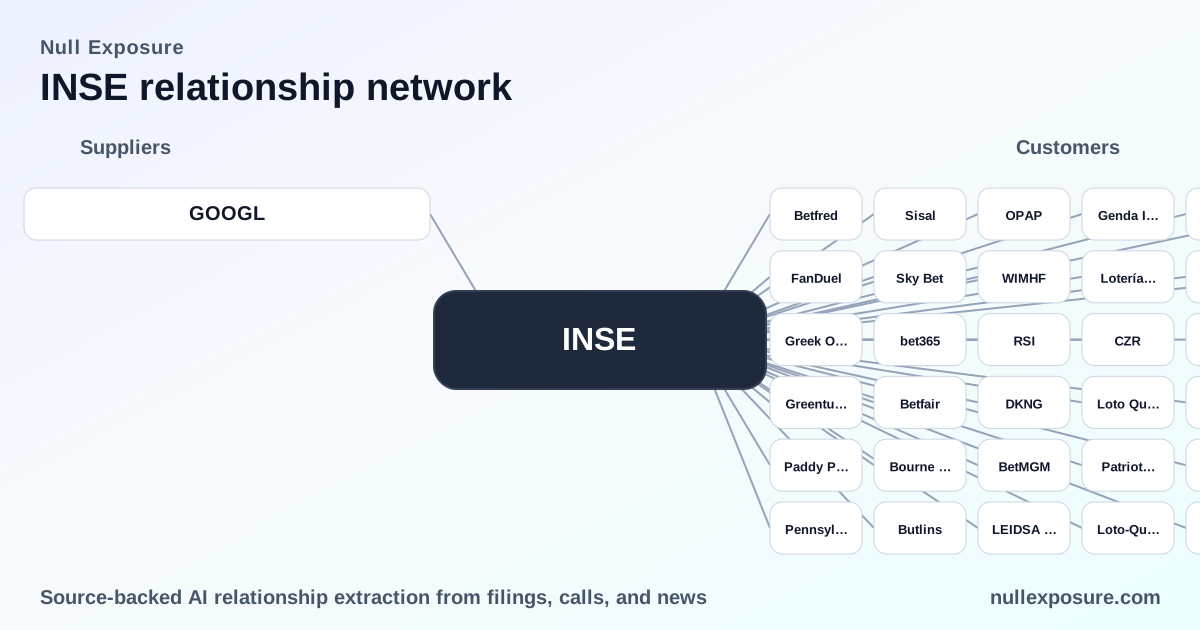
Inspired Entertainment (INSE): Strategic supplier relationships and what STRATA on Google Cloud means for investors
Inspired Entertainment is a B2B gaming technology company that sells server-based gaming terminals, virtual sports, and lottery platforms to regulated operators worldwide. The firm monetizes through a mix of software licensing, content provision, terminal sales/leasing, and long-term service agreements with lotteries and betting operators; recurring revenue from platform licensing and content drives gross margins while hardware and outsourced manufacturing controls cost structure. With FY2025 TTM revenue of $304.1M and EBITDA of $74.3M, Inspired trades at a compelling valuation (EV/EBITDA ~5.7) for a company executing a cloud-first product strategy. For deeper supplier and counterparty mapping, see NullExposure: https://nullexposure.com/.
The commercial logic: how STRATA and supplier ties change the revenue mix
Inspired’s launch of STRATA, a cloud-native lottery platform, shifts a portion of its business from physical terminals and licensed content to recurring platform economics. STRATA is engineered for scalability, security, and orchestration of lottery systems; building that product on a major public cloud converts part of the company’s cost base from capital-intensive on-premises infrastructure to variable cloud spend, while enabling faster customer onboarding and integration.
This move complements the company’s existing monetization levers:
- Licensing and platform fees for software such as STRATA.
- Content and terminal provisioning under long-term contracts.
- Outsourced manufacturing to reduce fixed manufacturing overheads.
For a quick provider-level glance and supplier tracking, visit NullExposure: https://nullexposure.com/.
What the market coverage documents — single relationship, multiple confirmations
Multiple news outlets documented the same supplier relationship: STRATA was engineered on the Google Cloud Platform. Below are the discrete items captured in the reporting record; each is summarized with source context.
-
TradersUnion reported on March 10, 2026 that Inspired launched STRATA built to “enhance scalability, security, and flexibility” using the Google Cloud Platform. The write-up focuses on the product launch and its cloud-native architecture. (TradersUnion, 2026-03-10) — https://tradersunion.com/news/companies/show/1416607-inspired-strata-launch/
-
Technology Magazine republished the company release on March 10, 2026, describing STRATA as “uniquely engineered from the ground up on the Google Cloud Platform” to provide “unparalleled scalability, security, and flexibility” for lottery operators. This is a distribution of the company announcement to industry readers. (Technology Magazine / GlobeNewswire, 2026-03-10) — https://technologymagazine.com/globenewswire/3233871
-
Quiver Quant picked up the company announcement on March 10, 2026, headlining the STRATA launch and noting the explicit Google Cloud engineering foundation as the technical differentiator for seamless operator integration. The piece mirrors the press release language for investor audiences. (Quiver Quant, 2026-03-10) — https://www.quiverquant.com/news/Inspired+Entertainment+Launches+STRATA%E2%84%A2%3A+A+Cloud-Native+Lottery+Platform+for+Enhanced+Scalability+and+Seamless+Integration
-
Yahoo Finance published the company statement on March 10, 2026, emphasizing STRATA’s cloud-native design on Google Cloud Platform and its target market of regulated lottery operators seeking reliable, scalable solutions. This outlet amplified the announcement to retail and institutional readers. (Yahoo Finance, 2026-03-10) — https://finance.yahoo.com/news/inspired-entertainment-launches-game-changing-142300410.html
Key takeaway: All coverage documents consistently link STRATA development to the Google Cloud Platform, indicating a deliberate vendor relationship and a strategic choice for infrastructure, security, and scalability.
Operating model constraints and what they imply for supplier risk
The company-level constraints extracted from recent disclosures provide a clear picture of Inspired’s contracting posture and operational maturity:
-
Licensing is core to the business model. The company purchases, licenses, and develops external-use software for its products; this signals a steady reliance on third-party software licenses and the legal/expense framework that accompanies them.
-
Long-term contracts shape procurement and manufacturing decisions. Inspired explicitly references long-term procurement contracts and a long-term manufacturing partner (Trio). That contracting posture indicates stable, multi-year obligations on both the revenue and cost sides—supporting recurring revenue but creating lock-in if underlying supply terms change.
-
Global supply exposure. The company sources parts globally and warns about potential damage or disruption, which is a standard but meaningful risk given hardware distribution and international regulations in gaming.
-
Outsourced manufacturing and manufacturer relationships. Inspired exited in-house manufacturing and now relies on a long-term manufacturing partner, indicating a lower fixed-cost structure but increased third-party operational dependence.
-
Licensor role as both licensee and licensor. Inspired licenses technologies from third parties and also licenses its content and platform to operators, which creates two-sided dependency risk: costs tied to supplier licensing and revenue reliance on operator adoption.
These constraints are company-level signals; they apply broadly and are not assigned to any single third-party relationship unless explicitly named in the disclosures.
Financial and strategic implications for investors
STRATA on Google Cloud is strategically meaningful for a few reasons:
-
Shift to recurring, high-margin revenue. Platform licensing and hosting economics support margin expansion across time; with current gross profit of $217.6M TTM, software-led revenue growth improves operating leverage.
-
Cost structure rebalancing. Outsourcing manufacturing to Trio and offloading infrastructure to Google Cloud convert capital and fixed costs into variable service costs, improving ROIC if customer uptake grows.
-
Valuation support. Trading at an EV/EBITDA of ~5.7 and with strong analyst buy-side coverage (majority Buy/Strong Buy), the market is pricing in improved profitability; cloud-native delivery strengthens that thesis by accelerating customer deployments.
-
Dependency risk. The Google Cloud relationship is functionally critical: it provides the underlying infrastructure for STRATA’s promise of scalability and security. Failure to maintain cloud partnerships or adverse cloud cost dynamics would be material to platform economics. Concentration risk exists because STRATA is engineered specifically on Google Cloud.
For deeper mapping of these supplier exposures and contract characteristics, consult NullExposure: https://nullexposure.com/.
Risk checklist and investor action items
- Supplier concentration: STRATA’s production on Google Cloud creates dependency on a single cloud provider for platform performance and compliance controls. Monitor service-level agreements and vendor terms in future filings.
- Contract length and counterparty quality: Long-term manufacturing and licensing agreements reduce volatility but increase lock-in; review new customer contract disclosures for term structure.
- Global supply chain: Continue tracking component sourcing and logistics exposures that impact terminal availability and rollout schedules.
- Regulatory exposure: Gaming and lottery platforms are highly regulated; STRATA’s cloud hosting must meet local compliance standards in each jurisdiction.
Bottom line and next steps
Inspired’s decision to architect STRATA on the Google Cloud Platform is a strategic inflection toward scalable, software-driven revenue, aligning cost structure and distribution for faster growth and margin expansion. The firm’s move to outsourced manufacturing and reliance on licensing contracts complements a cloud-first product strategy that supports recurring revenue. Investors should monitor contract disclosures, vendor SLAs, and customer adoption cadence to validate the transition.
For ongoing supplier intelligence, counterparty screening, and to track how these relationships evolve across filings and press coverage, visit NullExposure: https://nullexposure.com/.