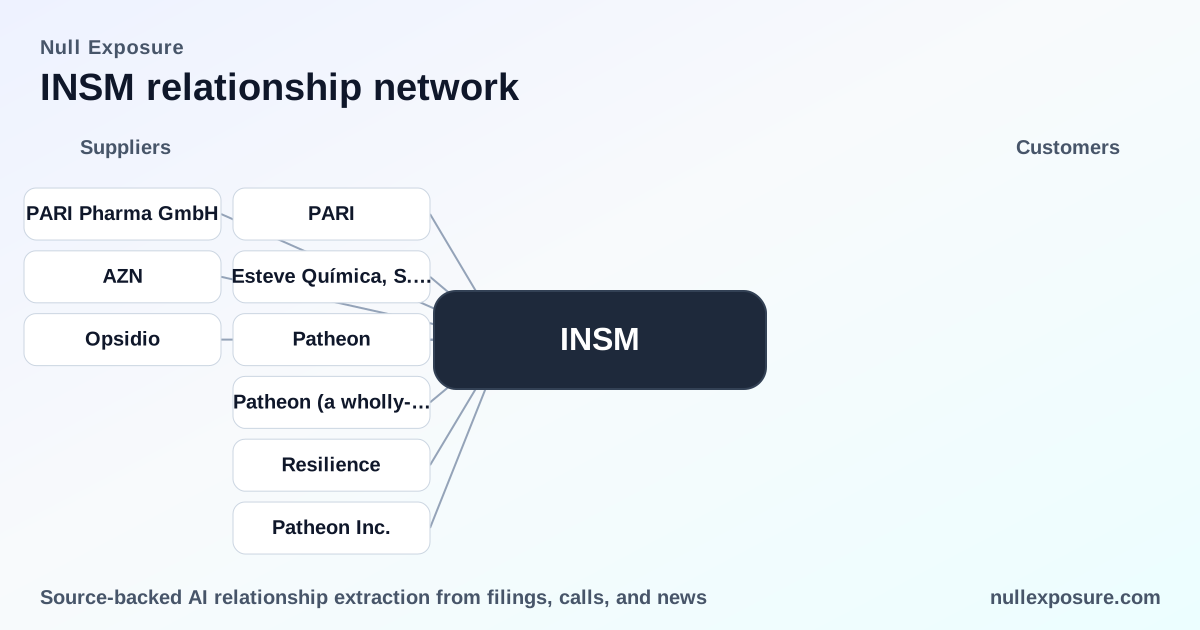
Insmed (INSM) — supplier relationships, contract posture and what investors should price in
Insmed is a development- and commercial-stage biopharma that monetizes by selling specialty inhaled and systemic therapies for rare respiratory and inflammatory diseases and by progressing proprietary assets like brensocatib into commercial launch. Revenue derives from product sales (notably ARIKAYCE and the newly commercialized brensocatib franchise), while the company outsources most manufacturing and device supply to third parties under multi‑year contracts. For investors, valuation and operational risk hinge on these supplier contracts: who makes product, how long contracts run, and the scale of committed spend. Learn more about how we surface supplier risk at the NullExposure homepage.
How Insmed organizes its supplier footprint — long-term outsourcing with concentrated critical vendors
Insmed operates with minimal in-house commercial manufacturing capability, relying on a small set of contract manufacturers and a device commercialization partner for delivery systems. The company's disclosures describe a mix of long-term commercial agreements (for example, a 15‑year commercialization agreement for the ARIKAYCE device) and multi‑year manufacturing commitments to scale commercial output. These arrangements produce three practical characteristics investors must price:
- Contracting posture and maturity: Several agreements have multi‑year initial terms with automatic renewals or extension options, which creates predictability for supply but reduces flexibility to switch vendors quickly; Insmed also uses shorter, rolling commercial manufacturing arrangements where appropriate.
- Concentration and criticality: A handful of manufacturers and a single device partner cover critical components (API, finished product, and the Lamira nebulizer), concentrating operational risk if a supplier fails or capacity proves inadequate.
- Spend commitment: Insmed discloses large, multi‑year spend commitments — including nearly $499m of clinical services under PPD project addenda and a reported ~$116m aggregate investment to expand long‑term production capacity tied to Patheon agreements — which convert supplier relationships into material cash flow commitments.
These are company-level signals drawn from public filings and investor communications. For a concise supplier-risk assessment tied to these contract features visit the NullExposure homepage.
Supplier roster — what each relationship means for operations and investors
Below I summarize every supplier relationship called out in Insmed’s supplier disclosures and recent news, with the reporting source provided for each entry.
PARI
Insmed has a long-term Commercialization Agreement with PARI for the manufacture and supply of the Lamira nebulizer used to administer ARIKAYCE; the agreement has a lengthy initial term tied to ARIKAYCE commercialization. According to Insmed’s FY2024 Form 10‑K, the Commercialization Agreement began upon first commercial sale and includes supply mechanics and exclusive manufacture provisions. (Source: FY2024 Form 10‑K)
PARI Pharma GmbH
ARIKAYCE is administered once daily using the Lamira Nebulizer System manufactured by PARI Pharma GmbH, reinforcing PARI’s operational role as the device supplier in commercial distribution. This was reiterated in Insmed’s Q4/2025 press release and financial update. (Source: PR Newswire, Q4 2025 financial results)
Esteve Química, S.A.
In September 2024 Insmed entered a commercial manufacturing and supply agreement with Esteve to produce the active pharmaceutical ingredient (API) for brensocatib, with the contract described as a commercial manufacturing and supply arrangement. The FY2024 10‑K records this deal and later press commentary reiterated Esteve’s role in long‑term brensocatib supply. (Sources: FY2024 Form 10‑K; TradingView news summary, Mar 2026)
Patheon
Insmed has agreements with Patheon to manufacture and supply ARIKAYCE and brensocatib for anticipated commercial needs; these contracts support the company’s long‑term production capacity plans and related capital investment estimate. The FY2024 10‑K details Patheon’s manufacturing responsibilities for product supply. (Source: FY2024 Form 10‑K)
Patheon (a wholly‑owned subsidiary of Thermo Fisher)
The company separately notes agreements entered in October 2017 with Patheon (a Thermo Fisher subsidiary) that expanded long‑term production capacity for ARIKAYCE, reinforcing Patheon’s status as a strategic commercial manufacturer. Insmed’s FY2024 filing documents the October 2017 agreements and their role in capacity expansion. (Source: FY2024 Form 10‑K)
Patheon Inc.
Recent commentary and news coverage cite Patheon Inc. specifically among the partners contracted for long‑term commercial manufacturing and supply of brensocatib (including the BRINSUPRI launch), highlighting Patheon’s continuing commercial role. This is reflected in March 2026 market summaries. (Source: TradingView news, Mar 2026)
Resilience
Insmed originally contracted Therapure Biopharma Inc. for ARIKAYCE manufacture in February 2014; that agreement was subsequently assumed by Resilience and remains the basis for ARIKAYCE production at commercial scale. The FY2024 10‑K confirms Resilience’s role in current commercial manufacturing. (Source: FY2024 Form 10‑K)
AstraZeneca AB
AstraZeneca is a licensor to Insmed under a license that granted Insmed exclusive global rights to AZD7986 (renamed brensocatib); contractual obligations and related licensing restrictions are called out as potential operational constraints. This licensing relationship is cited in Insmed’s investor disclosures and was referenced in recent company filings and press materials. (Source: PR Newswire summary, Mar 2026; FY2024 Form 10‑K)
Opsidio
In December 2025 Insmed acquired an investigational monoclonal antibody (INS1148, formerly OpSCF) from privately held Opsidio, indicating a licensed/acquisition relationship for pipeline expansion rather than a supplier for commercial product. Market reports and company announcements covered the transaction in Q4/2025. (Sources: Zacks/TradingView coverage, Dec 2025 / Mar 2026)
Translating these relationships into risk and valuation considerations
- Supply risk is concentrated and contractually sticky. The reliance on a small set of manufacturers and a single device partner creates a single‑point risk profile: production disruptions at Resilience, Patheon, Esteve, or PARI would have immediate commercial impact given Insmed’s limited internal manufacturing capability (FY2024 10‑K).
- Long-term contracts reduce supply-side uncertainty but raise switching costs. Multiple excerpts document five‑ to fifteen‑year initial terms and automatic renewals for key agreements, which stabilizes supply yet limits tactical responses to underperformance.
- Material financial commitments are embedded in suppliers. The company discloses nearly $499m in clinical service commitments to PPD and a roughly $116m plan to expand production capacity tied to Patheon commitments; these create fixed outflows that affect cash flow and capital allocation decisions (company filings).
- Device dependency is critical for product administration. The Lamira nebulizer agreement with PARI is integral to ARIKAYCE’s commercial model; device supply failures would be operationally acute (FY2024 10‑K; PR Newswire).
For a deeper, transaction-level supplier risk profile and to see how these contracts map to cash commitments, check the analysis hub at the NullExposure homepage.
Bottom line for investors
Insmed’s commercial profile is outsourced production supported by multi‑year supplier contracts that give the company predictable supply but concentrate operational and counterparty risk. Key questions for investors are whether contracted capacity will scale with demand for brensocatib and ARIKAYCE, how the company manages supplier concentration, and whether the committed spend leaves sufficient flexibility for R&D and M&A. Monitor production milestones at Patheon and Resilience, the integrity of the PARI device supply chain, and Esteve’s performance on brensocatib API delivery — changes there will be direct catalysts for revenue and margin outcomes.
For updates on supplier developments and to model contract-related cash flows, visit the NullExposure homepage.