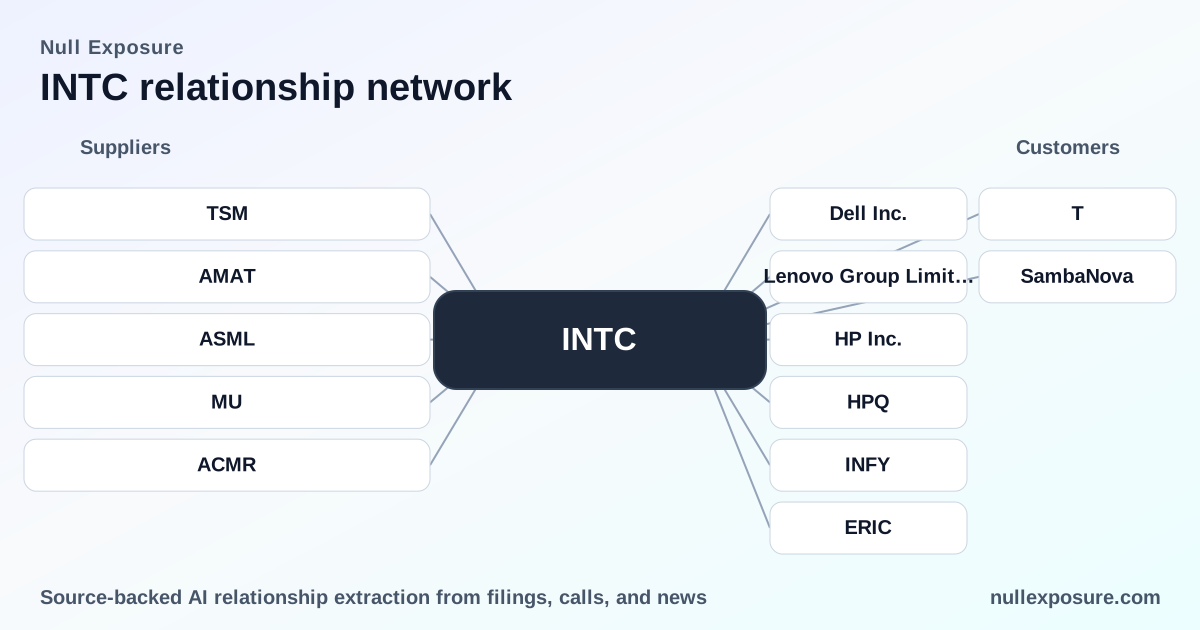
Intel’s supplier map: how external partners shape the company’s operating leverage and risk
Intel monetizes by designing, manufacturing, and selling microprocessors and related semiconductors for PCs, data centers and network infrastructure, while increasingly offering advanced packaging and foundry services to third parties. Its revenue comes from product sales and foundry/services arrangements; operationally Intel combines in‑house fabrication with selective third‑party manufacturing and long‑term supply relationships to support AI and high‑performance computing demand. For investors, supplier relationships constitute both a strategic accelerator (access to specialized tooling, memory and packaging) and a concentrated operational risk (few providers for the most advanced equipment and materials).
Explore supplier risk dashboards and relationship signals at https://nullexposure.com/.
Why suppliers matter now: concentration, critical tools and geopolitics
Intel’s business model blends a classic integrated device manufacturer (IDM) posture with an increasing reliance on external foundries and partners for cost, performance and timetable advantages. Two operating traits are decisive:
- Concentration on a handful of equipment and material providers increases supply fragility for leading nodes. Company disclosures highlight that advanced nodes depend on a small number of capital vendors and specialized materials. This is a company-level signal reflecting high criticality and limited supplier maturity in several categories (EUV machines, rare earths).
- Buyer leverage in capital procurement is meaningful: Intel negotiates extended payment terms (greater than 90 days) with capital vendors and reports large unpaid balances for property, plant and equipment under those terms, reflecting an active working‑capital and capex financing posture.
These features create asymmetric outcomes: when suppliers and tooling are available, Intel scales rapidly; when access is restricted (geopolitics, export controls), production and cost forecasts require material revision.
News‑flagged supplier relationships to watch (FY2026 reporting)
Below are concise, plain‑English summaries of the supplier relationships captured in recent coverage, with source references.
TSMC — silicon partners for mixed‑vendor packages
Intel leverages advanced packaging to integrate its in‑house silicon with dies manufactured by TSMC, signaling a pragmatic use of third‑party foundry capacity to assemble competitive products. According to The Register (March 2026), Intel’s packaging technology already melds chips made in Intel fabs with TSMC‑manufactured silicon, expanding supply and performance options (https://www.theregister.com/2026/03/05/intel_advanced_packaging_wins/).
Applied Materials (AMAT) — equipment demand driver
Intel’s capacity expansion and broader industry fab buildouts are boosting demand for semiconductor equipment makers such as Applied Materials; Intel’s capital spending on fabs is a direct source of order flow for AMAT. SimplyWallSt noted in a sector report (FY2026) that chipmakers including Intel are increasing fab capacity, which lifts demand for AMAT’s equipment (https://simplywall.st/stocks/us/semiconductors/nasdaq-amat/applied-materials/news/applied-materials-amat-valuation-check-after-sector-sell-off).
ASML — indispensable EUV lithography supplier
Intel depends on ASML’s extreme ultraviolet (EUV) lithography tools for leading‑edge node production; ASML’s near‑monopoly on EUV translates into strategic single‑supply exposure for the industry’s most advanced chips. An industry note (InsiderMonkey, FY2026) emphasized ASML’s central role in producing the EUV machines that enable advanced AI chips at TSMC and Intel (https://www.insidermonkey.com/blog/asml-holding-asml-plans-to-expand-beyond-their-core-euv-lithography-1710502/).
Micron Technology — long‑term memory supply for AI infrastructure
Intel maintains long‑term purchasing arrangements with memory suppliers such as Micron to secure DRAM and NAND capacity for AI infrastructure and data‑center products; these contracts support Intel’s product roadmaps and inventory planning. The Globe and Mail (FY2026) reported that Micron is engaged in long‑term agreements with major OEMs including Intel to capture AI infrastructure demand (https://www.theglobeandmail.com/investing/markets/stocks/INTC/pressreleases/566847/micron-why-the-recent-pullback-is-an-opportunity/).
ACM Research — regulatory scrutiny over testing and export risk
U.S. lawmakers raised national‑security and export‑control concerns about Intel’s testing of chipmaking tools from ACM Research, a vendor with significant ties to China; that scrutiny introduces a political and export‑control vector to supply‑chain risk. IndexBox and other reports (FY2026) referenced bipartisan congressional attention prompted by Reuters reporting on Intel’s testing of ACM tools (https://www.indexbox.io/blog/us-lawmakers-raise-security-concerns-over-intels-testing-of-acm-research-chip-tools/).
What investors should extract from these relationships
Intel’s supplier ecosystem demonstrates a mix of strategic flexibility and concentrated vulnerability:
- Critical single‑source dependencies exist at the tooling level. ASML’s control of EUV tooling is an industry determinant; Intel’s ability to operate at bleeding‑edge nodes is directly tied to this limited supplier base. This is a company‑level constraint tied to the capital‑intensive nature of leading‑edge manufacturing.
- Geographic concentration for certain materials is a structural exposure. Company disclosures highlight reliance on suppliers concentrated in APAC for rare earths and other materials, creating measurable geopolitical risk in procurement and pricing.
- Third‑party foundry relationships reduce time‑to‑market but shift control. Integration with TSMC and increased use of external fabs and packaging can accelerate product launches and manage cost, but also creates counterparty and strategic risk if foundry priorities diverge.
- Working‑capital management is a tool of procurement strategy. Intel’s use of extended payment terms with capital vendors is an explicit contracting posture that transforms supplier financing dynamics into a financial lever for capex programs.
- Regulatory and export‑control risk is real and actionable. Scrutiny over ACM Research underscores the potential for political interventions to interrupt testing or procurement cycles, particularly when suppliers have ties to sanctioned jurisdictions.
Investment implications and near‑term monitoring
For operating and research teams evaluating Intel supplier exposure, prioritize these monitoring actions:
- Track orders and backlog disclosures from ASML, AMAT and Micron for leading indicators of Intel’s capex and memory commitments.
- Monitor congressional actions and export‑control guidance that reference vendors with China ties; such moves can immediately constrain testing and equipment shipments.
- Watch Intel’s cash‑flow statements for movements in accounts payable tied to extended payment terms; rising unpaid capex balances shift balance‑sheet risk to suppliers and affect liquidity profiles.
For a consolidated view of supplier relationships and tracking signals, visit https://nullexposure.com/ and see the supplier intelligence center.
Bottom line
Intel’s supplier network is both an enabler and a constraint: access to ASML‑class tooling and memory supply from partners like Micron underpins growth in AI and data‑center product lines, while concentrated suppliers, APAC material exposure and regulatory scrutiny of vendors such as ACM Research create asymmetric downside risk. Investors should weigh Intel’s IDM flexibility and third‑party integrations against the concentrated, geopolitically sensitive nature of the capital and materials base that powers modern semiconductor fabrication. For continuous monitoring and supplier‑level alerts, start at https://nullexposure.com/.