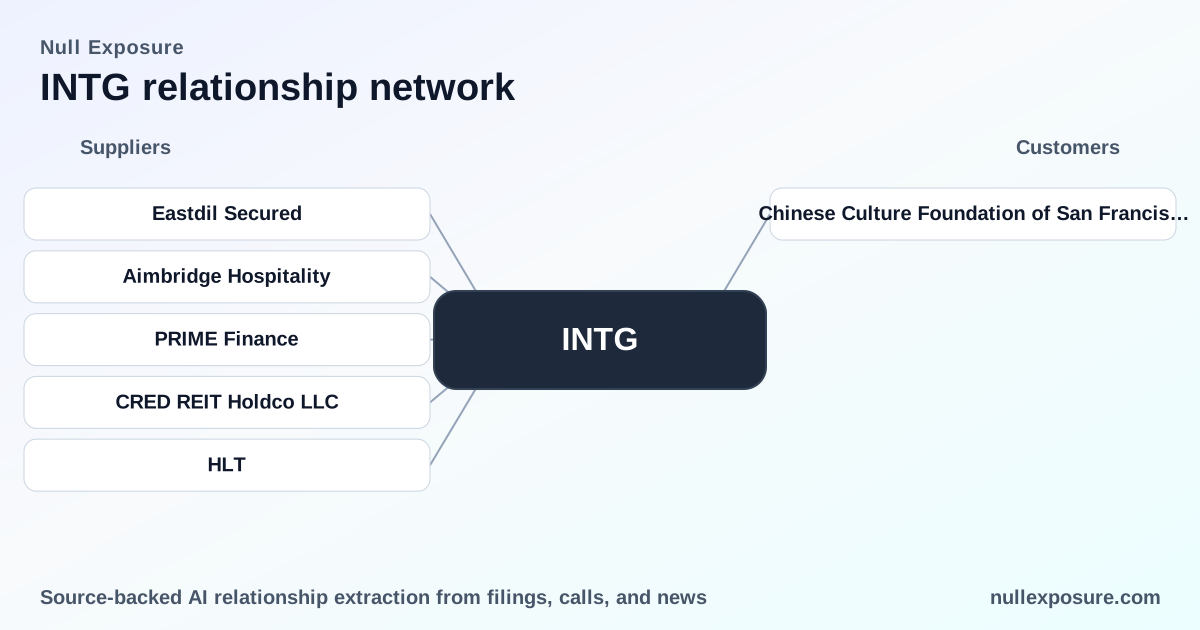
InterGroup Corporation (INTG): supplier relationships, capital counterparty map, and investor implications
InterGroup is a small-cap owner‑operator whose economic model is concentrated on a single full‑service hotel asset — the Hilton San Francisco Financial District — operated by subsidiaries under franchise and management arrangements. The company monetizes through room and event revenue, ancillary services (parking, event space fees), hotel operating margin and key‑money amortization, while financing and mezzanine structures shift capital risk to secured lenders and REIT mezzanine investors. Investors should view supplier and capital counterparties as direct drivers of cash flow stability and distribution optionality. For a clean, interactive view of counterparties, review full profiles at https://nullexposure.com/.
Business model in one line: operating a franchised, manager‑run hotel with external capital and service providers
InterGroup owns the real estate through Portsmouth Square subsidiaries and runs the hotel under a franchise license with Hilton and a management agreement with Aimbridge, while relying on third‑party lenders and mezzanine holders for capital. Revenue is sensitive to local RevPAR and labor cost pressure, while distributions are constrained by lender‑controlled cash management and debt covenants. The firm’s small market cap and high insider ownership concentrate execution risk in asset‑level performance rather than corporate diversification.
Visit the homepage for the complete supplier map: https://nullexposure.com/.
Key supplier and counterparty relationships investors should track
Eastdil Secured
InterGroup used Eastdil Secured to arrange a mortgage refinancing for its subsidiary Justice Operating Company; Eastdil acted as the arranger on a $67 million mortgage transaction tied to the Hilton asset. According to a GlobeNewswire press release (April 2025), Eastdil arranged the financing that underpins the new senior mortgage.
Aimbridge Hospitality
Aimbridge is the third‑party hotel manager under a hotel management agreement that carries a base fee of 1.70% of total hotel revenue plus an incentive tied to gross operating profit; the initial HMA ran ten years from February 3, 2017 with automatic one‑year renewals. TradingView coverage of InterGroup’s SEC disclosures (referencing the FY2024 10‑K) documents the Aimbridge fee structure and term.
PRIME Finance
PRIME Finance provided the $67 million senior mortgage to Justice Operating Company that refinanced the Hilton San Francisco Financial District and includes maturity and extension mechanics through 2027 with extension options. GlobeNewswire’s announcement of the refinancing (April 2025) identifies PRIME Finance as the senior lender.
CRED REIT Holdco LLC
A mezzanine modification with CRED REIT Holdco LLC resulted in a $36.3 million mezzanine at a fixed 7.25% rate, altering the subsidiary mezzanine profile beneath the senior loan. InterGroup disclosed this change in the same GlobeNewswire release detailing the refinancing (April 2025).
Hilton San Francisco Financial District (the hotel asset)
The Hilton San Francisco Financial District is InterGroup’s operating asset; the company operates the hotel under the Hilton brand and reports that the property is the core contributor to revenue and operating results. SimplyWallSt’s profile of InterGroup (FY2026 context) reiterates that the company operates this Hilton‑branded hotel in San Francisco.
Hilton (HLT — franchisor)
Hilton is the franchisor under a Franchise License Agreement that extends through January 31, 2030, making the brand license a long‑dated element of the cost and quality structure of operations. The company’s filings referenced in the constraints and public summaries (franchise agreement language) note the licensing term through 2030 and the hotel’s high marks on Hilton quality inspections, as reported in third‑party commentary (Zacks/TradingView coverage, FY2025).
For a consolidated supplier view and deeper counterparty analytics, go to https://nullexposure.com/.
What the contractual and constraint signals reveal about InterGroup’s operating posture
- Long‑term contracting is embedded in the model. The franchise license and hotel management agreements are multi‑year arrangements (Hilton license to Jan 31, 2030; Aimbridge HMA initial 10‑year term from 2017), which gives operational stability but locks in brand standards and fee schedules that affect margin flexibility.
- Usage‑based compensation for the manager aligns incentives but concentrates operational exposure. Aimbridge’s base 1.70% fee plus a 10% incentive on incremental GOP ties management cost to revenue performance and creates a variable cost structure tied to RevPAR.
- Capital stack constraints materially influence distributions. Senior mortgage terms (PRIME Finance: $67M maturing April 9, 2027 with extension options) and a $36.3M mezzanine at 7.25% (CRED REIT Holdco) impose debt service and covenant pressure, while lender cash‑management arrangements enable sweeps that restrict upstream distributions until DSCR and reserve conditions are satisfied.
- Spend and scale are modest but concentrated. Hotel management fees were roughly $783,000 in FY2025, and event space fees to a related Foundation are immaterial (payments measured in low tens of thousands), signaling operational scale centered on one asset rather than a diversified portfolio.
- Concentration risk is high. A single flagship hotel drives revenue and balance‑sheet commitments; any extended local demand weakness or cost inflation directly threatens free cash flow.
Investment implications: checklist for underwriting INTG exposure
- Monitor covenant windows and extension covenant triggers for the PRIME Finance mortgage due April 2027; failure to extend or cure could force a refinancing at materially higher cost.
- Track RevPAR trends in San Francisco and Aimbridge‑reported GOP, because Aimbridge’s incentive structure both rewards outperformance and passes through variable costs that compress owner EBITDA when demand softens.
- Watch mezzanine servicing and payment status to CRED REIT Holdco, as the 7.25% fixed mezzanine is a cash flow burden subordinate to the senior loan.
- Consider corporate governance and insider alignment: insiders own a large majority of shares (72% insider ownership), concentrating decision authority and reducing institutional oversight.
- Evaluate operational margin sensitivity to labor inflation and one‑time fee reversals; recent analyst commentary cited rising labor costs as a headwind while Hilton quality scores remained high.
Final takeaway and next steps
InterGroup is an asset‑level hospitality company whose supplier and capital relationships — Hilton (franchise), Aimbridge (management), PRIME Finance (senior lender), CRED REIT Holdco (mezzanine), and Eastdil (arranger) — form the operational and financial backbone of the business. The arrangement provides brand stability and professional management but also concentrates refinancing and market risk at the property level. For a mapped view of counterparties and to track changes to these agreements in real time, visit https://nullexposure.com/.
If you’re evaluating exposure to hotel ownership or asset‑level financing risk, review the full counterparty dossier and covenant timelines available on our platform at https://nullexposure.com/.